


How Locals Feel About It
“Obviously, as a St. Paul person, I wish it was ‘The Streets of the Twin Cities,’” says Marta Shore of Bruce Springsteen’s “Streets of Minneapolis” with a sly smile. The St. Paul, Minnesota, resident is mostly joking; she has no beef with the Boss, but does point out that President Donald Trump’s ICE surge in Minnesota has affected residents of the wider Twin Cities metro area.
The college biostatistics lecturer was, however, impressed with Springsteen for releasing a “very real” protest song just four days after the killing of Alex Pretti, a 37-year-old intensive care nurse for veterans who was shot and killed by ICE agents in Minneapolis on Jan. 24. That incident came less than three weeks after an ICE agent shot and killed 37-year-old mother Renée Good in Minneapolis. The federal government and the Trump administration raced to portray both slain U.S. citizens as domestic terrorists, despite video footage and eyewitness accounts telling a different story.
“(His song) was so timely. It wasn’t, ‘Let me stick my finger up and see which way the wind is blowing, and then run it through my publicist,’” muses Shore, whose son lives six blocks from where Pretti was killed and has been active in her community’s mutual aid efforts to assist families impacted by ICE (she also keeps a whistle in her purse and car to let locals know if ICE agents are nearby). “It was a powerful thing. It was, ‘I’m acknowledging you are in pain, and there is a villain here. There are people doing harm.’”
“It paints a picture of exactly what we saw,” says Marta Simpson, a Minneapolis resident active in mutual aid efforts for affected families, of the folk-rock song. “He talks about the streets by name: Nicollet Avenue, that’s just a few blocks over,” notes the kindergarten teacher, who has participated in a few protests and whistle-toting patrol shifts. “It felt like such a deeply personal thing to us as Minnesotans.”
Neither Shore nor Simpson consider themselves huge Springsteen fans, but both teachers are headed to Minneapolis’ Target Center on Tuesday (March 31) evening to see the rocker for the first time as he kicks off his Land of Hopes and Dreams American Tour. Shore is accompanying a “diehard” friend (“she vacationed in Asbury Park”) while Simpson and her sister — who was also active in anti-ICE mobilization — are attending thanks to a “rage buy” from their father. He lives in Colorado but purchased tickets to the Minneapolis tour kickoff to support Springsteen after Trump attacked the outspoken New Jersey rocker. “My dad loved that Bruce wrote that song.”
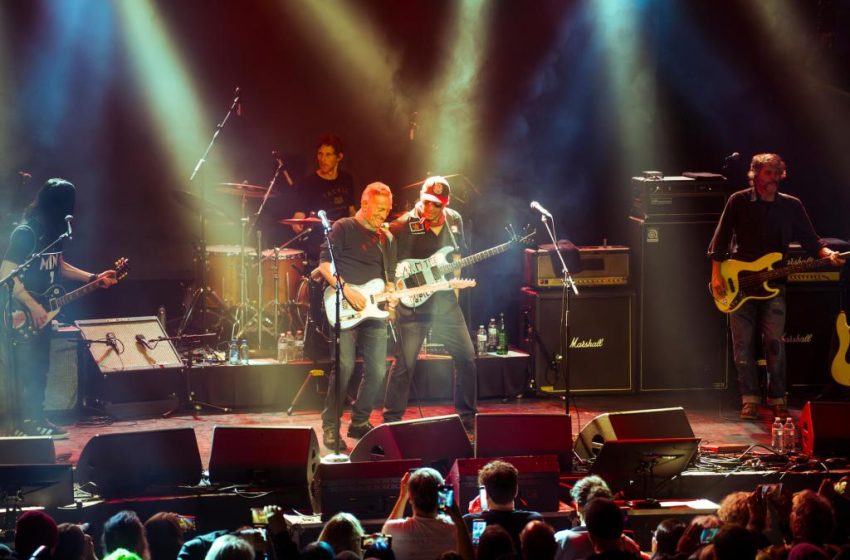
Springsteen gave “Streets of Minneapolis” its live debut at famed local venue First Avenue (where much of Prince’s 1984 film Purple Rain was shot) during Tom Morello’s Jan. 30 fundraiser for the families of Good and Pretti. At the flagship No Kings Rally on Saturday (March 28) in St. Paul, Springsteen performed “Streets of Minneapolis” for just the third time ever on the lawn of the Minnesota State Capitol. The Rock & Roll Hall of Famer wasn’t the only one playing his protest song at the 100,000-person strong rally, however: Thirteen-year-old Zeke Scott was strumming it on his acoustic guitar in the lead-up to the main event, which also featured Joan Baez, Maggie Rogers, Tom Morello, Sen. Bernie Sanders and Jane Fonda.
“When I heard the song, it brought up some feelings,” says the young musician, who learned to play it in one day. “A lot of the songs I listen to that are more protest-y don’t go specific. Bruce Springsteen went very specific with what happened. Me and my mom were really into it.”
“It’s no longer an issue of what the old people think or what the young people think,” says Campbell Casper, who traveled two hours from his college in Winona, Minnesota, to attend the No Kings Rally in St. Paul. “It’s one mission. It’s nice to have an older person feeling like they’re giving us the torch,” he says of the 76-year-old artist’s “Streets of Minneapolis.” “This isn’t the problem of yesteryear; we’re going to have to keep fighting.” Casper, who thinks what Trump is doing to the country is “royally f—ked up,” adds it’s “awesome” to see an artist like Springsteen, “who makes such good music,” speaking out.
“Everybody knows Bruce Springsteen,” says St. Paul resident Breanna Vandellen of the 20-time Grammy winner. “Having people with a huge platform like that speak out about these things can really help. It can feel isolating sometimes holding these views.”
Nearly everyone interviewed for this story was quick to point out that while they appreciate celebrities drawing attention to the ICE surge in Minnesota — which, aside from the killings, has terrorized local families and seen U.S. citizens dragged out of their cars, detained and beaten seemingly without provocation — it is the local protests and grassroots mobilization efforts that give them the most hope and sense of camaraderie.
Shore felt the Jan. 23 Day of Truth & Freedom protests in Minnesota — which included an economic blackout and tens of thousands of marchers despite the subzero Fahrenheit temperature — was especially “invigorating and motivating” at a time when she was in “despair” for her community. “It’s 50,000 of us. The high is negative nine, and not only are people showing up, but they’re showing up with hot chocolate, they’re showing up with hand warmers,” she recalls. “They’re showing up as community.” On the train ride home, Shore says people were “greeting each other (with) ‘F—k ICE’” in a way that reminded her of congregants saying “peace be with you” at a Catholic church service.
“It is nice to have Bruce Springsteen’s attention and the other big names, because it highlights the ongoing need, and brings more money in,” Simpson says. “Families are struggling to make payments because they have been home and not working, had hours cut, had main family earners detained. Our restaurants are struggling because employees had to stay home.”
The City of Minneapolis experienced an estimated $203 million in economic impact from Trump’s Operation Metro Surge, with small businesses and restaurants losing $81 million. “Minneapolis residents are feeling very used up; we’ve been supporting our community for months,” Simpson adds, pointing to these GoFundMe and GiveButter campaigns, as well as the Stand With Minnesota online directory, in particular. “This attention will hopefully lead to more resources.”
“This is our community,” says Shore, who has been heartened by local resolve in the face of federal opposition. “You don’t get to tell us what to do. You keep hearing for the past 20 years, ‘No one’s coming to save us, we have to save ourselves.’ It’s happening here, which is really the most heartwarming thing.”
Additional reporting by Brian and Jean Lynch.

First Appeared on
Source link






