


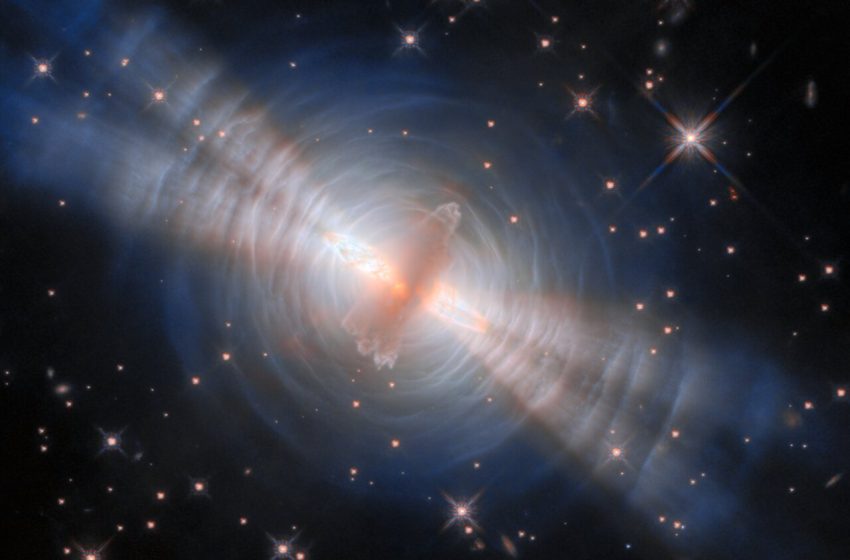
Hubble captures light show around rapidly dying star
heic2604 — Photo Release
10 February 2026
This stunning image from the NASA/ESA Hubble Space Telescope reveals a dramatic interplay of light and shadow in the Egg Nebula, sculpted by freshly ejected stardust. Located approximately 1,000 light-years away in the constellation Cygnus, the Egg Nebula features a central star obscured by a dense cloud of dust. Only Hubble’s sharpness can unveil the intricate details that hint at the processes shaping this enigmatic structure.
The Egg Nebula, also known as CRL 2688, is located in the constellation Cygnus (the Swan). It is the first, youngest, and closest pre-planetary nebula ever discovered [1].
The Egg Nebula offers a rare opportunity to test theories of late-stage stellar evolution. At this early phase, the nebula shines by reflecting light from its central star, which escapes through a polar “eye” in the surrounding dust. This light emerges from a dusty disc expelled from the star’s surface just a few hundred years ago.
Twin beams from the dying star illuminate fast-moving polar lobes that pierce a slower, older series of concentric arcs. Their shapes and motions suggest gravitational interactions with one or more hidden companion stars, all buried deep within the thick disc of stardust.
Stars like our Sun shed their outer layers as they exhaust their hydrogen and helium fuel. The exposed core becomes so hot that it ionises surrounding gas, creating the glowing shells seen in planetary nebulae such as the Helix, Stingray, and Butterfly nebulae. However, the compact Egg Nebula is still in a brief transitional phase — known as the pre-planetary stage — that lasts only a few thousand years. This makes it an ideal time to study the ejection process while the forensic evidence remains fresh.
The symmetrical patterns captured by Hubble are too orderly to result from a violent explosion like a supernova. Instead, the arcs, lobes, and central dust cloud likely stem from a coordinated series of poorly understood sputtering events in the carbon-enriched core of the dying star. Aged stars like these forged and released the dust that eventually seeded future star systems, such as our own solar system, which coalesced into Earth and other rocky planets 4.5 billion years ago.
Hubble has turned towards the Egg Nebula before. A first visible-light image from WFPC2 was complemented in 1997 by a near-infrared NICMOS image, giving a closer look at the light given off by the nebula. In 2003, ACS yielded a new view of the Egg, showing the full extent of the ripples of dust around it. A further image from Hubble’s WFC3 instrument in 2012 zoomed in on the central dust cloud and dramatic gas outflows. This new image combines the data used to create the 2012 image with additional observations from the same programme to deliver the clearest look yet at this intricate cosmic egg.
The data used in this image was obtained so it could be directly compared with earlier observations. Hubble’s high resolution enables astronomers to study how small details in the nebula’s dusty shell have evolved over the past decade and more, by comparing new and old images. This research contributes to better scientific models of planetary nebulae, allowing astronomers to accurately compute the evolution of all kinds of similar stellar outbursts.
Being able to revisit a remarkable celestial treasure like the Egg Nebula over the decades is a benefit of the Hubble Space Telescope’s trove of quality data. With its broad range of abilities and its now over thirty-five years of operation, it is truly unique among astronomical observatories.
Notes
[1] A pre-planetary nebula is a precursor stage of a planetary nebula, which is a structure of gas and dust formed from the ejected layers of a dying, Sun-like star. The term is a misnomer, as planetary nebulae are not related to planets.
More information
The Hubble Space Telescope is a project of international cooperation between ESA and NASA.
Image Credit: ESA/Hubble & NASA, B. Balick (University of Washington)
Links
Contacts
Bethany Downer
ESA/Hubble Chief Science Communications Officer
Email: [email protected]
First Appeared on
Source link






