


ICE’s alleged ‘ruse’ in Columbia student arrest may have violated law, attorneys say
Federal immigration officers may have violated the law when they allegedly used a ruse to gain entry into the apartment of Columbia student Ellie Aghayeva and arrest her early Thursday morning, according to civil liberties advocates and legal experts.
Columbia President Claire Shipman said the officers “misrepresented themselves” in Aghayeva’s arrest, gaining entry into her off-campus Columbia residential building and apartment by claiming they were “police” looking for a missing child. The officers were carrying photos of the allegedly missing child and did not provide “any kind of warrant,” Shipman said.
Federal officers are generally permitted to employ “ruses,” as they’re called in immigration enforcement training materials. But civil liberties advocates and legal experts said they can breach Fourth Amendment protections against unreasonable searches and seizures when their ruses are used to coerce cooperation and gain access to private areas.
Amy Belsher, director of immigrants’ rights litigation for the New York Civil Liberties Union, said if the officers gained entry to Aghayeva’s building under the guise of an emergency like a missing child, it would likely be unconstitutional.
“I think that that would be a violation of the Fourth Amendment because that consent was coerced, essentially,” she said.
“It sounds like ICE gained entry into the dorm by claiming to be looking for a missing child, something that’s very exigent, very time sensitive,” Belsher added. “And if that is what happened and permission to enter was given for that reason, that’s coerced permission. That’s not true voluntary permission.”
A Department of Homeland Security spokesperson said in a statement that the officers who arrested Aghayeva “verbally identified themselves” and “visibly wore badges around their necks.” The agency did not provide any additional detail about how the officers represented themselves. The DHS spokesperson also did not address Shipman’s assertion that the officers claimed to be searching for a missing child. The agency has not responded to requests for additional comment.
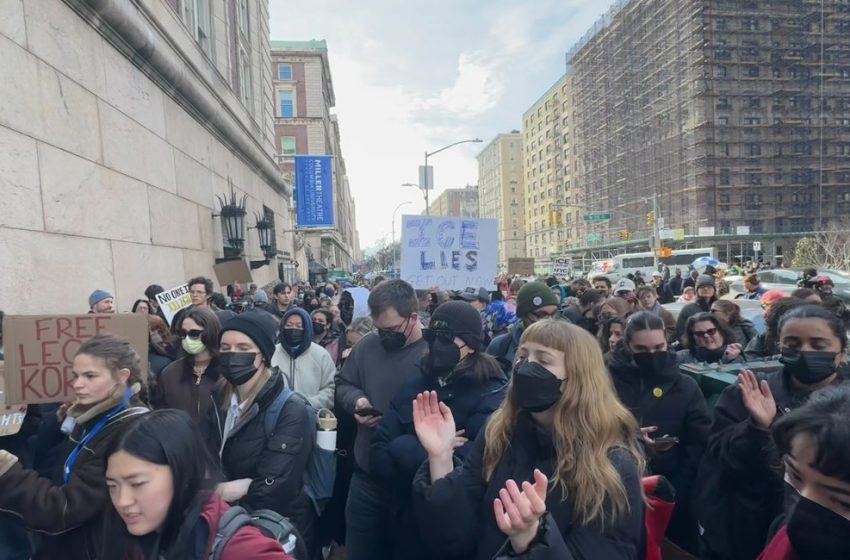
Aghayeva was released several hours after she was arrested, following a plea from Mayor Zohran Mamdani in his unannounced Oval Office visit with President Donald Trump. The arrest was followed by a midday protest, with about 200 students and faculty members marching outside Columbia’s gates.
The whirlwind of events prompted fresh scrutiny of federal immigration officers’ enforcement tactics, at a time where the Trump administration’s enforcement initiative has drawn a torrent of criticism from the public and in the federal courts.
Aghayeva, who is from Azerbaijan, is studying neuroscience and political science in Columbia’s School of General Studies, which caters to nontraditional students, who are usually older than typical undergraduates. She entered the U.S. around 2016 on a visa, according to a lawsuit filed on her behalf in federal court. A DHS spokesperson said her student visa was revoked that same year, “for failing to attend classes.”
Aghayeva’s lawyer declined to comment on her case.
ICE’s ruse playbook
Immigration authorities have employed ruses for years, including in New York City. In a 2019 case, ICE officers knocked on a woman’s door and told her in Spanish that they wanted to speak with her about the Bible, according to the Immigrant Defense Project, which references the encounter in “Know Your Rights” documents. The woman didn’t let the officers in, and when they turned to leave she saw “ICE” emblazoned on the back of their jackets.
In 2020, after ICE agents allegedly posing as NYPD officers arrested an Inwood resident, then-Mayor Bill de Blasio sent the agency a letter asking that officers stop stating or implying they were with the NYPD. In the letter, de Blasio said his office had received “numerous reports” of such ruses, and that the practice jeopardized the NYPD’s relationship with immigrant residents.
The use of ruses has been encouraged by ICE. The agency’s fugitive operations handbook states that ruses “result [in] improved safety for the offers and the public by reducing the opportunity for the target to flee.” But there are limitations on just how far immigration officers – or any police – can go, before bumping up against Fourth Amendment protections.
A federal judge in Los Angeles last summer barred ICE officers from identifying as state or local police and misrepresenting their purpose, following a class action lawsuit filed in 2020. The $2.6 million settlement, while allowing ruses under certain circumstances, bars local ICE officers from claiming they are conducting a criminal investigation when they are not; falsely claiming they are looking for people they aren’t — including presenting photos of other individuals; or falsely claiming that “their purpose involves danger to the resident and/or public safety.”
Lenni Benson, an immigration law expert and professor at New York Law School, agreed that if ICE agents used deception to enter Aghayeva’s building without a warrant, it would likely be unconstitutional.
“To dupe someone into consent to enter a building when you don’t have a warrant does seem to be a conspiracy to violate the Fourth Amendment,” Benson said.
But while the actions may have been unconstitutional, Benson said it’s hard to find legal recourse to hold immigration authorities accountable for potentially breaking the law. A court-ordered review of immigration cases in New Jersey revealed more than 50 orders by federal judges had been violated since early December by the federal government in connection with challenges by immigrants fighting their detention.
“In immigration law, finding a remedy for constitutional violations is extremely difficult,” Benson said. “Is this wrong? Yes. Is this unconstitutional? Yes. Are there remedies? Unfortunately, the remedies are not as powerful as we would like to believe.”
In the hours after Aghayeva’s arrest, Columbia officials announced they ramped up security around residential buildings and sent reminders to staff about their protocols for dealing with law enforcement officers.
In her statement Thursday evening, Shipman said the fault was with federal officers, saying “misrepresenting identity and other facts to gain access to a residential building is a breach of protocol.”
Shipman alleged the federal officers maintained the same ruse inside the building, where she said security camera footage captured the officers with a picture of the alleged missing child.
“They made their way to the apartment they were targeting with the same story,” Shipman said. A DHS spokesperson said the building manager and Aghayeva’s roommate allowed them into her apartment.
Once inside the apartment, Shipman said, “it became clear they (the officers) misrepresented themselves.” When a campus public safety officer arrived, Shipman said, he repeatedly asked for a warrant, which was not provided, and asked for time to call “his boss,” but was refused.
“The agents took our student,” Shipman said.
Under longstanding court rulings, law enforcement officers are generally required to have a judicial warrant or an occupant’s permission when entering private areas, such as a home or apartment. But the courts have permitted warrantless entries and searches when immediate action is necessary to prevent injury, the destruction of evidence or some other harm.
Columbia’s policies require all law enforcement agents have a judicial warrant or subpoena to enter private areas of the university, including housing, except for in “exigent circumstances.” If any law enforcement officers try to enter private spaces, university officials have instructed staff to “not interfere,” ask officers for credentials and any legal documents and contact the university’s public safety department to respond.
While Shipman called the federal officers’ conduct “a breach of protocol,” protesters on Thursday pointed the finger at the university. One sign at the protest read, “Where was the signed judicial warrant Claire?”
Shipman said in the statement the school understood the “fear and anger” caused by the incident, but said Columbia’s administration had provided no assistance to DHS or ICE for purposes of “arresting and taking” students.
In the aftermath of the incident, Shipman said in the statement, additional guidance and resources had been made available to students, faculty and staff.
First Appeared on
Source link






