


If Humans Vanish, Which Animal Will Become Earth’s Dominant Species? Scientists Say They Finally Know
Imagine a planet with no humans. No cities, no roads, no satellites orbiting overhead. The forests have reclaimed the concrete. The oceans have quieted. And somewhere on the seafloor, something with eight arms and three hearts is getting smarter.
It sounds like science fiction. But to Professor Tim Coulson, a biologist at the University of Oxford, it is a serious scientific thought experiment rooted in the logic of evolution. He has spent years studying how ecosystems shift when apex predators disappear, and that work led him to a striking question: if humans vanished, which species would eventually take our place?
His answer surprised a lot of people. It was not chimpanzees. It was not crows. It was the octopus.
Why Not Primates?
Coulson laid out his thinking in a November 2024 interview published in The European, timed to the release of his book The Universal History of Us, published by Penguin in June 2024. The book traces the history of the universe from the Big Bang to the present day, and includes a section on what Earth might look like in a post-human future.
The obvious candidates, he says, are the great apes. Chimpanzees and bonobos share many traits with us: opposable thumbs, tool use, and at least limited bipedal movement. But Coulson, does not see them as likely successors. “Primates depend heavily on strong social networks,” he said in the interview, “engaging in activities like hunting, grooming, and defence, which are essential for their survival. These constraints might help them struggle to adjust to a world undergoing dramatic ecological shifts.”
There is also the matter of numbers. Primate populations are small, geographically restricted, and reproduce slowly. Those are not the traits of a species ready to fill a global ecological vacuum.
Birds, he notes, are intelligent in their own right. Crows, ravens, and parrots can solve complex puzzles and maintain long-term community bonds. But they lack the fine motor skills to build anything resembling a civilisation. Insects construct elaborate structures, but that behaviour is driven by genetics, not intelligence.
The Case for the Octopus
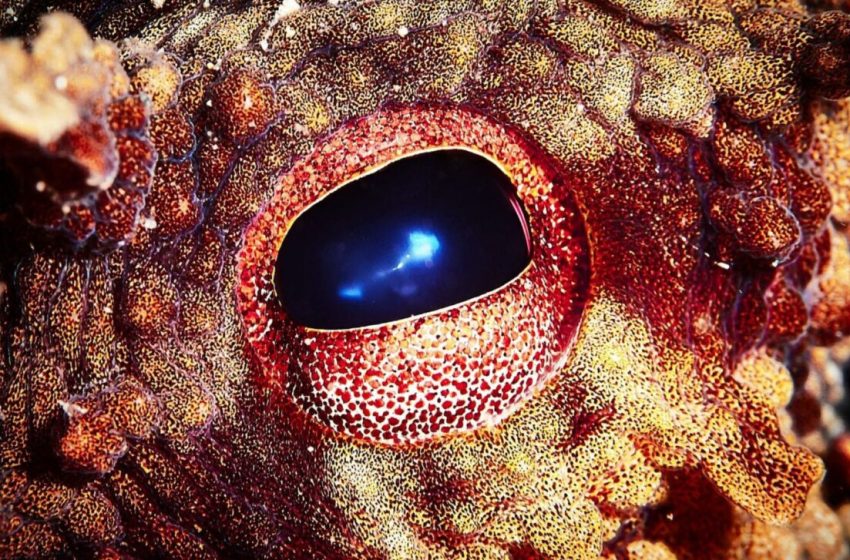
Coulson turns to octopuses not on a whim, but on the basis of their neurology and behaviour. “Their ability to solve complex problems, communicate with one another in flashes of colour, manipulate objects, and even camouflage themselves with stunning precision suggests that, given the right environmental conditions, they could evolve into a civilisation-building species following the extinction of humans,” he said.
Their nervous system is unlike anything else in the animal kingdom. Octopuses have a decentralized nervous system: two-thirds of their neurons are located in their arms rather than their central brain. Research published in PNAS has documented how this distributed neural architecture underlies octopus cognition and adaptive behaviour, allowing each arm to act semi-independently without waiting for signals from the brain. Coulson describes this as making “several species of octopus well suited for an unpredictable world.”
Their dexterity is already documented in research settings. A 2022 study in Nature Scientific Reports recorded octopuses using tools, solving multi-step tasks, and navigating novel environments in ways consistent with flexible, experience-based learning. They can distinguish between real and virtual objects, open sealed jars, handle tools with their thumb-like tentacles, and thrive across habitats from deep-sea trenches to shallow coastal waters. “Some individuals even escape from their tanks at night in some research centres, visiting those of their neighbours, believe it or not,” Coulson noted.
The Biological Obstacles
Not all researchers share Coulson’s optimism about octopus potential. As Earth.com has reported in its coverage of post-human species scenarios, the debate draws in biologists across several disciplines. Biologist Culum Brown of Australia’s Macquarie University has pointed out that octopuses are “still working from a snail blueprint,” and that their evolutionary prospects are “highly constrained by their very short life span,” with most species living for just a year and some for as little as six months, a ceiling that sharply limits how fast beneficial mutations can spread through a population. Short lives mean few generations, and fewer generations mean slower evolution.
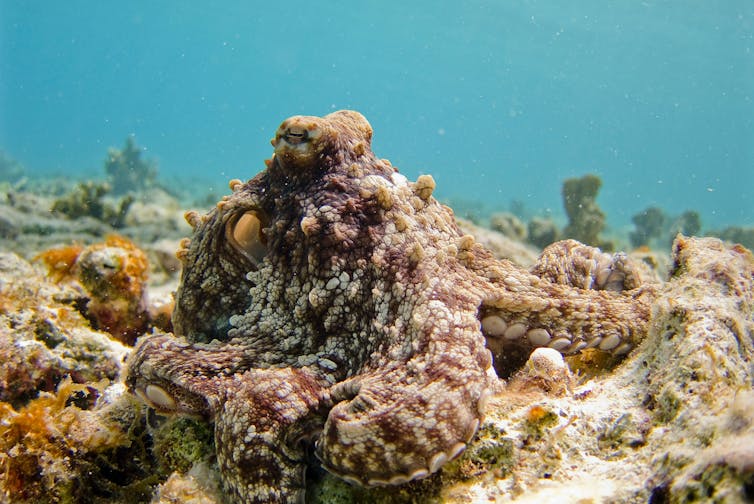
The social dimension is another constraint. University of Sydney Philosophy of Science Professor Peter Godfrey-Smith has noted that octopus parents are almost entirely absent from their offspring’s lives. For anything resembling a culture to emerge, octopuses would need to develop the kind of intergenerational connections that allow knowledge to be passed down. So far, hundreds of millions of years of octopus evolution have produced no such tendency.
Coulson acknowledges all of this. “It’s important to remember that these are just possibilities,” he said, “and that it’s impossible to predict with any degree of certainty how evolution will unfold over extended periods.”
The Land Question
One of the most speculative elements of Coulson’s argument involves the possibility of octopuses eventually leaving the ocean. He is direct about the current barrier: “Octopuses are unlikely to adapt to life on land due to their lack of a skeleton, which makes swift and agile movement out of water challenging.”
But he does not rule it out over long timescales. “With evolutionary advances, it is possible, if not probable, that they might develop ways to breathe outside of water and eventually hunt terrestrial animals like deer, sheep, and other mammals, assuming they have survived the catastrophic event that drove humans extinct.”
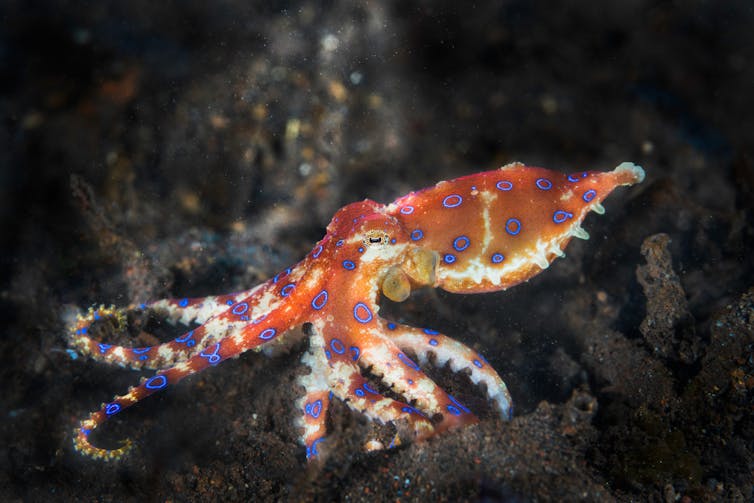
Some species of octopus already reach considerable size. Coulson notes that certain individuals grow up to 20 feet in length and weigh around 110 pounds. Underwater, they are already powerful predators. The jump to land, while biologically extreme, is not categorically different from transitions that evolution has already produced elsewhere in the fossil record.
“Would octopuses build vast underwater cities and come onto land wearing breathing apparatus to shoot a deer? We’ve no way of knowing,” Coulson said. “But we certainly can’t rule it out.”
The deeper point Coulson is making is not really about octopuses at all. It is about the nature of evolution itself. “Random mutations, unforeseen extinction events, and population bottlenecks can all significantly influence the trajectory of evolution,” he said, “making it challenging to determine whether another species will develop human-level intelligence or the inclination to construct cities.”
First Appeared on
Source link






