


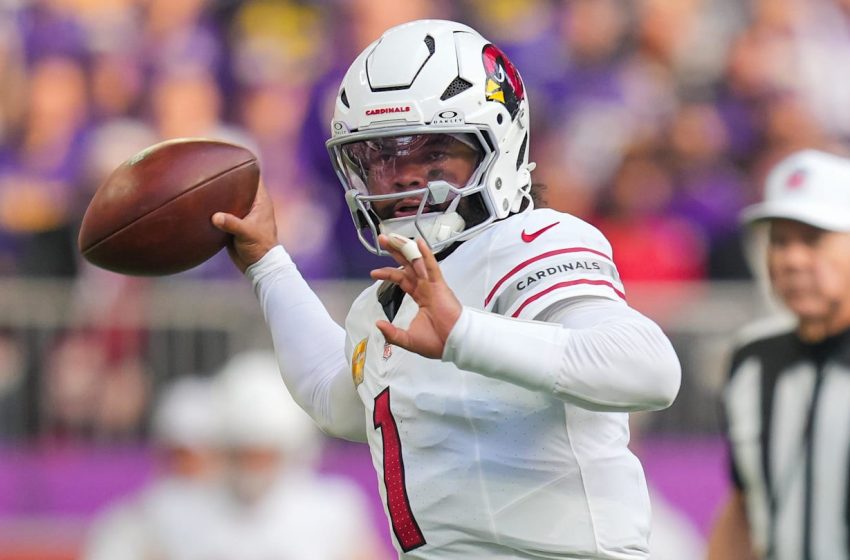
Inside Kyler Murray’s Decision to Join the Vikings
We’re through the mayhem of the first week of free agency, with plenty to recap. We’ll do that right now, in the takeaways …
Kyler Murray
Kyler Murray’s celebration of the latest landmark in his football journey was probably much more understated than the previous ones—for the state titles as a Texas prep star, the Heisman Trophy at Oklahoma or getting drafted with the No. 1 pick in 2019.
This time around, he took his agent, Erik Burkhardt, out for a burger at a Minneapolis institution, Parlour, that he’d visited when the Cardinals came to the Twin Cities for joint practices three summers ago. He ordered a burger (the Parlour Burger is what the place is famous for), and his splurge was getting the basket of fries to go with it.
That could be symbolic of how the trip, and this offseason in general, was about football, and nothing else, for the diminutive 28-year-old gunslinger.
Ideally, for Murray, the conclusion to his visit to Minnesota will be far more of a beginning than an end. It’s been a wild six months for the quarterback. He started the season hopeful that Year 3 under Jonathan Gannon would be the point where his Cardinals took flight, after two years of steady progress. Then, he got hurt, kind of/sort of benched, shut down, put on the trade market and cut, with Gannon losing his gig in the process.
Now, Murray has this new lease on football life and a very intriguing new football marriage.
So I figured, to start our recap of the first week of free agency, we’d take you through how Murray and the Vikings got here—from the quarterback’s slow-motion divorce from Arizona, to a new, enviable position he finds himself in.
• Murray’s final start as a Cardinal came in what wound up being the game where Arizona’s 2025 downturn accelerated from 0 to 60. Yes, a 2–0 start had already flipped to 2–2 by then, but the two losses were competitive games decided by a total of four points against the 49ers and Seahawks. Then, the winless Titans came to town. Arizona went up 21–3, led 21–6 at the half and held that lead well into the fourth quarter, before it all came undone.
Emari Demercado dropped the ball at the goal line at the end of what should’ve been a game-clinching, 72-yard touchdown. Tyler Lockett scored a Holy Roller-type of touchdown after a Cam Ward pick was fumbled away, and Murray hurt his foot. It swelled up after the game. He got checked out and would be sidelined for a few weeks, though he didn’t need surgery. But the loss left a mark—the Cardinals lost their next two, and went into the bye at 2–5.
• Coming out of the bye, Jacoby Brissett starred in what was probably Arizona’s best win of the season, a 27–17 Monday night victory in Murray’s hometown over the Cowboys. Murray had practiced before the pre-bye losses to the Colts and Packers, and was questionable for the Dallas game—seemingly inching closer to playing. Then, after Dallas, Gannon named Brissett the starter, but it was unclear if it was just for that week or the rest of the season.
Things got funky thereafter. Murray’s foot, still at around 60%, wasn’t getting better. He could play on it, but with a blood-flow issue, there’d be a risk of a more significant Lisfranc injury if he did. So the decision was made, the day after Gannon named Brissett the starter, to move Murray to injured reserve, to give him a month to heal. That was Nov. 5. Exactly a month later, on Dec. 5, with the team 3–9, having lost four straight since Dallas, the Cardinals and Murray’s camp mutually agreed it made no sense not to shut him down.
• Meanwhile, the Vikings were 4–8, and J.J. McCarthy’s growing pains had led to discussions about Minnesota’s next steps at quarterback—with a reclamation project, like the one the team undertook with Sam Darnold in 2025, a logical option for 2026. That would essentially run back the initial plan for 2025, which was to bring back Darnold or Daniel Jones to compete with McCarthy, before those guys found greener pastures.
Murray was one of a handful of guys Minnesota dove into and studied.
• Gannon’s firing genuinely surprised Murray. Arizona asked him to let the coaching search play out—but by then it was pretty clear where things were going. He was due $38.6 million fully guaranteed in 2026, and if he was on the roster on March 15, $19.5 million of his 2027 money would become fully guaranteed. GM Monti Ossenfort inherited Murray’s contract in 2023. Murray had been in Arizona for two coaching firings. His time was about up.
The Cardinals hired Rams OC Mike LaFleur at the outset of Super Bowl week and wanted to assemble his staff before giving Murray final word. Murray liked the LaFleur hire, having met and enjoyed talking to his brother, Matt, the Packers’ coach. But that didn’t alter the writing that had been on the wall for weeks. So Burkhardt was studying Murray’s options.
• Ossenfort tried to find a trade solution, where he could buy back a pick. The problem was the 2027 guarantee, which would effectively lock in a team trading for him for another year. Ridding the contract of the guarantee would require Murray’s cooperation, and the best thing for Murray, at that point, was to be released, because it would allow him to make choosing his next destination a pure football decision.
Why? Because if the Cardinals had cut Murray to avoid paying the 2027 guarantee, then they’d be responsible for the entire 2026 guarantee, minus what another team paid him. That would allow him and the new team to do a one-year minimum deal and stick Arizona with the bill for the rest. Which effectively made the financials a nonfactor.
• In the 24 hours before the negotiating window opened last Monday, Cardinals owner Michael Bidwill called Murray to let him know Arizona would release him at the start of the league year on Wednesday. The conversation was cordial. The team would wait out the two days before announcing anything, on the off chance that something changed on the market and someone came to them with a trade offer. And at 4 p.m. ET Wednesday, Murray was cut.
• By then, Murray and Burkhardt had identified Minnesota as, far and away, his best option, with the plan being to prioritize winning, sign a one-year deal and then hope for a long-term landing spot, be it in his 2026 home or elsewhere, in 2027. As part of it, they’d even come up with the idea to do Zooms with teams that might not have an interest in 2026, but could in 2027—to take advantage of the fleeting freedom Murray would have to do so.
But things wound up moving too fast for that. Murray and Burkhardt were together in Texas, with Murray having come off the field from a morning workout, when the agent’s phone started buzzing at 3 p.m. local time. The Vikings’ call came quickly—with EVP of football ops Rob Brzezinski and coach Kevin O’Connell together on the line. They asked to get Murray on a plane ASAP. He booked a 9:10 p.m. flight out of DFW on American.
• The flight was delayed an hour and landed in the Twin Cities at around 12:30 a.m. CT. Burkhardt and Murray didn’t get to the Omni Viking Lakes, adjacent to the team’s opulent practice facility, until 1 a.m. The team wanted to start meetings at 7 a.m. the next day, and the sides agreed—after what had happened with Maxx Crosby in Baltimore the day before and given that Murray was coming off the foot injury—to start Murray’s itinerary with the physical.
He and Burkhardt met in the hotel lobby—Murray actually stayed at that Omni with the Cardinals in 2023—at 6:30 a.m., quickly discussed this being where Murray wanted to be, and then were scooped up by the Vikings at the valet at 7. Murray had part of his physical done off-site and wrapped that part of his day at 9:30 a.m., then met with O’Connell one-on-one, before going into meetings with assistants Wes Phillips, Josh McCown and Jordan Traylor.
Then, Murray, Brezinski, O’Connell, Burkhardt and a few others had lunch in the draft room, the Vikings’ brass broke off for a final meeting with the doctors, and then O’Connell pulled Murray aside and told him he wanted him to come aboard. Murray responded, “This is where I want to be.” And from there, Brezinski and Burkhardt went to negotiate a relatively simple deal on the minimum, with a second year briefly explored, and a no-tag provision included.
• And while Murray still has to win the job from McCarthy, what O’Connell said to Murray did stick with him—that he was the one guy on the market that they could see as a potential longer-range answer, rather than a one-year Band-Aid. The idea of growing with Justin Jefferson, Jordan Addison, Christian Darrisaw and O’Connell and his staff was already wildly attractive to begin with. The chance to, perhaps, put down roots only made it more so.
So with all that done, and a 9:20 p.m. CT flight back to DFW scheduled, Murray suggested he and Burkhardt grab that burger, remembering how good it was the last time he was there. Yes, it was an understated way to celebrate for a guy whose high-school recruitment was treated like a presidential election. But, again, there was no intention ever to make the situation more than what he’d intended it to be: a football decision.
And if this all works out? Maybe the next time he goes to Parlour, he’ll feel like he’s home.
Indianapolis Colts
The Colts’ aggression draws a pretty clear line: For Chris Ballard and Shane Steichen, it’s sink or swim with the current core. Daniel Jones signed a two-year, $88 million deal, with upside to $100 million. Alec Pierce is in for $114 million over four years.
And those two join a top-heavy balance sheet that has CB Sauce Gardner ($30.1 million APY), LT Bernhard Raimann ($25 million APY), DT DeForest Buckner ($23 million APY), OG Quenton Nelson ($20 million APY), CB Charvarius Ward ($18 million APY), S Cam Bynum ($15 million APY) and RB Jonathan Taylor ($14 million APY) at its upper reaches.
Now, last week’s new deals for Jones and Pierce do make sense.
The Colts’ decision to put the transition tag on Jones set a two-tag floor for doing a two-year deal at $83.2 million. Two franchise tags, had they used that designation, would’ve cost $96.6 million. The leverage for Jones, then, would be the prospect he signed the tender. Then the team was looking at a minimum price tag of $45.5 million, and an untenable figure for a third tag in 2028, which would’ve made him very hard to re-sign (Dak Prescott had that leverage point in getting $60 million).
So Jones gave them the second year, and got a little above the mark of the transition tags on the base, and the franchise tags on the deal’s max value.
As for Pierce, the base value of $28.5 million, with a max at $29 million, puts him right where Terry McLaurin, Tee Higgins and Jaylen Waddle have done deals over the past couple of years. The number, to be sure, looks big for a guy who had just 47 catches last season. But the Colts are paying him for what they think he’ll become, and flipped Michael Pittman Jr. out because what Pierce brings to the table (big-play ability) is harder to find than what Pittman does (toughness, reliability and chain-moving production). Which I get.
And that brings us to the bigger picture: Ballard is heading into his 10th year as GM, Steichen is going into his fourth year as coach, and the Colts are in their first full offseason with Carlie Irsay-Gordon in charge. Ballard has made the playoffs twice, and last won a postseason game at the end of the 2018 season. Steichen hasn’t made it to the tournament yet, so there’s a lot riding on where this goes.
Clearly, you can see that those guys are O.K. pushing their chips in on the group they’ve assembled and seeing where the whole thing goes.
Jaelan Phillips
The Jaelan Phillips deal slipped a little under the radar. But the numbers show that Carolina’s deal for the former first-rounder, still just 26 years old until May, was the biggest one done for a free agent last week outside of Jones—four years, $120 million, $60 million fully guaranteed, a $35 million signing bonus and an $80 million injury guarantee.
Why were the Panthers willing to go so far to land Phillips?
The first reason is obvious, and illustrated perfectly by the seven-play, 71-yard drive that Matthew Stafford authored in the wild-card round in Charlotte to end the Panthers’ surprise uprising of a season. Ejiro Evero’s defense barely got a finger on Stafford on the drive, as the league MVP connected on 6-of-7 throws to cover all 71 yards and win the game.
The second is that Phillips’s presence should be really good for the younger rushers Carolina does have, like 2025 second-round pick Nic Scourton. GM Dan Morgan identified Phillips early in free-agent meetings as someone who could both solve their issue in getting to the quarterback and help establish a play style with the guys up front, effectively becoming a multiplier. Phillips, for what it’s worth, was Carolina’s highest-graded free agent at any position.
The third thing to look at here is the circumstances. The first question the Panthers ask about free agents—and this isn’t unique to them—is why a guy is available in the first place. With Phillips, it was pretty obvious. The Dolphins traded him in a contract year, with big changes coming across the organization and a deep cap problem to solve. The Eagles, meanwhile, have their cap leverage, a lot of mouths to feed and the knowledge that they could get the third-round pick they gave up to get him back as a comp pick if he left.
That knowledge put the Panthers in a position where they felt like they could outbid Philly, particularly after losing out on the bidding for another ex-Eagle in a similar circumstance, Milton Williams, last offseason. So that’s exactly what they did.
Now, of course, the Panthers had to get comfortable with Phillips’s injury history—a torn Achilles ended his 2023 season, and a torn ACL ended his 2024 season, and that all came after he medically retired from football in college at UCLA due to concussions, before mounting a comeback as a Miami Hurricane.
Obviously, they got there, and they got their man, and did so, even with the big number, at around two-thirds of the top of the edge rusher market, where the 2025 contracts for Micah Parsons and Aidan Hutchinson sit.
It’s a big gamble, and one that probably would’ve gotten more attention had it happened in a bigger market. But it’s a worthwhile one, I think, based on Carolina’s logic.
Kirk Cousins
Kirk Cousins is in an interesting spot heading into the second week of free agency. He doesn’t have a home yet. He does have a $10 million guarantee from the Falcons, one that will shape negotiations in how another team approaches him. And my sense is he’s considering three different paths for his next, and maybe final, step as a pro football player.
The first path has narrowed considerably—that’s the one to a starting job somewhere. There are two places, as it stands now, where that could happen for Cousins. One is in Las Vegas, as the placeholder for presumptive No. 1 pick Fernando Mendoza. The other would be Pittsburgh, if Aaron Rodgers decides not to come back (and we don’t have an answer on that yet, obviously).
The second path would be to join a playoff team as a backup, which would give Cousins the best chance to play well if he did get to come off the bench. That could be the Rams, if Jimmy Garoppolo doesn’t re-sign, given Cousins’s background with Sean McVay. It could be the Chiefs, where Chris Oladokun is currently Patrick Mahomes’s primary backup. Or it could be several other places.
The third path would be to wait. The risk there is that the right opportunity never comes along, but the payoff could be starting somewhere for a good team that’s dealing with a quarterback injury down the line.
For now, Cousins is weighing all of that, as one of the last quarterbacks on the market, along with Garoppolo, Joe Flacco, Russell Wilson and Tyrod Taylor, with extensive history as a starter.
Pittsburgh Steelers’ QB spot
And no, I don’t know who the Steelers quarterback will be, but I do like the augmenting they’ve done around whoever that winds up being. To me, the acquisitions of WR Michael Pittman Jr. and RB Rico Dowdle make sense both stylistically and from a need standpoint, as the team reworks its roster under first-year coach Mike McCarthy.
Simply put, Dowdle runs like a Steeler. He should be a nice complement for the recently re-signed Jaylen Warren, and also light a fire under 2025 rookie Kaleb Johnson. The three together give the Steelers a little more depth than they’ve had in a while.
Pittman, meanwhile, is how you’d draw up a complement to DK Metcalf, as a chain-mover capable of doing the dirty work and eating up yards after the catch. Add him to the aforementioned backs, and tight end Pat Freiermuth, and there’s real balance in the Pittsburgh passing game that last year got a little too reliant on Metcalf in his first year as a Steeler.
Now, from a global standpoint, I’m a little iffy on the way the roster has aged. I felt like this was probably the point where they would tear things down and start rebuilding. But hiring McCarthy shows the Rooneys are still focused on trying to get a championship from the current group, even though only Cam Heyward (who was re-signed last week) and Chris Boswell are the only guys left from Pittsburgh’s last playoff win.
I don’t know if it’ll work. But Dowdle and Pittman should help.
Maxx Crosby
I’d believe Maxx Crosby and the Raiders when they tell you they’re moving forward together. Here’s why: Las Vegas was never going to give Crosby away. And when teams tried to look for such a deal in calling the Raiders after last Tuesday’s physical fiasco, they heard as much.
Could someone come along and offer the ransom number for Crosby? Sure, but I don’t see that being likely.
That’s mostly because, now that it’s public knowledge that Crosby failed his physical, another coach or GM is going to be leery about taking anything near the sort of swing that Baltimore was initially prepared to take. Mostly because if you do, and then he breaks down in the next year or two, it becomes awfully hard to explain it to your owner.
Also, some of the fractured trust between Crosby and the Raiders was rebuilt organically last week, when the team showed the five-time Pro Bowler that it had his back, in reaching out and offering any help he needed after the Ravens backed out of the trade. Crosby likes new coach Klint Kubiak and GM John Spytek, and loves his old position coach Rob Leonard, who’s now his defensive coordinator. So it’s not as uncomfortable for him.
As for the team’s side of it, it won’t hurt Kubiak’s effort to build a culture to have someone like Crosby, who’s now on his sixth head coach as he heads into his seventh NFL season. If Crosby buys in, and there’s no reason to think he won’t, he has the potential to be what he’s always wanted to be for the Raiders—a flagbearer and agent of change.
And if Crosby plays well, and the team doesn’t, and a big offer comes along before the trade deadline in November? Well, that wouldn’t be the worst problem to have.
Kansas City Chiefs
I’d call the Chiefs a winner at this early stage of the offseason. Kansas City entered last week with every intention of taking care of two needs—running back and nose tackle—quickly in free agency, and did just that. The top back on the market, Kenneth Walker III, came aboard at $43.05 million over three years. A stout nose tackle, ex-Patriot Khyiris Tonga, joined him at the reasonable price of $21 million over three years.
In a vacuum, I like both moves. I look at Walker like Saquon Barkley, Derrick Henry and Josh Jacobs on the 2024 market, top players who were real values simply because of how their position had been devalued (especially when considered against the amount each of those guys carries the ball). And I see Tonga as a giant run-plugger who was an invaluable cog in a Patriots defense that steadily improved as its Super Bowl run built last year.
But it’s more than just liking the players, for me. It’s also how the moves have left the Chiefs in a position to do really good work in the draft, six and a half weeks from now.
They’ll go in with flexibility now to do what they did a few years ago when they traded Tyreek Hill—build a strong base of young, cost-controlled talent. It’s more necessary now with guys from those years, such as Creed Humphrey, Nick Bolton, Trey Smith and George Karlaftis, going on to big second contracts, and the Trent McDuffie trade gives them the capital to make it happen as the Hill deal did.
The running back situation illustrates the point perfectly here. Absent Walker, the Chiefs may have had to force something to go up and get Notre Dame’s Jeremiyah Love in the top 10, or pressed to get his teammate, Jadarian Price, in the second round, to get the position taken care of. Now, they don’t have to do that. Yes, they have a need at corner, but even there they have some young players they like and have brought in Kader Kohou from the Dolphins.
Bottom line: This sets the Chiefs up nicely for the next transition, and the next phase of the Mahomes era. Now they have to get the picks right.
A.J. Brown
The A.J. Brown saga feels like it’s turned into a staring contest. With Brown’s other desired AFC landing spots (Chiefs, Chargers, Bills) now out of the mix, the Patriots stood as the only real suitor at the end of the week, and Brown wasn’t moved. The Patriots aren’t going to bid against themselves. Philadelphia isn’t giving Brown away. And so on.
Meanwhile, the Eagles reached an agreement with Dallas Goedert on a reworked one-year deal, which allows them to free up some cap space (they’re nearly out of contracts left to restructure) and continue to consider their options for the rest of the offseason.
That could mean trading Brown. But I don’t think it makes it inevitable, as some people may have surmised over the past few days.
The reality is the Eagles needed breathing room, Goedert could give them that on a new deal, and Philly really wanted to keep him separate from all that. So they work something out, and it opens some options. Trading Brown is one, but trading Brown would mean replacing him, too. And moving him after June 1 would give Philly the chance to spread the cap damage out, even if that’s more kicking the can down the proverbial road.
Brown also has his eyes wide open to what his own options might be here, too, which is to say it’s not like anyone is in the dark on all this.
Yes, it’s complicated, so stay tuned.
Offensive line market
One big-picture observation: The offensive line market did finally seem to cool. It could be due to teams being fearful of where the market took middling tackles Dan Moore Jr. and Jaylon Moore last year. It could be the crop of available players itself. The reality is that only offensive lineman who really knocked it out of the park was Tyler Linderbaum, and the Raiders’ new center was the only O-lineman available who is truly elite at his position.
New Panthers tackle Rasheed Walker, hoping for $20 million per year, wound up taking a fraction of that on a one-year deal. New Patriots guard Alijah Vera-Tucker had $12.75 million of the $42 million on his three-year deal tied up in per-game roster bonuses, designed to protect the team against injury. Bills center Connor McGovern stayed put at a modest $13 million per year, and older vets such as Joel Bitonio and Jawaan Taylor are still on the market.
This isn’t something I saw coming, and I don’t think many teams did, either.
The long-term implications? I’m not sure. Elite linemen will continue to get paid, and those positions remain vital to most great teams. But perhaps some front offices and coaching staffs see a little less separation between the merely good players and those on the fringes.
We’ll see in a year whether this was a blip or perhaps the start of a trend.

Quick-hitters
Time for the first batch of quick-hitters, after the free-agent frenzy. Let’s roll …
• I’d look at the Dolphins, Browns, Jets and Cardinals, and say it looks to me like every one of them is looking down the line at the 2027 draft at quarterback. I don’t think there’s a single guy where you can say, Yes, lock it in, he’s a top-five pick, as you could a year ahead of time for Caleb Williams and Drake Maye in 2023. But, between Dante Moore, Arch Manning, CJ Carr, Julian Sayin, Trinidad Chambliss, LaNorris Sellers, Sam Leavitt, John Mateer, Jayden Maiava, Brendan Sorsby, Darian Mensah, DJ Lagway, Drew Mestemaker … there are a lot of names with tools/potential, which increases the chances that a handful will hit and will go in the first round.
• I’d also say, for what it’s worth, that it made sense for the Dolphins to get Malik Willis, though it was expensive—and might jeopardize their draft position in a way that going with a cheaper option would not. As they rebuild, Jeff Hafley and Jon-Eric Sullivan will have to build credibility with their players, and Willis will give those guys a fighting chance to succeed in the here and now, which is generally what matters to the locker room.
• Travis Kelce is coming back on a one-year, $12 million deal, and the Chiefs built the contract in a pretty interesting way. First, as a rule, they don’t do void years, but they used the 50% rule and a post–June 1 mechanism in 2027 (we’ll explain in a separate post) to spread the cap damage out over three years. Second, the $3 million in incentives are attainable—if the Chiefs make the playoffs, he’ll get $750,000 at 60% playing time, $1 million at 70% playing time or $2 million at 80% playing time. If they get to the Super Bowl, he’ll get another $250,000 at 60% playing time, or $1 million at 70% playing time. Third, this sure reads like a farewell deal.
• The Commanders are taking a big swing on Chargers free agent Odafe Oweh, spending $96 million over four years, with the first three years effectively guaranteed at $74 million. The Ravens dealt Oweh at midseason, and really came alive playing for Jesse Minter down the stretch, with 7.5 sacks in the 12 games after the trade. But the Chargers did choose to keep Khalil Mack over Oweh, which is interesting.
• Part of that decision is about the Chargers gaming the comp pick formula, though, which isn’t surprising, given that the Ravens have been the masters of it for a long, long time, and Chargers GM Joe Hortiz was imported from Baltimore. Another team heavily in that game? The Jaguars, who’ll be in line to get 2027 picks now for Devin Lloyd and Travis Etienne Jr. (we dove into their strategy last week in one of our free-agency notebooks).
• Interesting, maybe only to me: The Seahawks chose to keep Rashid Shaheed at $17 million over Kenneth Walker III at $14.035 million. I do know Seattle GM John Schneider is taking some lessons from the last time he was in this position, when it comes to paying guys coming off a championship. And I have to think in this case, he thinks there’s still a lot of untapped potential with Shaheed, who is a really nice complement stylistically to Jaxon Smith-Njigba.
• I’m not sure the Broncos are done yet at tight end. Denver has had interest in Dallas Goedert, and David Njoku is still unsigned.
• Along the same lines of what’s happened with running backs, I do wonder if off-ball linebackers have become so devalued on the market that they’re now a value, too. And that’s why the Raiders doing what they did, signing both Nakobe Dean and Quay Walker, is so interesting. Vegas got both of them for a combined $25.5 million, or just a touch over what it cost the Commanders to sign Oweh (and less than they paid for Tyler Linderbaum).
• We grouped Cam Jordan with Mike Evans last week as a guy who could surprise everyone and leave his longtime home. Jordan is planning to play in 2026, and the ’11 first-round pick still hasn’t re-signed with the Saints. We’ll see where that one goes.
• Finally, it would be cool to see the Bosa brothers reunite in San Francisco. They’ve only been teammates once before, when Nick made the varsity at Florida prep powerhouse St. Thomas Aquinas as a freshman during Joey’s senior year.
More NFL on Sports Illustrated
First Appeared on
Source link






