


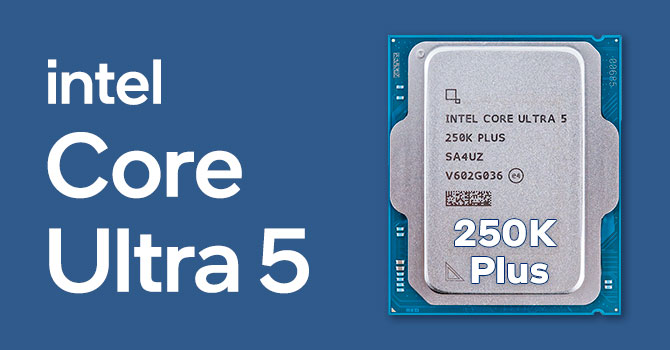
Intel Core Ultra 5 250K Plus Review – Disrupting AMD’s Entry-Level
Introduction
Intel Core Ultra 5 250K Plus is a slick new performance-segment processor that looks to shake things up significantly—at a time when gamers are being priced out of the market through exorbitant memory and SSD prices. The 250K Plus, along with the Core Ultra 7 270K Plus which we’ve also reviewed today, are parts of the company’s Arrow Lake Refresh family of desktop processors. The processor model numbering remains Core Ultra Series 2, but the two are differentiated by the new “Plus” brand extension. Intel debuted the series in Q4 2024, so this refresh has been over a year in the making. It takes into account the rapidly changing market for the client PC, and is Intel doing its part to strengthen the ecosystem. The Core Ultra 5 250K Plus is priced at just $200, which makes it a whopping 35% cheaper than Core Ultra 5 245K at launch. If you recall, the 245K launched at $310, and price cuts over the year saw it settle down to $200.
The new Core Ultra Series 2 Plus refresh not only increases clock speeds but also boosts CPU core counts and L3 cache sizes across the two SKUs. The Core Ultra 5 250K Plus comes with 6 performance cores (P-cores) and 12 efficiency cores (E-cores), which is the highest core count for any “5” segment desktop chip from Intel. The older 245K came with a 6P+8E configuration, same as its predecessor, the Core i5-14600K. Intel also gave this chip an incredible 30 MB of shared L3 cache, the highest among all of its predecessors.
The increase in CPU core counts and shared L3 cache size are just part of the hardware-side upgrades the Core Ultra 5 250K Plus has over the 245K, the company also increased the die-to-die interconnect frequency from 2.10 GHz to 3.00 GHz, a 900 MHz increase. Over 2025, Intel had released the “Core 200S Boost Mode” UEFI BIOS toggle that increases this frequency for older SKUs from the series without breaking the processor’s warranty coverage, so this is now baked into the processor. Lastly, Intel slightly increased the clock speeds of the 250K Plus over the 245K. The P-cores come with a maximum boost frequency of 5.30 GHz, a 100 MHz increase over the 245K; while the E-core frequencies remain unchanged, boosting up to 4.60 GHz, there are now four additional E-cores. What’s also unchanged are the power limits out of the box, with a 125 W processor base power, and 159 W maximum turbo power.
Perhaps the biggest reason behind the Plus brand extension isn’t the hardware changes, but a new software-side improvement Intel is introducing, called Intel Binary Optimization Technology, which builds on top of its Application Performance Optimization tech. Designed to be opt-in, and game-specific, Binary Optimization Technology is the CPU analog of shader replacement in computer graphics. It modifies the machine code of game binaries, making it more optimal for Intel x86 architecture. This code modification happens during runtime, and Intel is working with game developers to create application profiles that don’t break anti-cheat or DRM technologies. Intel will ship these profiles through its new Intel Platform Performance Package (IPPP) releases. Much like monthly graphics driver updates, IPPP contains the latest platform chipset drivers, and application profiles for Binary Optimization and APO.
Binary Optimization is exclusive to the 250K Plus and 270K Plus at launch, it doesn’t yet work on older Core Ultra Series 2 Arrow Lake SKUs, not even the flagship Core Ultra 9 285K comes with it. In best case scenario implementations, Intel claims performance gains of over 20%, making this essentially an IPC uplift for the processor. The underlying architecture of this Plus refresh is still Arrow Lake, which is Intel’s first disaggregated, tile-based chip for the desktop platform. Its Compute tile, which contains the CPU cores, is built on the TSMC 3 nm process, a node more advanced than the TSMC 4 nm used by AMD for its Zen 5 processors. The SoC tile, which contains the memory controllers, NPU, and PCIe root complex, is built on 6 nm, and the Graphics tile continues to be 5 nm. The die-to-die interconnect binding these tiles has a clock speed of its own, which was 2.10 GHz on the 245K, but has been increased to 3.00 GHz on the 250K Plus.
Intel is launching the Core Ultra 5 250K Plus at $200, a fantastic launch price that is sure to disrupt the competition. Its competitors are Intel’s own Core i5-14600K, which remains sought after for its DDR4 memory support; and AMD’s Ryzen 5 9600X. The 250K Plus comes with 18 cores, which is a higher thread-count than the 12 of the 9600X. The six Lion Cove P-cores lack Hyper-Threading, but Intel took big strides in increasing the IPC of its E-cores with Skymont, and the 250K Plus has 12 of these.
| Price | Cores / Threads |
Base Clock |
Max. Boost |
L3 Cache |
TDP | Architecture | Process | Socket | |
|---|---|---|---|---|---|---|---|---|---|
| Intel Core i5 | |||||||||
| Core i5-13400F | $170 | 6+4/16 | 2.5/1.8 GHz | 4.6/3.3 GHz | 20 MB | 65 W | Raptor Lake | 10 nm | LGA 1700 |
| Core i5-13600K | $225 | 6+8/20 | 3.5/2.6 GHz | 5.1/3.9 GHz | 24 MB | 125 W | Raptor Lake | 10 nm | LGA 1700 |
| Core i5-14600K | $260 | 6+8/20 | 3.5/2.6 GHz | 5.3/4.0 GHz | 24 MB | 125 W | Raptor Lake | 10 nm | LGA 1700 |
| Intel Core Ultra 5 | |||||||||
| Core Ultra 5 245K | $200 | 6+8/14 | 4.2/3.6 GHz | 5.2/4.6 GHz | 24 MB | 159 W | Arrow Lake | 3 nm | LGA 1851 |
| Core Ultra 5 250K Plus | $200 | 6+12/18 | 4.2/3.3 GHz | 5.3/4.6 GHz | 30 MB | 159 W | Arrow Lake Plus | 3 nm | LGA 1851 |
| AMD Ryzen 5 | |||||||||
| Ryzen 5 8500G | $150 | 6/12 | 3.5 GHz | 5.0 GHz | 16 MB | 65 W | Phoenix 2 | 4 nm | AM5 |
| Ryzen 5 5600X | $135 | 6/12 | 3.7 GHz | 4.6 GHz | 32 MB | 65 W | Zen 3 | 7 nm | AM4 |
| Ryzen 5 7600 | $185 | 6/12 | 3.8 GHz | 5.1 GHz | 32 MB | 65 W | Zen 4 | 5 nm | AM5 |
| Ryzen 5 7600X | $210 | 6/12 | 4.7 GHz | 5.3 GHz | 32 MB | 105 W | Zen 4 | 5 nm | AM5 |
| Ryzen 5 9600X | $180 | 6/12 | 3.9 GHz | 5.4 GHz | 32 MB | 65 W | Zen 5 | 4 nm | AM5 |
| Intel Core i7 | |||||||||
| Core i7-13700K | $280 | 8+8/24 | 3.4/2.5 GHz | 5.4/4.2 GHz | 30 MB | 125 W | Raptor Lake | 10 nm | LGA 1700 |
| Core i7-14700K | $340 | 8+12/28 | 3.4/2.5 GHz | 5.6/4.3 GHz | 33 MB | 125 W | Raptor Lake | 10 nm | LGA 1700 |
| Intel Core Ultra 7 | |||||||||
| Core Ultra 7 265K | $280 | 8+12/20 | 3.9/3.3 GHz | 5.5/4.6 GHz | 30 MB | 250 W | Arrow Lake | 3 nm | LGA 1851 |
| Core Ultra 7 270K Plus | $300 | 8+16/24 | 3.7/3.2 GHz | 5.5/4.7 GHz | 36 MB | 250 W | Arrow Lake Plus | 3 nm | LGA 1851 |
| AMD Ryzen 7 | |||||||||
| Ryzen 7 5700G | $165 | 8/16 | 3.8 GHz | 4.6 GHz | 16 MB | 65 W | Zen 3 + Vega | 7 nm | AM4 |
| Ryzen 7 5700X | $160 | 8/16 | 3.4 GHz | 4.6 GHz | 32 MB | 65 W | Zen 3 | 7 nm | AM4 |
| Ryzen 7 7700 | $280 | 8/16 | 3.8 GHz | 5.3 GHz | 32 MB | 65 W | Zen 4 | 5 nm | AM5 |
| Ryzen 7 7700X | $275 | 8/16 | 4.5 GHz | 5.4 GHz | 32 MB | 105 W | Zen 4 | 5 nm | AM5 |
| Ryzen 7 9700X | $305 | 8/16 | 3.8 GHz | 5.5 GHz | 32 MB | 65 W | Zen 5 | 4 nm | AM5 |
| Ryzen 7 5800X | $165 | 8/16 | 3.8 GHz | 4.7 GHz | 32 MB | 105 W | Zen 3 | 7 nm | AM4 |
| Ryzen 7 5800X3D | $340 | 8/16 | 3.4 GHz | 4.5 GHz | 96 MB | 105 W | Zen 3 | 7 nm | AM4 |
| Ryzen 7 7800X3D | $365 | 8/16 | 4.2 GHz | 5.0 GHz | 96 MB | 120 W | Zen 4 | 5 nm | AM5 |
| Ryzen 7 9800X3D | $420 | 8/16 | 4.7 GHz | 5.2 GHz | 96 MB | 120 W | Zen 5 | 4 nm | AM5 |
| Ryzen 7 9850X3D | $500 | 8/16 | 4.7 GHz | 5.6 GHz | 96 MB | 120 W | Zen 5 | 4 nm | AM5 |
| Intel Core i9 | |||||||||
| Core i9-13900K | $415 | 8+16/32 | 3.0/2.2 GHz | 5.8/4.3 GHz | 36 MB | 125 W | Raptor Lake | 10 nm | LGA 1700 |
| Core i9-14900K | $460 | 8+16/32 | 3.2/2.4 GHz | 6.0/4.4 GHz | 36 MB | 125 W | Raptor Lake | 10 nm | LGA 1700 |
| Intel Core Ultra 9 | |||||||||
| Core Ultra 9 285K | $530 | 8+16/24 | 3.7/3.2 GHz | 5.7/4.6 GHz | 36 MB | 250 W | Arrow Lake | 3 nm | LGA 1851 |
| AMD Ryzen 9 | |||||||||
| Ryzen 9 5900X | $265 | 12/24 | 3.7 GHz | 4.8 GHz | 64 MB | 105 W | Zen 3 | 7 nm | AM4 |
| Ryzen 9 7900 | $370 | 12/24 | 3.7 GHz | 5.4 GHz | 64 MB | 65 W | Zen 4 | 5 nm | AM5 |
| Ryzen 9 7900X | $400 | 12/24 | 4.7 GHz | 5.6 GHz | 64 MB | 170 W | Zen 4 | 5 nm | AM5 |
| Ryzen 9 7900X3D | $580 | 12/24 | 4.4 GHz | 5.6 GHz | 128 MB | 120 W | Zen 4 | 5 nm | AM5 |
| Ryzen 9 9900X | $430 | 12/24 | 4.4 GHz | 5.6 GHz | 64 MB | 120 W | Zen 5 | 4 nm | AM5 |
| Ryzen 9 5950X | $345 | 16/32 | 3.4 GHz | 4.9 GHz | 64 MB | 105 W | Zen 3 | 7 nm | AM4 |
| Ryzen 9 7950X | $640 | 16/32 | 4.5 GHz | 5.7 GHz | 64 MB | 170 W | Zen 4 | 5 nm | AM5 |
| Ryzen 9 7950X3D | $550 | 16/32 | 4.2 GHz | 5.7 GHz | 128 MB | 120 W | Zen 4 | 5 nm | AM5 |
| Ryzen 9 9950X | $515 | 16/32 | 4.3 GHz | 5.7 GHz | 64 MB | 170 W | Zen 5 | 4 nm | AM5 |
| Ryzen 9 9950X3D | $675 | 16/32 | 4.3 GHz | 5.7 GHz | 128 MB | 170 W | Zen 5 | 4 nm | AM5 |
First Appeared on
Source link






