


Iran war: What is happening on day 13 of US-Israel attacks? | US-Israel war on Iran News
EXPLAINER
Cyberattacks, tensions in the Strait of Hormuz and rising oil prices are deepening the global consequences of the war.
Published On 12 Mar 2026
The United States and Israeli strikes on Iran continue, as Tehran has stepped up attacks to disrupt energy markets, triggering a spike in oil prices.
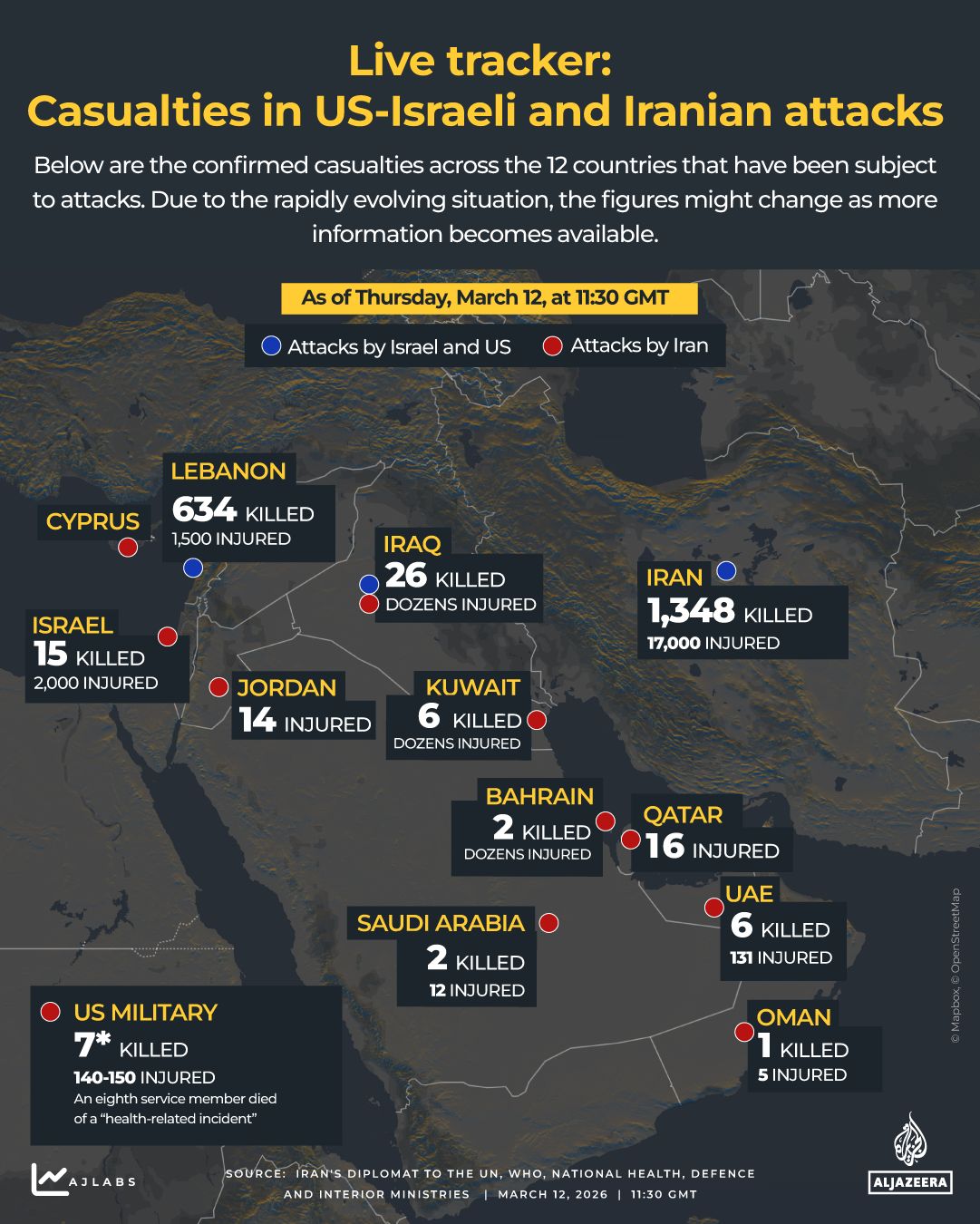
According to Iran’s representative to the United Nations, Amir Saeid Iravani, at least 1,348 civilians have been killed as the war entered its 13th day on Thursday.
Recommended Stories
list of 1 itemend of list
Meanwhile, Iranian President Masoud Pezeshkian has outlined three conditions to end the war: recognition of Tehran’s legitimate rights, payment of reparations, and firm international guarantees against future aggression.
This comes as Tehran has continued retaliatory attacks and signalled potential conditions for ending the conflict.
At the same time, cyberattacks, maritime incidents in the Strait of Hormuz and rising oil prices are adding to the global fallout of the war.
Here are the latest developments:
In Iran
- Growing death toll: At least 1,348 civilians have been killed and over 17,000 injured in Iran since the US and Israel launched their attacks on February 28.
- Iran ‘only targeting US bases’: Iran’s new Supreme Leader Mojtaba Khamenei said the Strait of Hormuz oil shipping lane will remain closed, and issued a warning that bases used by US forces will be subjected to further attacks unless they are shut down.
- Conditions for peace: President Pezeshkian said Tehran would consider ending the war if its “legitimate rights” are recognised, reparations are paid, and firm international guarantees prevent future attacks.
- Three million displaced in Iran: Up to 3.2 million people have been displaced in Iran since the war erupted nearly two weeks ago, the United Nations refugee agency said.
- Top adviser calls Trump ‘Satan’: Yahya Rahim Safavi, a senior adviser to Iran’s Supreme Leader Mojtaba Khamenei, lashed out at US President Donald Trump on state television, calling him “the most corrupt and stupid American president” and “Satan himself”.
- No evidence of mines: French President Emmanuel Macron said he had “no confirmation” Iran was laying sea mines in the Strait of Hormuz after reports the key waterway had been mined.
- Joint strike with Hezbollah: Iran’s Islamic Revolutionary Guard Corps (IRGC) said it carried out a joint missile operation with Lebanese ally Hezbollah against targets in Israel.
- Tensions in the Strait of Hormuz: The IRGC said it fired at two vessels that allegedly ignored warnings. Additionally, Oman’s navy rescued 20 sailors from a Thai-flagged vessel attacked in the strait.
The Gulf countries
- Saudi Arabia: The Ministry of Defence on Thursday said two drones heading towards the Shaybah oilfield were intercepted and destroyed over the kingdom’s Empty Quarter desert. Another drone heading towards the oilfield had earlier been “intercepted and destroyed”. Earlier on Thursday, the ministry said it shot down one drone approaching a district housing foreign embassies, and another in the eastern region.
- Oman: A drone attack damaged several fuel tanks at the port of Salalah, an act strongly condemned by Qatar as a dangerous escalation. Iran has denied being behind the attack.
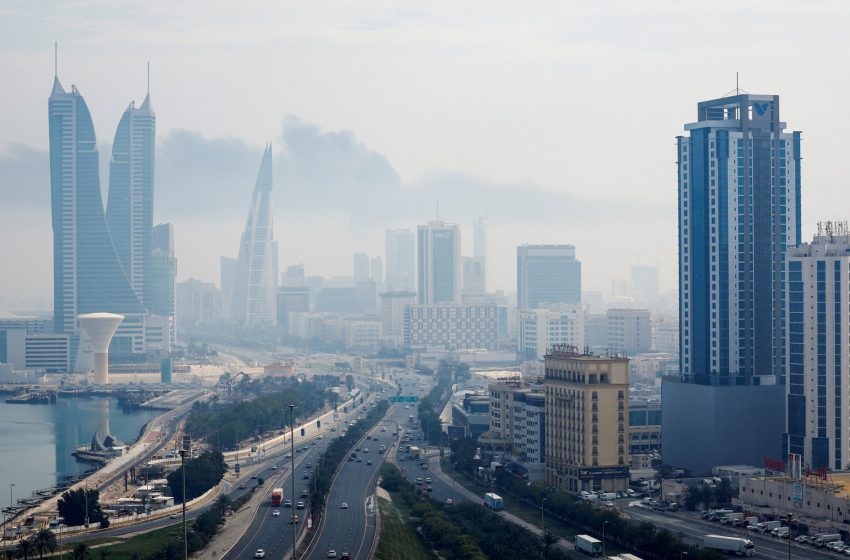
- Bahrain: The country responded to an Iranian attack on fuel tanks in Muharraq, urging residents to stay indoors to avoid smoke.
- UAE: The United Arab Emirates intercepted a massive wave of Iranian projectiles, including six ballistic missiles, seven cruise missiles, and 39 drones on March 11. Citibank has told The Associated Press news agency that it will close all its branches except one following a threat from Iran to target financial institutions in the region.
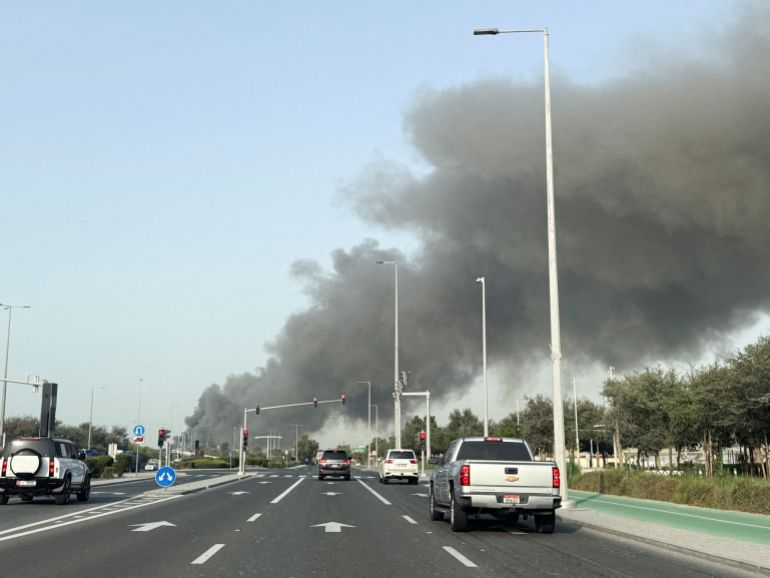
- Kuwait: Six electricity transmission lines in Kuwait went out of service after debris from intercepted drones fell on the infrastructure, the country’s Ministry of Electricity said on Thursday. Earlier, the Gulf country intercepted several drones, though one struck a residential building, wounding two people.
- Espionage arrests: Bahrain’s Ministry of Interior said four Bahraini citizens were arrested on charges of spying for Iran’s IRGC.
- Qatar Airways to resume flights: The airline said it will operate 29 flights to and from Doha on Thursday after receiving temporary government authorisation.
- ‘Proud as a Qatari’: Qatari Prime Minister Sheikh Mohammed bin Abdulrahman bin Jassim Al Thani praised the unity of citizens and residents during repeated Iranian attacks, pledging to keep daily life undisrupted.
In the US
- Trump rebuffs oil price concerns: The US president wrote on social media that stopping Iran from developing nuclear weapons was “of far greater interest and importance to me” than controlling oil prices.
- ‘Targeting error’ likely led to school strike: An Iranian school was likely hit by a US Tomahawk missile due to a targeting mistake, The New York Times reported, quoting US officials.
- US war costs hit $11.3bn in six days: The opening week of the war cost the US military more than $11.3bn, lawmakers were told in a Pentagon briefing, according to media reports.
- Ongoing military campaign: The US Central Command (CENTCOM) announced that approximately 6,000 targets have been struck in Iran since the operations began. Additionally, more than 90 Iranian vessels, including over 30 mine-laying ships, have been damaged or destroyed.
In Israel
- No time limit for operation: Israeli Defence Minister Israel Katz said the operation “will continue without any time limit, as long as required, until we achieve all objectives and win the campaign”.
- Israeli soldiers wounded: The military says 14 Israeli soldiers have been injured since the war began, including six in southern Lebanon.
- 179 injured in 24 hours: Israel’s Ministry of Health says 179 people were injured in the last 24 hours, with the majority of them being in “mild condition”.
- ‘Large-scale’ Beirut strikes: The Israeli military said it began a “large-scale wave of strikes” on Hezbollah infrastructure in the Dahiyeh area.
- Iran’s missiles detected: The Israeli military said it had detected missiles fired from Iran heading towards Israeli territory.
In Lebanon, Iraq
- Israel moves further into Lebanon: The Israeli military moved further into southern Lebanon, telling residents to “move immediately north of the Zahrani River”, 40km (25 miles) from the Israeli border.
- Turkiye warns Israel over Lebanon: Turkish Foreign Minister Hakan Fidan called for an end to Israel’s bombardment of neighbouring Lebanon “before it collapses”, a disaster that would “profoundly affect the entire region”.
- Lebanon toll rises: The Lebanese government said the death toll in the war between Israel and Hezbollah was more than 630 people, while some 800,000 have registered as displaced.
- Oil tankers attacked off Iraq: Two oil tankers were attacked off Iraq’s coast, government officials told the INA news agency. At least one crew member of a ship was killed, and several were missing, while 38 people had been rescued.
Oil and energy
- Maritime warfare and economic impact: The war continues to disrupt global trade, with oil prices climbing to $100 a barrel. In response, the International Energy Agency is releasing a record 400 million barrels of crude oil, with the US contributing 172 million barrels to calm markets.
- Emergency talks on Hormuz: The International Maritime Organization (IMO) announced an “extraordinary session” next week to discuss threats to shipping in the Middle East and particularly in the Strait of Hormuz.
First Appeared on
Source link






