


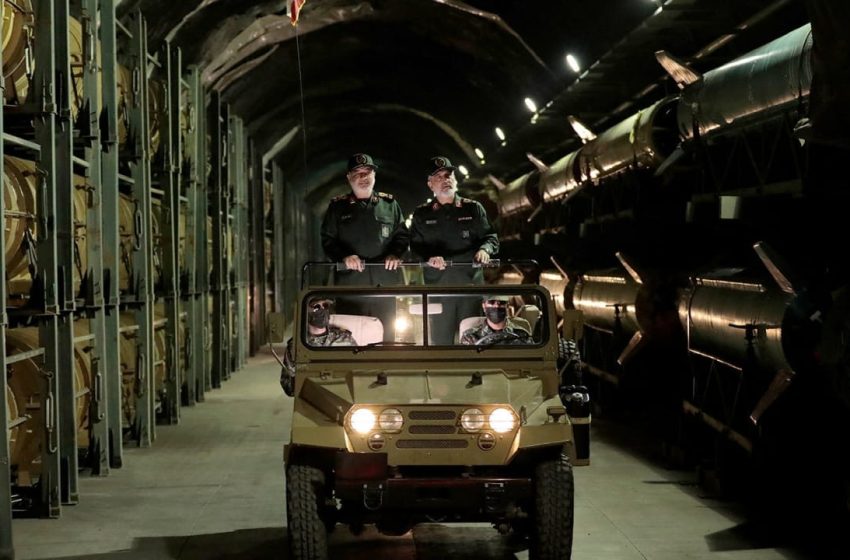
Iran’s ‘missile cities’ become targets in Israel, US war
The Islamic Republic’s “missile cities” strategy, once seen as a significant advantage in case of an armed conflict, has become its biggest weakness during the current conflict with Israel and the US, as what used to be a mobile platform difficult to target now became a predictable target easy to locate, The Wall Street Journal reported on Thursday.
According to the report, the US and Israel entered a phase in their operations -called Operation Epic Fury and Operation Roaring Lion respectively- where there is no need to use manned vehicles to monitor the underground facilities of the regime to strike their positions when they prepare launchers.
With Iran’s air defenses almost neutralized, Israel and the US are now reportedly using drones to monitor a dozen known underground missile facilities and only deploy manned fighter jets to destroy the launchers once activity is detected near their exits.
“What was once mobile and difficult to find is no longer mobile, and easier to hit,” Sam Lair, a research associate at the James Martin Center for Nonproliferation Studies, told the WSJ.
The report also notes that, even if most facilities are almost completely underground, they have aboveground buildings, roads, and entrances that make them visible in satellite photos.
Admiral Brad Cooper, who is in charge of the US Central Command (CENTCOM) and is handling the main operations in Iran, said during a video briefing on Tuesday that the US Air Force is “hunting Iran’s last remaining ballistic missile launchers to eliminate what I would characterize as their lingering ballistic missile capability. We’re seeing Iran’s ability to hit us, and our partners is declining.”
This goes along with Iran’s capacity to launch missiles, which was greatly reduced from the initial 500 that were launched during the first days of the operations. A CENTCOM report from Wednesday said that the strikes managed to reduce Iran’s launches an 86% in four days of war.
The main problem now, according to the WSJ, is obtaining an accurate count of how many launchers are still operational for the regime. “No one can count their arsenal, which means there’s a lot of uncertainty about how long they can last, which helps them,” Decker Eveleth, a research analyst with CNA Corp., a Washington, DC-area think tank, told the WSJ.
Another challenge is predicting the launches, which are now conducted in a decentralized manner after Tehran decided to stop relying on its top officials to launch a response to the US and Israeli operation.
The Islamic Revolutionary Guard Corps (IRGC) had already delegated far down the ranks before Saturday’s US-Israeli attack, according to a Reuters report. This raised the level of miscalculation that could trigger a wider war, like Iran’s attack on Turkey, a NATO nation, or Qatar.
First Appeared on
Source link






