


Iron Age Surgeons Fixed a Woman’s Shattered Jaw With Primitive Prosthetic—and She Survived
In 1994, Russian archaeologists unearthed a tiny cemetery with a grave holding a mummified woman wearing a wig. More than 30 years later, researchers revisited the long-dead body—exposing what appears to be a primitive prosthetic in her jaw.
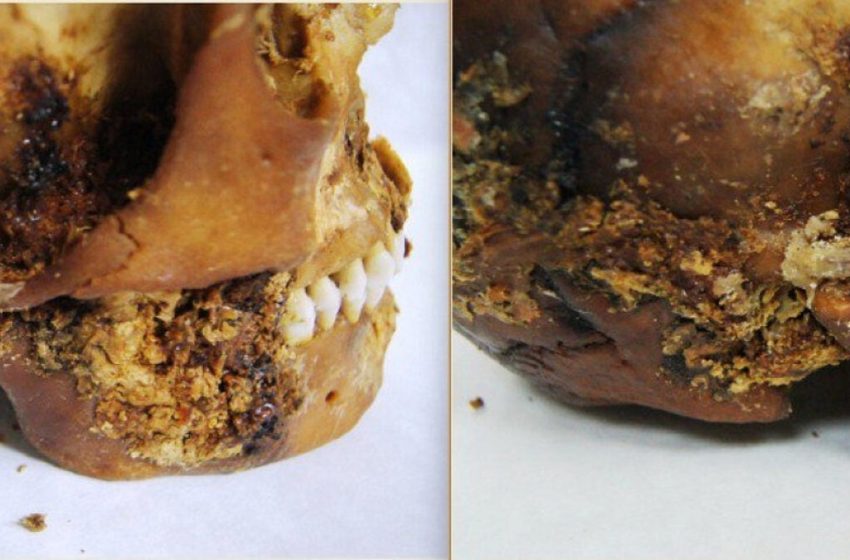
In a statement, archaeologists at Novosibirsk State University in Russia announced that a recent analysis of a 2,500-year-old skull found that the woman likely received jaw surgery after a serious head injury. The researchers performed a CT scan of the skull, revealing signs of severe physical trauma and, more importantly, remnants of an “elastic material” that would have been a “surgical ligature to stabilize the jaw,” they said.
“The CT scanner acted as a ‘time machine,’ providing non-destructive access to anatomical structures,” Vladimir Kanygin, head of the university’s Laboratory of Nuclear and Innovative Medicine, said in the translated statement.
A mystery preserved in time
The mummy was found on the Ukok Plateau, a region in southern Siberia associated with the Pazyryk culture, a nomadic population from the Iron Age. At the time of excavation, researchers estimated the woman’s age at around 25 to 30 years. But that was about it. Only a part of her head was mummified, making it difficult for archaeologists to fully investigate the body. A patch of mummified skin on the skull prevented researchers from studying the skull without disturbing the remains.
Getting under a mummy’s skin
The CT scans revealed far more than the researchers expected. The facial injury had destroyed the woman’s right temporomandibular joint (TMJ), a small section of the upper jaw near the ear. The severity of the injury suggested that the woman wouldn’t have been able to eat or speak.
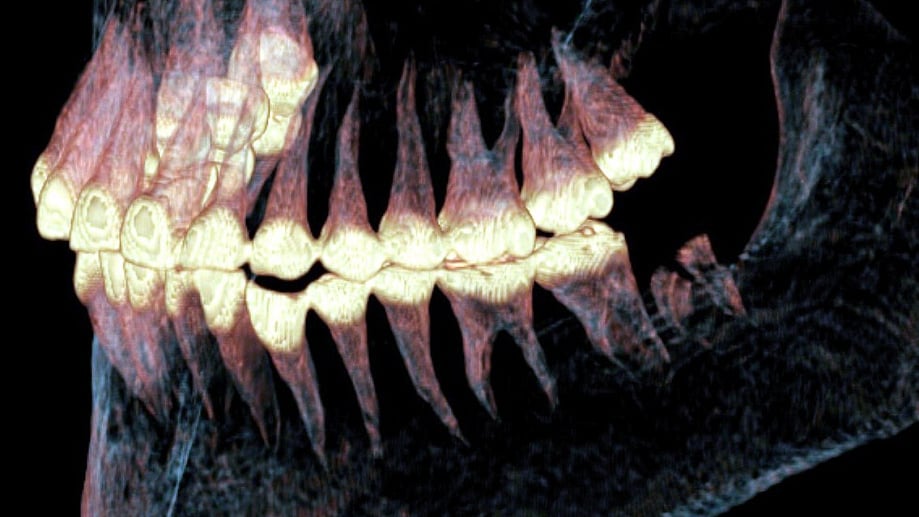
That was the least surprising part. Further examinations uncovered thin canals drilled into the woman’s temporomandibular joint, in addition to a ligament structure that might have been horsehair or animal tendon.
What’s more, the woman’s teeth on the left side were severely damaged compared to the right, hinting she was mostly chewing with her left teeth, meaning she survived for an extended period after the surgery. New tissues grew inside her mouth, and the prosthetic allowed her to move her jaw to a certain extent.
The team isn’t sure what caused the injury, although the woman may have fallen from a horse, considering the nomadic lifestyle of the Pazyryk.
Masters of preservation
The researchers note that while the new discovery was unexpected, it wasn’t “particularly surprising.” Archaeologists knew the Pazyryk people had a nuanced response to injuries and death—the “Siberian Ice Maiden,” a mummy found in a Pazyryk tomb with perfectly preserved tattoos, being a prime example.
The Pazyryk people were also skilled seamstresses, creating sophisticated, lightweight leather coats stitched in fine parallel rows, added Natalia Polosmak, an archaeologist with the Russian Academy of Sciences. These motor skills certainly would have come in handy for surgical operations, she said.
The values of an ancient society
Importantly, the findings further exemplify the Pazyryk culture’s deep respect for life, the researchers said. For example, the mummy’s burial was considered to be “ordinary” compared to that of the Siberian Ice Maiden, suggesting she may have been of a lower status.
Her injuries would also have left her face distorted. The prosthetic allowed her jaw to move again, but probably with a lot of pain, the researchers noted. Needless to say, that likely curtailed the woman’s contributions to her community, which arguably made her a burden in the already harsh conditions the Pazyryk had to weather.
Yet, the archaeological record clearly demonstrates she was properly treated and later buried in a proper coffin of wood—a valuable resource for the region.
“We don’t know what her personal value to society consisted of,” Polosmak mused. “In this society, everyone was valued in life simply for their existence and honored after death.”
First Appeared on
Source link






