


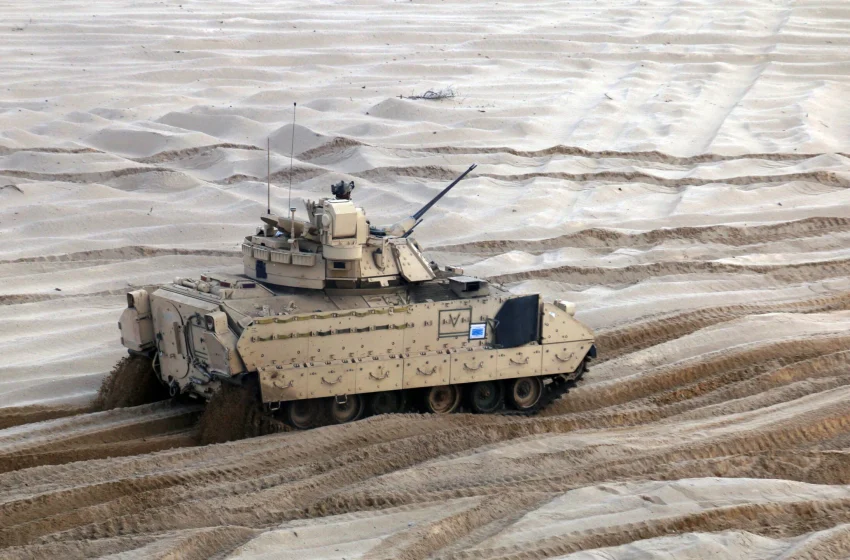
Is the Army about to shake up its Bradley replacement, XM30? Sources see major signs.
WASHINGTON — Last June, Army officials gathered behind closed doors to decide if their most recent attempt at replacing the Bradley Fighting Vehicle was ready to move into the Engineering and Manufacturing Development phase, known as Milestone B. The officials agreed and greenlit moving the program forward.
That is, until Army Chief Gen. Randy George and Secretary Dan Driscoll halted it, opting not to sign a document finalizing the decision, Breaking Defense has learned. The reason: a conscious decision to leave the door open to a major reworking of the XM30 Mechanized Infantry Combat Vehicle program. And there are now signs the Army is starting to look into alternatives.
“The Army is not going to rubber-stamp a process that has consistently failed to deliver the capabilities our warfighters need at the speed of relevance or locks us into a specific design that decreases flexibility,” Army spokesperson Maj. Pete Nguyen told Breaking Defense today when asked about the decision not to sign off on the Milestone B approval. “Gen. George is fully aligned with [Defense] Secretary [Pete] Hegseth’s vision: we must break the cycle of slow, bureaucratic acquisition.
“We are actively assessing multiple, competing designs for the XM30 to foster a truly competitive environment,” Nguyen added. “We continue to look for partners who can deliver cutting-edge solutions now, not decades from now. This is a deliberate and necessary step to ensure we assess and select the best approach to deliver a world class vehicle today and into the future.”
The Milestone B pause, combined with a recent solicitation, is raising eyebrows among watchers of the XM30 about whether the Army is already considering its other options — potentially setting up a seventh go at replacing the Bradley, an effort that first began in the 1980s.
While the Request for Information (RFI) does not specifically mention the XM30 or the Bradley, three sources with knowledge of the program — two former defense officials and one current industry representative — told Breaking Defense on background that the solicitation may be a backdoor effort to speed up, or potentially revamp entirely, the competition.
The thinking, the sources agreed, is that the RFI is a way to look at other options for the program, including non-traditional and commercial vendors, while keeping current competitors American Rheinmetall and General Dynamics Land Systems (GDLS) on contract and moving forward with prototyping efforts.
John Ferrari, a retired Army Maj. Gen., told Breaking Defense that the RFI “likely” points to revamping the XM30. But even if it doesn’t lead down that path, he said, it should help put pressure on the two contractors to speed up the program.
“This RFI is showing the Army is very serious,” Ferrari, now with the American Enterprise Institute, said in an interview. “It’s laying the stakes to say that ‘if you’re not delivering fast enough, we may turn to nontraditional vendors.”’
Further, a former defense official said the Army has been weighing its options on how to proceed with the XM30 program for some time, and believes the RFI is a chance to find out about its options for the program without disrupting ongoing work.
“It is clearly aimed at we want to consider some alternatives for XM30 but we don’t want to spook the herd — meaning Rhemnetall and GD or congressional supporters — by saying, ‘Well, we’re trying to consider an alternative,” a former defense official said. “It sounds like the Army is revisiting what it might want under this [XM30] program and how that decision will affect schedule.”
Take Seven?
Starting in the 1980s, the Army has struggled to replace the venerable Bradley, with XM30 representing the sixth attempt. The effort started with the Armored Systems Modernization, then went into the early 2000s with the Future Combat System, then the Future Fighting Vehicle that never escaped the lab, followed by the Ground Combat Vehicle and eventually the ill-fated first Optionally Manned Fighting Vehicle (OMFV) competition.
Then after revamping the OMFV program and hosting a new competition, the service first picked five teams to produce concept designs for the program in November 2022 before whittling the field down to Rheinmetall and GDLS in June 2023 and renaming it the XM30 Mechanized Infantry Combat Vehicle.
The two companies were tasked with focusing on detailed design activities to mature their vehicle blueprint under Phase 3, before heading into Phase 4 where they build and test prototypes. A second Army spokesperson told Breaking Defense that the plan is for American Rheinmetall and GDLS to deliver eight prototype vehicles, which the service “anticipates” will start rolling out in July. Then the vehicles will undergo testing and be used in the service’s Transformation in Contact exercises.
Given that history, the Army community has been carefully watching for any signs that XM30 is in trouble or facing yet another reboot.
“At this point XM30 has made it further than any of its five predecessors,” the first ex-defense official said. “You have full up, system-level prototypes about to be delivered, but the Army can grab defeat from the jaws of victory.”
The RFI caught the attention of those looking for issues around the program.
The document asks industry for “innovative solutions for the rapid design, production, and delivery of ground combat vehicles.” It homes in on tracked vehicles with a weight at 40 to 80 tons and calls for speedy timeline with the possibility of acquiring 10 prototypes later this year with “continuous production” of up to 2,500 vehicles per year.
That rules out a replacement for the M2A2 Bradley, which, while a tracked combat vehicle, comes in at 33 tons, below the weight class listed in the RFI. The XM30, in comparison, scales towards 55 tons, squarely in the middle of the weight range. Sources did acknowledge that the RFI could have implications on other programs like the Armored Multi-Purpose Vehicle, but all stated they still believed the XM30 is the target here, given the drama around the Milestone B decision.
Given that XM30 is nearing the prototype delivery stage, it may seem odd that the Army would be looking for alternatives this late in the game. But both former defense officials pointed to “pressures” on the program.
That first former defense official explained that the per unit price tag for XM30 has been a concern for service officials for some time, as the Army simultaneously looks at fielding the Future Long-Range Assault Aircraft (FLRAA), long-rage fires platforms, new air defense weapons and a new network.
“There’s a lot of pressure on the Army’s overall budget,” the first former defense official said. “It’s not the development cost to the program. It’s the procurement cost when you go into production,” they added, noting that the RFI could be used to examine different cost cutting options.
In addition, recent cancellations to ground vehicle programs like the Robotic Combat Vehicle (RCV) and M10 Booker, and a push backed by Pentagon leadership to look at the commercial automotive sector, has put extra heat on the XM30.
Added the second former defense official, “The program is under significant pressure to accelerate. But to accelerate it, you have to have a critical, credible path for delivering faster than you would have.”
Jim Schirmer, senior vice president of sales and marketing at American Rheinmetall, told Breaking Defense in a statement that it’s always “healthy” for the Army to “routinely” conduct market surveys, and the company supports open competition.
But he argued that the XM30 program as it is has “achieved what none of its predecessors did, full system-level prototypes on track for delivery this summer,” and maintained there is no “off-the-shelf platform, domestic or foreign, [that] meets the full spectrum of Army’s XM30 requirements for lethality, survivability, open architecture, and domestic production capacity[.]”
“We trust the Army’s process,” Schirmer said. “Our job is to perform, on schedule, and to standard, and to deliver the Army’s next generation of combat power. That is what we are doing.”
Possible Interests In The Commercial Sector
Army leaders have been eyeing just how new tech start-ups and the commercial automotive sector can help across the service’s portfolio. However, both former defense officials said they were skeptical that commercial vehicle companies would be interested in producing the limited number of combat vehicles under a program like the XM30 or meeting military requirements for things like armor or an enclosed powertrain.
“They have to be confident that the volume of production is sufficient to meet their commercial processes and tooling. …There may not be sufficient volume for those commercial companies to close their business case,” the second former defense official explained.
Placing the commercial sector aside, both former defense officials and the industry source said the RFI will also provide the Army with a window to taking a closer look at existing infantry vehicles.
The first former defense official pointed to four possible “concrete” options — South Korea’s AS21 Redback by Hanwha Aerospace, the CV90 infantry fighting vehicle designed by Swedish subsidiary BAE Systems Hägglunds, Poland’s Borsuk that is produced by Huta Stalowa Wola and Germany’s Lynx by Rheinmetall.
In the developmental category, all four sources also pointed to BAE’s push to outfit the Army’s AMPV with a new turret as a possible option too, though they noted it is not in production and would likely require more testing.
“If you went to buy off-the-shelf, which theoretically we could have done years ago, the requirements were such … that you have to compete and it’s still going to take you at least a year,” the first former defense official added.
“So the fastest way to capability at this point is you’re already getting prototypes delivered, and you’re going to test them … and then you make a decision to go into production,” they added.
The other outstanding question is whether the Army would look to shift its acquisition model for the XM30.
The industry official floated the options as extending the Middle Tier Acquisition pathway, transitioning to a Federal Acquisition Regulation (FAR)-based contract or revamping everything and hosting a new competition where vendors each deliver 10 prototypes.
UPDATED 2/27/2026 at 4:44pm ET to include comments from American Rheinmetall.
First Appeared on
Source link






