


Israel agrees to ‘limited reopening’ of Gaza’s Rafah crossing once operation to locate hostage completed | Israel
Israel said on Sunday its military was conducting a “large-scale operation” to locate the body of the last hostage in Gaza, adding that it would only reopen the Rafah crossing with Egypt after the mission was completed.
The statement came as Israel’s cabinet met to discuss the possibility of opening the key border crossing, and a day after top US envoys met prime minister, Benjamin Netanyahu, and reportedly urged him to reopen the vital entry point for aid into Gaza.
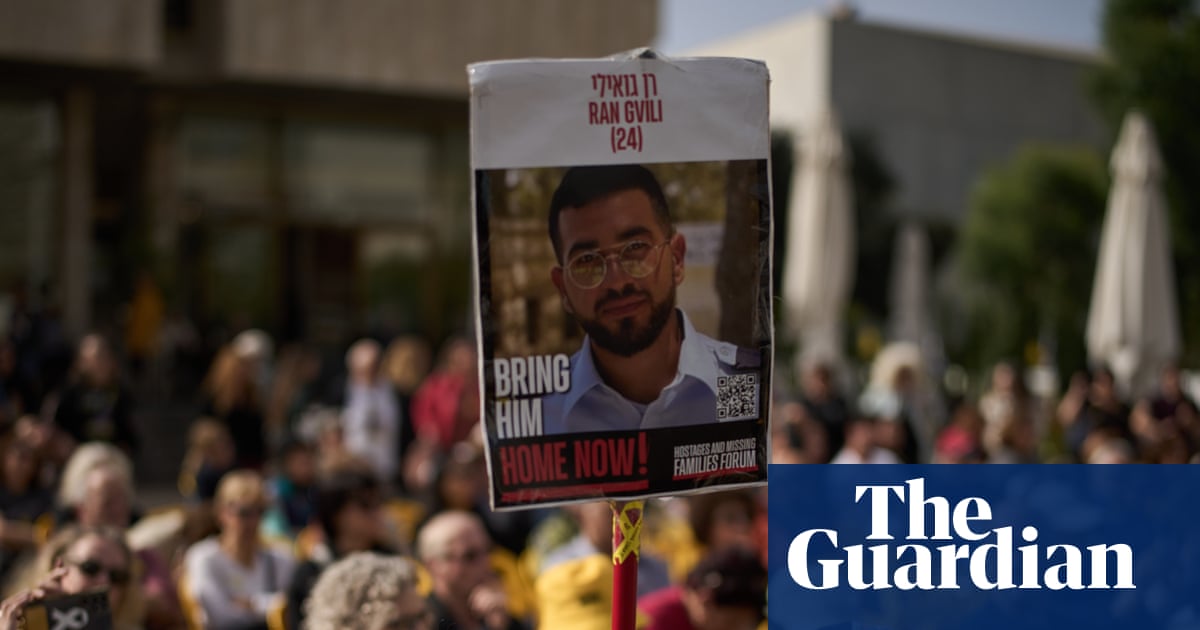
Israel’s demand for the return of the last hostage, Ran Gvili, has been widely seen as the last obstacle to opening the Rafah crossing and beginning the US-brokered ceasefire’s second phase. The border was supposed to have opened during the initial phase of Donald Trump’s plan to end the war last October.
Israel conditioned the reopening on the return of all living hostages held by Palestinian militant factions in Gaza, as well as a “100% effort” by Hamas to locate and return the bodies of all deceased hostages. All have been returned except for the body of Gvili, a police officer.
The Israeli military “is currently conducting a focused operation to exhaust all of the intelligence that has been gathered in the effort to locate and return the fallen hostage, Master Sgt. Ran Gvili, of blessed memory,” Netanyahu’s office said in a statement, adding that once this search operation is “exhausted” Israel will open the Rafah crossing.
On Thursday, Ali Shaath, head of a transitional Palestinian committee backed by the US to temporarily administer Gaza, said the Rafah Crossing would open this week. It is effectively the sole route in or out of Gaza for nearly all of the more than 2 million people who live there.
The Gaza side of the crossing has been under Israeli military control since 2024.
While Israel has carried out search efforts before for Gvili, more detail than usual was released about this one. Israel’s military said it was searching a cemetery in northern Gaza near the “yellow line”, which marks off Israeli-controlled parts of the territory.
Separately, an Israeli military official said Gvili may have been buried in the Shuja’iya-Daraj Tuffah area, and that rabbis and dental experts were on the ground with specialised search teams. The official spoke on condition of anonymity because they were discussing an operation still under way.
Gvili’s family has urged Netanyahu’s government not to enter the ceasefire’s second phase until his remains are returned.
But pressure has been building, and the Trump administration has already declared in recent days that the second phase is under way.
Israel has repeatedly accused Hamas of dragging its feet in the recovery of the final hostage. Hamas in a statement Sunday said it had provided all the information it had about Gvili’s remains, and accused Israel of obstructing efforts to search for them in areas of Gaza under Israeli military control.
Meanwhile, the shuttered headquarters of the UN agency for Palestinian refugees in East Jerusalem was set ablaze overnight, days after Israeli bulldozers demolished parts of the compound.
It was not known who started the fire. Israeli settlers were observed at night looting the main building for furniture, said Roland Friedrich, the agency’s West Bank director. He said holes were cut in the fence.
Israel’s fire department said it sent teams to prevent the blaze from spreading. In May 2024, Unrwa said it was closing its compound after settlers set fires to its fence.
Unrwa’s commissioner-general, Philippe Lazzarini, told the Associated Press the incident was the “latest attack on the UN in the ongoing attempt to dismantle the status of Palestine refugees”.
Unrwa’s mandate is to provide aid and services to 2.5 million Palestinian refugees in Gaza, the Israeli-occupied West Bank and East Jerusalem, as well as 3 million more refugees in Syria, Jordan and Lebanon. But its operations were curtailed last year when Israel’s Knesset passed legislation severing ties and banning it from functioning in what it defines as Israel, including East Jerusalem.
Israel has long railed against the agency, accusing it of being infiltrated by Hamas and alleging that some of its employees were involved in the 2023 attack that triggered Israel’s two-year war in Gaza. Unrwa leaders have said they took swift action against the employees accused of taking part in the attack, and have denied allegations that the agency tolerates or collaborates with Hamas.
First Appeared on
Source link






