


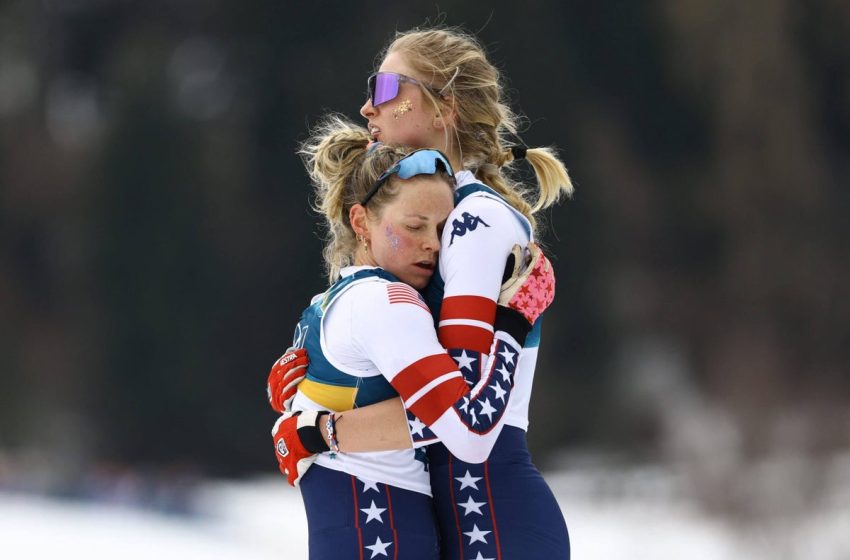
Jessie Diggins, skiing through rib injury, wins a bronze in her final Olympics
TESERO, Italy — The United States’ most decorated cross-country skier of all time took a deep breath, smiled to the camera and pushed off.
Twenty-three minutes, 38.9 seconds later, Jessie Diggins, decked out in her signature glitter and the very same hair tinsel she wore at the 2018 Games, crossed the finish line in third place and held on for a bronze medal in Thursday’s women’s 10-kilometer interval start freestyle, gutting through a rib injury for another podium finish in her final Olympics.
Sweden’s Frida Karlsson was too good to be caught, picking up her second gold of the Games. Like Saturday’s skiathlon, she left her competition behind with a time of 22:49.2, followed by yet another Swedish silver, the second from Ebba Andersson, who trailed by 46.6 seconds. Sweden has now won seven of the nine women’s cross-country skiing medals given out at the Games so far.
Diggins holds her ribs and yells out in pain after getting up following her bronze-medal race on Thursday at the Olympics. (Anne-Christine Poujoulat / AFP via Getty Images)
After the race, Diggins, who finished 49.7 seconds off Karlsson’s time, collapsed to the snow and wheezed in agony for minutes. That’s not unusual for a cross-country race, but Diggins has been dealing with extra pain this week after a fall Saturday in her first event left her with bruised ribs.
“I was just insanely grateful to my entire team for getting me to that start line,” Diggins said after the race, “and then helping me at the finish line. I knew it was probably going to be really tough to breathe and really painful.”
Fans waved homemade signs reading “Digg Digg City” as Diggins entered the final stretch, doubled over, reaching deep. With a staggered start, U.S. fans held their breath as Norway’s Astrid Oeyre Slind pushed Diggins’ time, but Slind crossed the finish about four seconds behind the American for fourth.
Diggins is known for her ability to dig deep, to reach the depths of the so-called “pain cave” and come out better for it. That’s the kind of performance she needed on a day like Thursday, skiing through bruised ribs from a crash that left her in eighth in the skiathlon and 17th in the sprint over the past week.
“It’s been a tough couple nights, I’ve been waking up feeling things like clicking in and out, and it’s just been disconcerting and really pretty painful,” she said. “Two days ago, I was like, I honestly don’t know how I’m going to do this.”
The bronze is Diggins’ fourth medal in four Olympics, winning the country’s first-ever cross-country gold with Kikkan Randall in the team sprint in 2018, and individual silver in the 30-kilometer freestyle and bronze in the sprint in 2022. She plans to retire at the end of this season.
“There’s been, also honestly, some mental pain, knowing this isn’t how it was supposed to go,” Diggins said, emotionally describing a video of support she received from her Nana in Canada, “and it’s really hard when things out of your control are feeling like it’s going sideways, and you just are hurting. But I felt so much love from so many people, and that made a huge difference.”
Diggins often talks about how, for her, it’s not about the medal around her neck, forget the color. She’s driven by chasing a great race, of experiencing the feeling of crossing the finish line on empty, having given everything she had to give. Thursday’s performance required nothing less.
“I just was focusing on doing the best that I could in every moment,” Diggins said. “To be honest, I had no idea what place I was in at the finish, and I really didn’t care. I was just focused on doing the best that I could do.”
Looking around the stadium in Tesero on Thursday, signs of Diggins’ influence on the sport were all around. You saw it in the American fans — and some fellow athletes — wearing glitter on their faces and in their hair, Diggins’ signature style she has sported for years. You saw it in the way she, Karlsson and Andersson waited at the finish line to hug the final competitor, Mexico’s Regina Martinez Lorenzo, and the way Diggins bent down to remove Lorenzo’s skis for her.
And you saw it in Ben Ogden’s silver medal on Tuesday, when he became the first U.S. man to medal in the Olympics in 50 years. Nine years younger than Diggins, her success meant Ogden grew up on a U.S. ski team with podium experience in the present, not just in decades past.
Twelve years after her first Olympic appearance and eight years after her first medal, Diggins waved on the podium, pink mittens in the air, as the crowd chanted her name. No one looked happier.
“I think I’m the most grateful, happiest bronze medalist in the history of the world,” she said.
First Appeared on
Source link






