


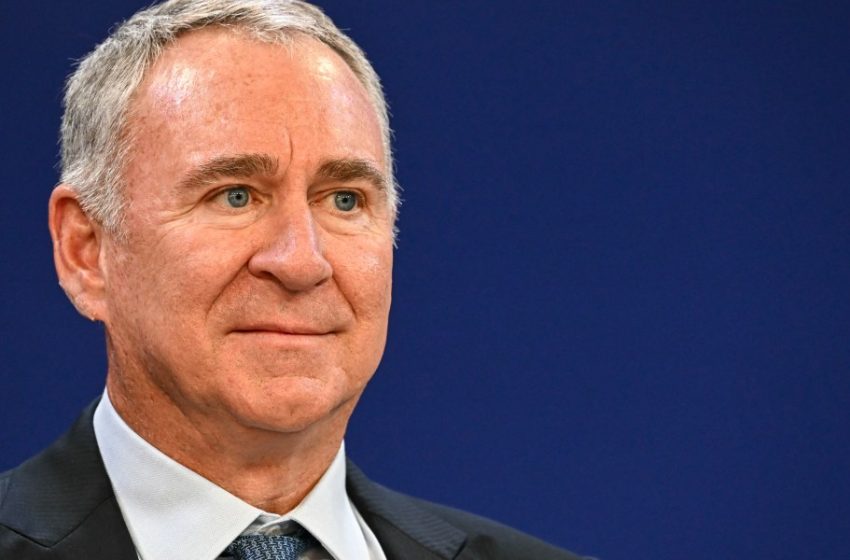
Ken Griffin, the CEO who won’t bend the knee to Trump
Oil declined to $106. The S&P 500 index closed down 0.34% yesterday but futures were up 0.95% this morning after traders digested Fed chair Jerome Powell’s remarks yesterday in which he said it was too soon to make conclusions about the effect of rising oil prices on the economy. The implication is that the Fed may not automatically want to raise interest rates to squeeze out oil-fueled inflation—and stock buyers love low rates. Bonds rose for the same reason. Asian markets largely fell this morning but Europe and the U.K. were up in early trading.
- Stocks just had their worst quarter in four years, the Wall Street Journal says.
- Crypto is safer than gold? Fascinating chart here from Goldman Sachs tracking the decline in various assets since the start of the war through March 27. The best performing asset is…crypto? That feels like a typo but it’s true. Bitcoin prices have stayed flat over the last month. The worst asset was gold, which lost 15% of its value after an unsustainable run-up.
ONE BIG THING
Exclusive: Citadel’s Ken Griffin won’t bend the knee to Trump
The CEO of Citadel ($70 billion in assets under management) is building a 54-story, 1,049-foot Norman Foster–designed tower on the Miami waterfront at a cost of $2.5 billion. It’s a physical symbol of his growing political influence—he has donated almost a quarter of a billion dollars to candidates such as Florida Gov. Ron DeSantis, and Senators Tim Sheehy (R-Mont.) and Dave McCormick (R-Pa.).
But there is one Republican he hasn’t donated to: President Trump. In fact, Griffin (net worth: $50 billion) is a rare business voice that has grown louder and more critical of what he sees as the president’s wrong turns. Though he supports some of the president’s policies, it galls him that so many fellow CEOs are forced to curry favor at the White House. He feels the regime of tariffs “encourages crony capitalism,” he told Fortune’s Shawn Tully. “CEOs have to stomach going to D.C. and sucking up to one administration after another.”
Iran
Trump wants out. Iran says, what talks?
President Trump is willing to end his war against Iran even if U.S. forces cannot reopen the Strait of Hormuz, according to the Wall Street Journal. The price of oil declined to $106 per barrel this morning on the news, down from yesterday’s high of just under $116. The president doesn’t want to exceed his preferred timeline for the conflict to end in six weeks, White House insiders told the paper. (Fortune told you about this six-week thing yesterday.)
On social media, Trump continued his threats against Tehran, while simultaneously promising to end the war soon. “The United States of America is in serious discussions with A NEW, AND MORE REASONABLE, REGIME to end our Military Operations in Iran,” he said on Truth Social yesterday. “Great progress has been made but, if for any reason a deal is not shortly reached, which it probably will be, and if the Hormuz Strait is not immediately ‘Open for Business,’ we will conclude our lovely ‘stay’ in Iran by blowing up and completely obliterating all of their Electric Generating Plants, Oil Wells and Kharg Island (and possibly all desalinization plants!), which we have purposefully not yet ‘touched.’”
- Reality check: Trump has said the war is about to end 12 times so far, Axios notes, and Iranian officials continued to insist they have had no talks with the U.S. for the entire war. Strikes continued across the region today, including an Iranian bombing of a Kuwaiti oil tanker docked in Dubai.
- War Secretary Pete Hegseth denied a report in the Financial Times that his broker at Morgan Stanley contacted BlackRock before the war started about a multimillion-dollar investment in a defense stock fund. The investment was never executed, the FT said.
- Energy ‘vulnerable’ India seeks U.S. help to produce more oil and wean itself off Russia and the Middle East reliance amid geopolitical turmoil, by Fortune’s Jordan Blum.
LAW & ORDER
He jiggled her mouse, then allegedly traded on her emails
The Securities and Exchange Commission charged a 37-year-old Connecticut man with insider trading in the stocks of VMware and Score Media and Gaming after his friend allegedly obtained a “mouse jiggler” to stop his girlfriend’s computer from locking him out when she left the apartment. The woman—not accused of wrongdoing—was an executive assistant at an investment bank responsible for scheduling meetings involving potential deals for the bank’s clients. The friend helped himself to her email and scheduling apps and passed the info to the accused, who allegedly made $530,000 in illicit profits from the info.
CHART OF THE DAY
You cannot fight the Fed
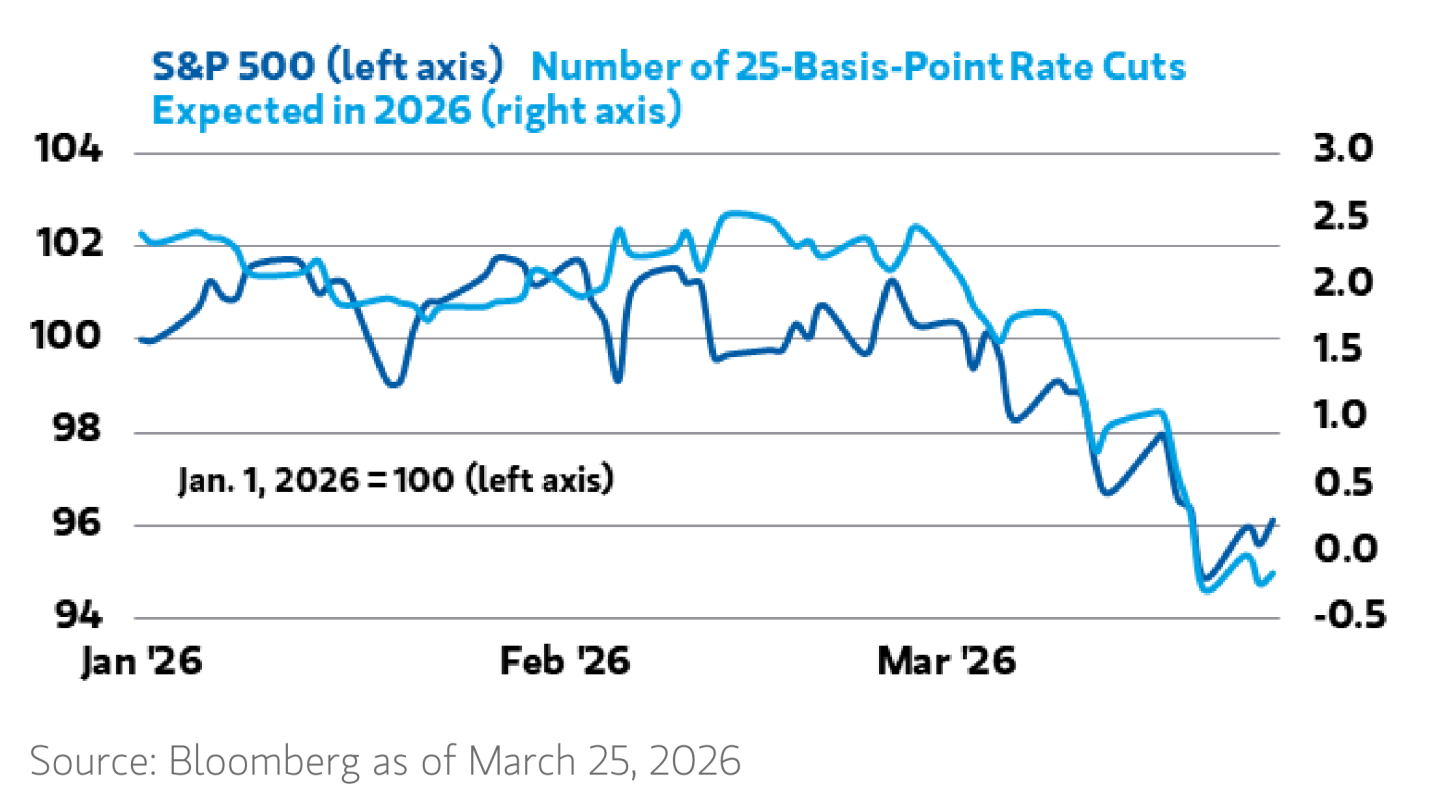
Where interest rate-cut expectations lead, stocks will follow, this chart from Morgan Stanley’s Lisa Shalett shows. Oil is up, inflation is (probably) up, and thus the number of expected future rate cuts has declined, as tracked by CME’s Fed Futures index. The S&P 500 has declined in lockstep. (Morgan Stanley has taken some artistic liberties with the vertical axes on this chart, but you can see why.)
“With markets now forecasting nonzero prospects of actual rate hikes this year, even an end to Mideast hostilities might not be enough to catalyze S&P 500 recovery if high oil prices, and thus inflation threats, are persistent and lengthy enough to keep the Fed on the sideline through year-end,” Shalett says in her most recent note.
- And yet…the bond markets rallied yesterday on the prospect that the Fed may be more afraid of weakening GDP growth than inflation.
NUMBER OF THE DAY
2.7%
The German canary in the coal mine: Germany was the first country in Europe to report a war-fueled jump in inflation, and it was a doozy: In March, prices rose 2.7%, compared to 1.9% the month before. “In Germany, if gasoline prices remained at their current levels until the end of the year, the loss in purchasing power for consumers would already be larger than in 2022,” ING’s Carsten Brzeski said. Energy inflation alone was 7.2%.
MORE FROM FORTUNE
Is the org chart dead in the age of AI? LinkedIn’s chief economic opportunity officer thinks so – Nicholas Gordon
The federal government shed 385,000 employees last year. Now the Trump administration is on a blitz to hire Gen Z workers – Sasha Rogelberg
Wealth taxes on billionaires and $30 minimum wages are part of the same plan, advocate says. ‘They should pay their fair share’ – Catherina Gioino
The Air Canada CEO’s English-only condolence video cost him his job—and it’s a warning for every global CEO to read the room – By Phil Wahba
THE FRONT PAGES TODAY
In the age of AI, the US must rethink the taxation of labour and capital – FT
U.S. gasoline hits $4 per gallon, highest since 2022, as Iran war drives up fuel prices – CNBC
Exclusive: Zelensky says Russia winning from Iran war – Axios
Iran war chokes off helium supply critical for AI – WSJ
Democrats examine Elon Musk’s role in suspension of business disclosure law – NYT
ONE MORE THING
Caltech quantum research team claims it can break standard computer encryption
A team of researchers from quantum computing startup Oratomic and the California Institute of Technology (Caltech) claim they have devised a method that could crack standard computer encryption using “only” 10,000 atomic qubits per one logical qubit. The encryption in standard computing—the kind that safeguards your email from hackers—is so difficult to solve that classical computers using regular chips can never break it. Quantum computers, however, are theoretically powerful enough because they perform vast arrays of calculations in parallel. The problem is that you usually need a large number of “physical” qubits (the quantum version of bits) to correct all the mathematical noise thrown off by one “logical” (or accurate) qubit. Until now, the number of qubits required to crack encryption was thought to be in the millions, and therefore out of reach. Oratomic and Caltech’s claim—made in a press release seen by Fortune—that they can do it with just 10,000 makes it (theoretically) doable.
First Appeared on
Source link






