


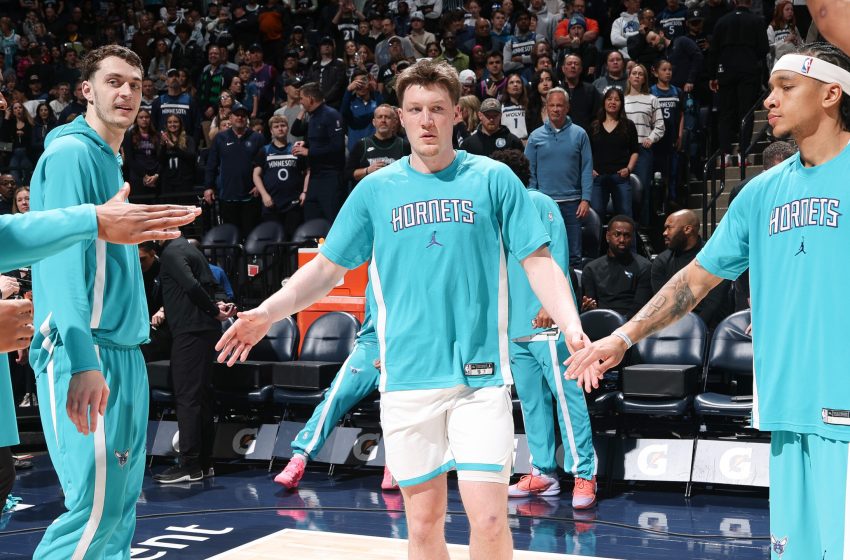
Kia Rookie Ladder: Kon Knueppel finishes in No. 1 spot ahead of Cooper Flagg
A closer look at Kon Knueppel’s rookie season, which includes breaking a few records.
There’s no reason to bury the lead, as we say in the news business.
This is the final Kia Rookie Ladder of 2025-26, which is essentially one voter’s ballot reveal for the NBA’s Rookie of the Year award, plus its first and second All-Rookie teams.
Here are the Top 3 choices:
- Kon Knueppel, Charlotte Hornets
- Cooper Flagg, Dallas Mavericks
- VJ Edgecombe, Philadelphia 76ers
More than most seasons, a ROY tie might feel appropriate for this year’s top two contenders: They’re friends and former collegiate teammates, who have made their impacts this season playing different styles in vastly different situations.
Any tie, though, would need to happen organically because the voting rules prohibit splitting one’s votes. It is possible the votes could break 50-50, and the league does make all voters and their selections publicly available once the award winner is announced.
There have been four ROY ties: Elton Brand and Steve Francis in 1999-00, Grant Hill and Jason Kidd in 1994-95, Geoff Petrie and Dave Cowens in 1970-71, and Mel Hutchins and Bill Tosheff in 1951-52.
No matter who wins the award, the spirited competition between the two recent Duke products was enough to dial up the intensity and interest for this season’s race.
Cooper Flagg becomes the first teenager to score 50+ points in an NBA game by setting a new career-high with 51 vs. the Magic.
Flagg was the marquee name upon arrival, a 6-foot-9 forward from Newport, Maine, who entered as the league’s youngest player but produced like anything but. Because of his age – he didn’t turn 19 until Dec. 21 – he took on not just his fellow rookies but some of the most successful teenagers in NBA history to hit a series of “youngest” and “first” thresholds. Catching or surpassing the likes of Kobe Bryant, LeBron James and Luka Dončić.
Normally, that might have been enough. Flagg had some explosive, spectacular performances as the lone Dallas attraction on many nights. His counting stats, as they’re called, ranked at or near the top of his class: 21.2 points per game (1), 6.6 rpg (3), 4.5 apg (2), 1.2 steals per game (2), and 0.9 blocks per game (2). (All stats through Tuesday, April 7.)
But the ROY race with Knueppel turned into an NBA version of the “tortoise and the hare” fable. Only in this case, Flagg didn’t nap like the overconfident hare – he missed eight consecutive games heading into and out of the All-Star break (left midfoot sprain), 12 overall so far. And Knueppel is no tortoise, just a less hyped yet highly consistent hare who used the stretch to close the gap and edge ahead.
Knueppel’s traditional stats – 18.7 ppg, 5.3 rpg, 3.4 apg, 0.7 spg, 0.2 bpg – all yield to Flagg’s. But the margins aren’t huge. At 2.4 points, 1.3 boards and 1.2 assists, he’s about a low-level, two-way player’s contribution away from Flagg.
Equalize their results for minutes played and the difference – 1.0 point, 0.9 rebound and 1.0 assist per 36 – is even less. When Flagg scores 20 points or more, Dallas is 15-17. When Knueppel does it, Charlotte is 19-17.
Knueppel lands on top due to his availability, 3-point prowess, efficiency and impact on Charlotte’s surprising success.
The 6-foot-6 guard/forward from Milwaukee has missed only one game, helping him shatter the NBA record for 3-pointers by a rookie – 265 with three games left, blowing by Keegan Murray’s 206 in 2022-23 – and lead the league overall. He is making them at 43% rate, averaging 3.4 makes on 7.9 attempts.
His accuracy already is elite. Knueppel ranks second among rookies to his 7-foot teammate and paint presence Ryan Kalkbrenner, in both effective field-goal percentage (60.8%) and true shooting (64%). Flagg, owing to his 29.7% 3-point shooting, ranks 18th (50.4%) and 14th (55.2%), respectively.
Let’s talk about doing more with less: Knueppel’s average time of possession is 2.1 minutes per game, which means he has the ball about 7% of his time on the court. Flagg runs the show far more for Dallas with 4.3 minutes of possession per game, or 12.7% of his time on the floor.
The Mavericks rookie stays in possession for an average of 3.74 seconds per touch, with 3.02 dribbles. Knueppel moves it after 2.48 seconds and 1.98 dribbles. More of his field goals are assisted vs. Flagg’s.
Want to equalize some more? Flagg could stack up eight scoreless games and still be averaging more points than Knueppel. But Knueppel could miss his next 276 shots from the arc and still be hitting a better rate than Flagg.
The biggest reason for choosing Knueppel over Flagg, though, is the impact of each young player’s game on his team.
Some might argue that “winning isn’t important with rookies” since the best ones often end up on bad teams. But that’s the point of the draft, isn’t it? To deliver help to the teams that need it, ASAP? And at a time when NBA coaches dole out All-Star reserve spots based on whether the candidates’ team is winning or not, it’s disingenuous to think winning should factor into ROY competition.
Consider: Of the past 25 Rookie winners, 19 of them helped their teams win more that season than in the prior year. Only three saw their team’s W-L record slide backwards.
Yet heading into Tuesday’s slate of games, Charlotte had more than doubled its victory total from last year, from 19 to 43. Dallas, despite adding the No. 1 pick and potentially a generational talent, has lost 14 more than last season. The Hornets are 43-35 in the games their rookie has played compared to the Mavs’ 21-45 in their guy’s appearances.
Critics can say Knueppel air-dropped into a better situation, but seriously? It’s just as likely his addition at No. 4 overall could have led to a tug o’war over touches and shots with young vets LaMelo Ball, Brandon Miller and Miles Bridges.
Instead, Charlotte has been a well-oiled machine since the calendar flipped to 2026. They are 32-13 since Jan. 2, with the NBA’s best offensive rating from that point (121.2), fourth-best defensive rating (109.5) and top net rating (11.7).
Both Knueppel’s game and his personality have provided glue and gravity for a team discovering its potential. His individual ratings reflect it: 119.4, 112.9 and +6.5, with an overall plus/minus of +326.
Flagg, in a disjointed Dallas season, is at 109.1, 114.8, -5.7 and -275. And his remarkable weekend with a combined 96 points Friday vs. Orlando and Sunday vs. Lakers, with eight days left in the season, swayed Las Vegas oddsmakers but didn’t eclipse Knueppel’s body of work for the Ladder. Or my ballot.
Here are my picks for the first and second units (which are never position-specific, and thus can be listed here in final Ladder order):
All-Rookie First Team
- Kon Knueppel, Charlotte Hornets
- Cooper Flagg, Dallas Mavericks
- VJ Edgecombe, Philadelphia 76ers
- Dylan Harper, San Antonio Spurs
- Maxime Raynaud, Sacramento Kings
All-Rookie Second Team
- Cedric Coward, Memphis Grizzlies
- Ace Bailey, Utah Jazz
- Derik Queen, New Orleans Pelicans
- Jeremiah Fears, New Orleans Pelicans
- Tre Johnson, Washington Wizards
Honorable mentions: Toronto’s Collin Murray-Boyles, Brooklyn’s Egor Dëmin, Dallas’ Ryan Nembhard, Charlotte’s Ryan Kalkbrenner, and Boston’s Hugo González.
* * *
Steve Aschburner has written about the NBA since 1980. You can e-mail him here, find his archive here and follow him on X.
First Appeared on
Source link






