


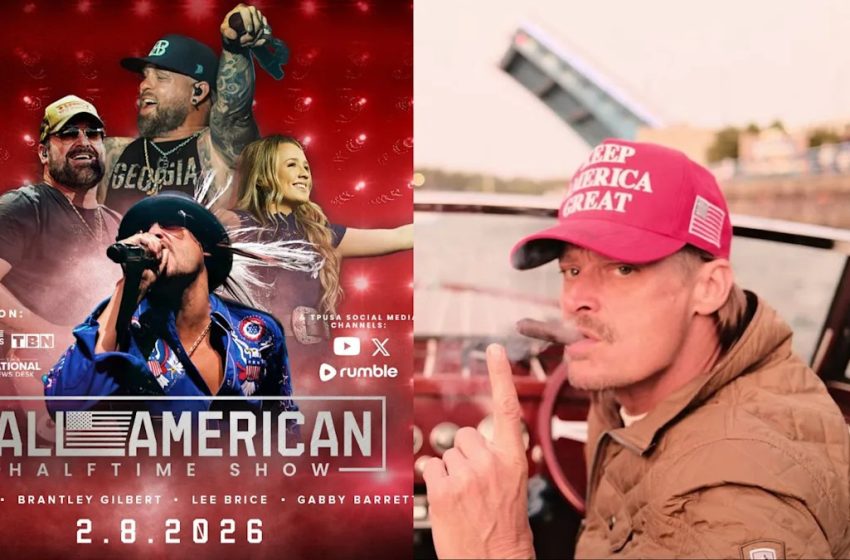
Kid Rock Is Headlining TPUSA’s “Family-Friendly” Halftime Show — But He Sang a Song About Liking Underage Girls
TPUSA wanted a wholesome counter to Bad Bunny. The internet had other ideas.
Turning Point USA thought it had a winning formula: patriotism, country music, and a familiar culture-war face to counter Bad Bunny’s Super Bowl halftime performance. On February 2, the conservative organization announced Kid Rock as the headliner for its “All-American Halftime Show,” billing the event as a celebration of faith, family, and freedom.
It took roughly 24 hours for that framing to unravel.
Not because of a new scandal. Not because of leaked footage. But because people remembered a song Kid Rock recorded years ago — for a children’s movie.
The “family-friendly” pitch didn’t survive first contact with social media
The backlash didn’t start with outrage. It started with curiosity.
Almost immediately after TPUSA’s announcement, social media users began revisiting Kid Rock’s past catalog. What they found wasn’t obscure or disputed. It was Cool, Daddy Cool, a song Kid Rock recorded for the 2001 animated movie Osmosis Jones.
The lyrics were blunt enough to speak for themselves:
“Young ladies, young ladies, I like ’em underage. Some say that’s statutory, but I say it’s mandatory.”
Yes — that song appeared on the soundtrack of a movie marketed to kids.
Screenshots of the lyrics began circulating on X, Reddit, and Instagram. TikToks stitched together Kid Rock’s “family values” branding with the song’s verses. The contradiction was immediate and easy to grasp, which made it spread fast.
This was meant to be the moral alternative — and that’s why it backfired
The irony landed harder because of who Turning Point USA was trying to counter.
Bad Bunny, a Puerto Rican global superstar, is set to headline the official Super Bowl halftime show — a first for a solo Latino artist. When the announcement was made, some conservative commentators criticized the choice, framing the performance as inappropriate, overly sexual, or out of step with “American values.” Kid Rock himself mocked it as “a dance party, wearing a dress and singing in Spanish.”
That framing — we’re the wholesome option — is what made the resurfaced lyrics explode.
Once people connected the dots, the contrast became unavoidable. A Latino artist performing in Spanish was treated as unsuitable for families, while a performer with a documented song joking about liking underage girls was positioned as the family-friendly alternative.
That contradiction quickly became the story.
People weren’t digging deep — they were remembering
Image credit: @kidrock/Instagram
What stood out wasn’t just the content of the song, but how little effort it took to find.
This wasn’t a buried demo or an off-mic quote. Cool, Daddy Cool was officially released. It was part of a studio soundtrack. It’s still listed and searchable. And many people remembered it the moment Kid Rock’s name resurfaced.
That’s why the reaction felt less like a “gotcha” and more like inevitability.
Within days, Snopes stepped in to fact-check the claims and confirmed the lyrics were real, accurately quoted, and taken directly from the song. The verification didn’t reignite the debate — it simply closed the door on denials.
The backlash wasn’t really about one song
Online reactions reflected more than shock or outrage. Many users framed the situation as a familiar pattern: conservative backlash focused on aesthetics — language, fashion, culture — while overlooking substance. Others questioned why a Spanish-language halftime show drew more scrutiny than lyrics explicitly referencing statutory rape.
The humor followed naturally. Memes, quote-tweets, and side-by-side comparisons did the work faster than any formal critique could.
Once a contradiction becomes funny on the internet, it’s almost impossible to reverse.
TPUSA hasn’t changed course — but the framing is already broken
As of now, Kid Rock is still scheduled to headline the “All-American Halftime Show.” TPUSA hasn’t addressed the resurfaced lyrics directly, and there’s no indication the lineup will change.
But the original pitch — a wholesome, values-driven alternative — has already collapsed.
Instead of talking about Bad Bunny’s performance, people are talking about hypocrisy. Instead of debating halftime shows, they’re debating who gets labeled “inappropriate” and why.
And that wasn’t the conversation TPUSA set out to start.
In 2026, branding collapses faster than ever
This episode isn’t really about cancel culture or old lyrics. It’s about how fragile moral posturing has become in the age of screenshots and shared memory.
You can’t position yourself as the arbiter of family values without someone checking your back catalog. You can’t build a movement on “protecting kids” while ignoring the parts of your culture heroes’ past that don’t fit the message.
The internet will notice. Quickly.
And when it does, it won’t need to exaggerate — it’ll just quote you.
First Appeared on
Source link






