We must explain to you how all seds this mistakens idea off denouncing pleasures and praising pain was born and I will give you a completed accounts off the system and expound
Slate’s Washington, 1707 L St. NW, Washington, D.C., 20036.
In normal times, about 20 percent of the world’s oil production passes through the Strait of Hormuz. That flow has been cut off except for Iranian oil and a handful of other vessels the Iranians are allowing through. This disruption has led to a large spike in oil futures prices: [see map at link]
But this price rise has been speculative, driven by the (justified) expectation of future shortages rather than a current lack of oil. In fact, so far deliveries to markets around the world haven’t declined, because shipping oil from the Persian Gulf to major markets takes 4-6 weeks. As a result there was a large quantity of oil already at sea, outside the Strait, when the war began.
However, this grace period is about to end. The oil crisis is about to get physical. The map at the top of this post shows J.P. Morgan’s estimates of when tankers from the Gulf will stop arriving at various destinations. Deliveries to Asian markets will end this week; deliveries to Europe will end next week.
And once the crisis gets physical, there will no longer be room for jawboning the markets. Since the war began there have been several occasions on which Donald Trump has been able to talk prices down by asserting that meaningful negotiations are underway with his invisible friends the Iranian regime, but that won’t work once the oil runs out. So prices will have to rise to whatever level destroys enough demand to match it to the available supply.
emphasis added
Coming to a gas pump Real Soon Now?
For all that Trump was insisting in his April 1, 2026 rant to the nation that America has more oil than anybody — and that now includes oil extorted from Venezuela — prices will rise until to meet demand, and demand will begin to fall as prices rise until a balance is reached. $4.00 a gallon for gas? That’s only the start of how high it can go.
Krugman warns that if Trump tries to seize Kharg Island or bombs it, and if Iran retaliates against the other Gulf state oil facilities, oil at $200 a barrel can’t be dismissed.
BUT WAIT — THERE”S MORE:
It’s not just about gasoline being in short supply. A followup on April 1, 2026 by Krugman warns that higher gasoline prices are only half the story. Krugman looks at rising prices for jet fuel, diesel, fertilizer, and more. It’s not just gas prices that are going to soar:
…Less than half of U.S. consumption of petroleum products was gasoline. And the price of distillate fuel oil — mostly diesel — is up about 70 percent more than the price of gasoline. Add in soaring costs for fertilizer and feedstocks for plastic, and the surge in gas prices, even though it dominates headlines, is well under half of the economic story.
And who pays the higher prices of diesel, jet fuel, fertilizer and plastics? The answer is that these show up initially as costs to producers but will quickly be passed on to consumers in the form of higher prices for shipping and, indirectly, almost everything you buy.
Sure — America has lots of oil, and it’s not all bad news… for some:
Now, America produces a lot of oil, and the domestic oil industry will be earning large windfall profits even as U.S. consumers suffer. But so what? We don’t have any mechanism in place to capture and redistribute those windfall gains, so ordinary U.S. families will bear the full brunt of the global oil shock even though America is a net oil exporter.
There’s an additional, technical but important reason to be even more worried about soaring prices for diesel, jet fuel and industrial materials than about gasoline prices. It involves how the Federal Reserve is likely to react.
The Fed normally bases its decisions about whether to reduce or increase interest rates on “core” inflation — inflation excluding food and energy prices. The reason it does this is that food and energy prices are highly volatile and are usually a poor indicator of what inflation will be over the next few years. So the Fed tries to “look through” inflation fluctuations driven mainly by the prices of groceries and gasoline. For example, it didn’t raise rates in 2011, when there was a temporary uptick in inflation driven entirely by oil prices.
Krugman On Why Trump’s Speech Shows He Is Not a Mensch
Krugman posted a short video about Trump’s speech on April 2, 2026. Among other things, he notes Trump’s threats caused oil prices to start going up and the stock market to react. Where it gets interesting is Krugman saying that Trump lacks the courage to run away.
What really strikes me, and there’s obviously deeper stuff in here, but it is a question of character. It’s funny, I don’t think there’s a sort of, if you like, native English term for the Yiddish — but it’s effectively English now — word mensch. A mensch is literally a person, but it means somebody who takes responsibility for their actions, who accepts defeats as being defeats and tries to move on, who tries to improve, basically just being a mensch.
It’s hard to imagine somebody who’s less of a mensch than Donald Trump, except maybe for some of the members of his cabinet. It’s incredible that they’re so lacking in the basics of character.
The thing about what this means for America’s role in the world is not only that Trump and company are doing great damage, but the whole world is watching. They saw that this guy, and it wasn’t hard to see what kind of a person Trump was, that America elected this guy twice. It appears that the American public has completely lost sight of what it means to be a responsible, serious person…
…We have Trump lecturing the world and saying, why are you cowards? Why don’t you come in and help us in this ill-conceived, disastrous war that we started without checking with you? But the reality is that the world is looking and saying, my God, what is wrong with America? They may still have a lot of bombs — although not as many as we started with — but it’s not a country anybody can trust for anything. And that, even more than the price of oil, is going to be the legacy of this war.
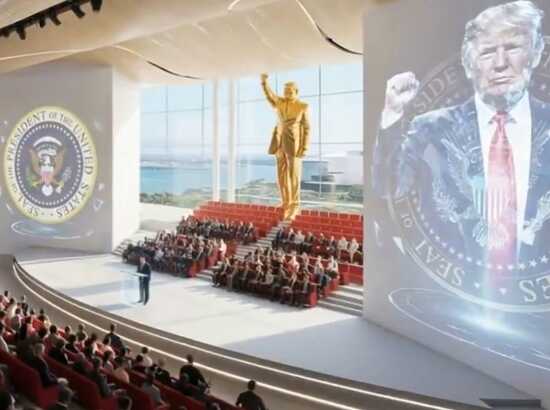
Trump statue striking a victory pose in his proposed presidential library — to be built in Miami
…And here is the rub, he can declare “victory” at any time, indeed he declares victory multiple times every day with ever outlandish claims. However, if he ends the campaign and the Strait of Hormuz is not open, the Iranian theocratic regime in power, and Iran’s nuclear weapons program not being “obliterated”, he understands that his claims will be a farce. Moreover the first of these alone means that the world economy will on the point of implosion with a real chance of a world-wide recession and high oil prices. This stagflation world will be a massive problem for him and the GOP in the run up to the 2026 elections.
He would love to leave but he might not be able to. In war, the enemy gets a vote.
O’Brien remarks that Trump desperately needs to have something he can call a victory — but he can’t as long as Iran can control the Strait of Hormuz. This is where the math referred to above gets interesting.
The US Government is in full military metric mode as it tries to explain why the US is definitely defeating Iran. We hear daily about the thousands of strikes that the US and Israel have launched on Iran, and the declining fire Iran has launched in return. And the metrics are, in their own way, accurate.
The problem is, the numbers do not tell the whole story.
What we see is that Iran does not need to match the US and Israel, indeed it cannot hope to do so. All Iran needs to do is convince the world’s shipping bodies, insurance companies, and markets, that it can successfully launch one bomb—and that alone seems enough for them to fight their war for now.
And last night the Iranians launched one such bomb to put the world on notice.
Iran can block billions of dollars in shipping a day — trillions as it begins add up. A drone like the one that hit the tanker costs about $20,000 — $50,000. That would fund only a few minutes of the war the way the U.S. and Israel have been fighting it. O’Brien estimates 200-300 tankers are waiting to transit the Strait. The math is all in Iran’s favor.
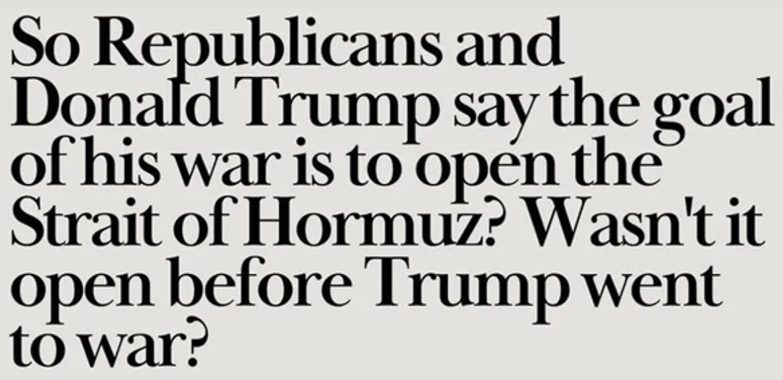
This is why Trump is now trying to insist it’s not the job of the United States to open the Strait of Hormuz “because we don’t need any of their oil.” He’s trying to shift responsibility for reopening the Strait to all the countries that get oil from the region so he can walk away and claim he won. (Never mind that it’s still affecting the U.S. whether or not we get any oil from there. (See Krugman above.)
O’Brien goes on to discuss what the Trump regime considers conditions it can cite to claim victory and dismisses them. He also goes on to speculate on how the Gulf states feel about how the bribes they’ve invested in Trump and family are working out.
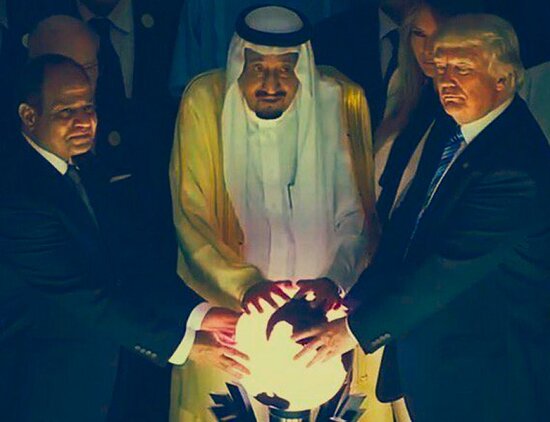
I have no sympathy for these leaders. Many have bribed Trump and showered his family with money. They simply made the great mistake of thinking that this lucre would make him reliable and willing to always serve their interest. They are now learning the opposite. If he does pull out, they are, to put it kindly, screwed.
The Saudis are likely having buyers remorse at this point.
Donald Trump has no friends.
On March 27, 2026, Donald Trump stood at a podium in Miami — at a conference bankrolled by Saudi Arabia’s sovereign wealth fund, in front of 1,500 of the kingdom’s investors and partners — and announced to the room that Mohammed bin Salman was “kissing my ass.”
His exact words: “He didn’t think he would be kissing my ass. He really didn’t. And now he has to be nice to me. You tell him he’d better be nice to me. He’s got to be.”
The President of the United States, on a Saudi-funded stage, publicly declared the Crown Prince of Saudi Arabia a subordinate who must perform deference to retain American protection. A dominance display. Performed for investors. Broadcast on C-SPAN. On Saudi money. There was no walk-back. No clarification. No suggestion that Trump misspoke.
And here’s the kicker:
On the same day, Zelenskyy was in Jeddah signing a comprehensive 10-year military pact with MBS, which REALLY pissed off the Trump Regime. [Trump tweet at link]
While Trump was performing his humiliation routine in Miami, Saudi Arabia’s Ministry of Defence was signing a landmark defence memorandum with Ukraine — an integrated air defence pact covering drone warfare, electronic jamming, anti-aircraft systems, and AI-driven aerial threat detection. Not just a supply deal. A full security architecture partnership. Built by the country that’s been fighting off Iranian-designed drones for five years, it signed with the kingdom currently being bombarded by those exact same drones.
Saudi Arabia has been burning through interceptors since America and Israel started attacking Iran — and the Saudis have been taking real damage. The Saudis may have thought having the U.S. and Israel “mow the lawn” in Iran was a good thing to do, to eliminate Iran’s ability to disrupt the region and threaten their regimes. They may have assumed it would be simple and quick. Oops.
All of a sudden the American defense umbrella doesn’t look like a good deal — and the world community that has relied on the U.S. to keep the oil flowing is looking elsewhere. Meanwhile Trump is throwing insults around as he flails impotently, but the Saudis said nothing. As Blundell figures it:
That silence isn’t weakness. It’s the sound of a decision being made.
The implicit deal behind all those trillion-dollar investment pledges was simple: do not set the Middle East on fire. That deal is broken. The fire is burning. And the kingdom is now building relationships that don’t require tolerating public humiliation from a president who treats allied leaders like tabloid props.
This is the part the foreign policy establishment keeps dancing around, so let’s just say it plainly: Trump is building a wall around the United States. Not a physical wall — an isolation wall. A wall made of alienated allies, broken compacts, and the steady erosion of the credibility that makes American security guarantees worth anything.
Canada. Europe. Now the Gulf. One by one, the relationships that constituted the American-led world order are being stress-tested and found wanting. Not because America is weak — because Washington is making itself untrustworthy. Unpredictable. Humiliating to stand next to in public.
emphasis added
This has strategic implications that reach beyond the relationship between the U.S. and Saudi Arabia.
…And the strategic implications spiral outward fast. Saudi Arabia now views Russia as a co-belligerent — reports that Moscow is sharing targeting intelligence with Iran and supplying advanced drone warfare training have reportedly circulated at the highest levels of Gulf leadership, and the GCC finds them credible. Saudi Arabia has been coordinating with Russia through OPEC+ for years to manage oil markets. If Riyadh decides Russia is actively helping Iran kill Saudis, that relationship ends. And if Saudi Arabia floods the oil market to punish Moscow’s war economy, the pressure on Russia to negotiate in Ukraine increases dramatically. The Ukrainian-Gulf security pact doesn’t just change Middle Eastern defense architecture. It potentially changes the economics of Russia’s war.
Ukraine wins because of their hard-won expertise in modern warfare. They were begging for money — now they are entering into partnerships that will bring money in as they prove more reliable partners than America.
Zelenskyy understood the assignment faster than anyone. While Trump was freezing his military aid and calling him weak in the Oval Office, Zelenskyy was deploying drone specialists to the Gulf, signing decade-long security partnerships with three of the world’s wealthiest monarchies, and positioning Ukraine as a global security exporter. He turned a country that was begging for weapons into a country that other nations are now paying to protect. In five years of war, Ukraine went from supplicant to supplier. And today’s Trump is threatening to stop sending weapons to Ukraine unless allies help open up the Strait of Hormuz because Ukraine just usurped the US as Saudi’s preferred military partner. LOL.
And here we are.
Blundell Bonus — see his dissection of Trump’s speech, and Trump’s threats earlier in the day against Medicare, Medicaid, and childcare.
As always, please read the rest of the material at the links from Krugman, O’Brien, and Blundell — and please consider supporting them if you aren’t already.
Thank you for your attention to this matter. GOPus delendus est.