


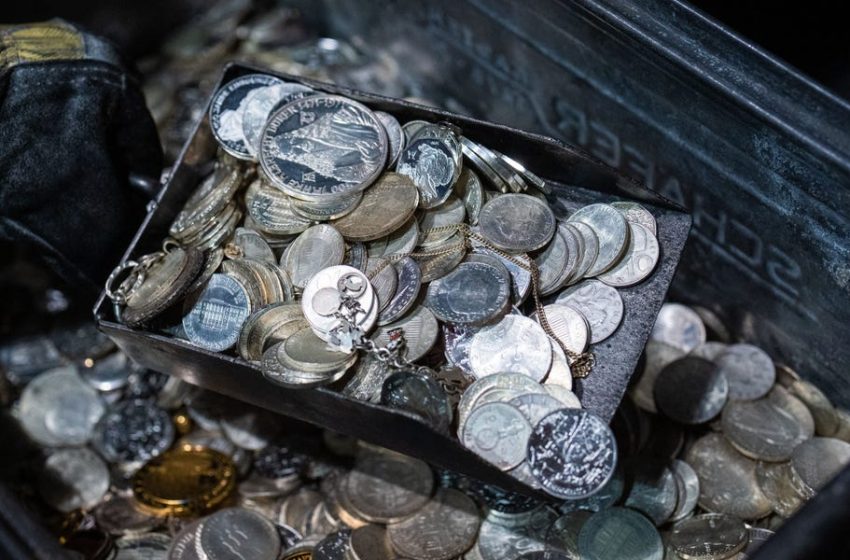
Local Coin Shops Are Swimming in Silver and Gold With Refineries Full
If January was a party in the precious metals market, February is the hangover.
The per-ounce price of gold topped $5,300 and silver reached nearly $120 at the end of January before tumbling sharply. The stretch of record gains and losses has since stabilized in the early days of February.
“These price moves have done a lot of damage all across the line,” HSBC precious metals analyst James Steel told Business Insider.
One type of business bearing the brunt of volatility is local coin shops, where people often trade in gold and silver. High prices have led to a huge influx of people selling, but some shops tell Business Insider they’re running out of their usual places to offload excess metals.
As the market was in its tailspin, Tim Heuer said the shop he manages, University Coin & Jewelry in Madison, Wisconsin, was still doing deals.

Heuer said a customer came in to sell some silver when the spot price was $98 an ounce and falling: “By the time I wrote his check, silver was already down $3.50 from the time he walked in the door.”
The recent volatility is putting those businesses in an uncomfortable position, beyond quickly changing spot prices that erode profit margins.
Local coin shops play an essential role in the circulation of physical gold and silver by providing a reliable way for individuals to sell their bars, coins, or scrap metal.
If someone bought a gold bar last year from Costco and wants to turn it back into cash, a local coin shop is one of the first places they might go.
And while these shops do turn around and sell some of what they buy, most of the metal is sold to refineries to be melted and minted into new bars or coins.
Precious metals refineries are experiencing major backlogs
That flow has been interrupted in recent months as the run in gold and silver prices has encouraged more people to trade in their metals, leading to a backlog of raw materials at refineries.
Jarret Niesse, president of Precious Metal Refining Services in Chicago, said his company stopped buying scrap silver back in October, when the price crossed $50 per ounce, sparking a frenzy of people trading in old silverware, platters, and other tchotchkes that had been gathering dust.
And the market has only gotten wilder since then.
“This entire crazy silver move that has happened, we have been sitting on the sidelines,” he said.
Refineries like Niesse’s are one step in the process. Much of the product they melt down gets further refined by other mints and exported to Asian markets, where demand for bars and coins is higher. With so much gold and silver to process, those refineries have also stopped buying, thereby cutting into the cash flow of local coin shops.
“When the guys at the top say they’re going to open the doors and start accepting more material, the guys in the middle, like me and my competitors, will send in,” Neisse said.
A balance sheet balancing act
Due to their role in their local markets, reputable coin shops can’t simply stop buying altogether. They’re finding ways to adjust, but it’s a tricky balance.
“If you do this wrong, you run out of capital really fast,” said Tom Spoerl, manager at Rick’s Olde Gold, also in Madison.
It’s not the kind of business where tapping debt or credit from a bank makes real sense, either.
“You don’t want to hold metal and finance it for any length of time,” HSBC’s Steel said.
Both Spoerl and Heuer’s shops have recently started instituting limits on how much they’ll buy from a single person in a day, a move that they say allows them to serve more customers and get people the cash they might need for expenses like annual tax payments or medical bills.
It’s anyone’s guess what prices will do in the coming days and weeks, but Spoerl and Heuer said they’ll keep trying to thread the needle between serving customers and not overstretching their balance sheets.
“For us to stop buying now would be a little odd,” Spoerl said. “This is something that we haven’t seen before, so it’s just kind of going with the flow and figuring out what to do in the moment.”
Heuer, meanwhile, is thinking long-term: Gold is still up 76% and silver is up 147% from a year ago.
“If you look at a one-year, short-term investment, you still almost tripled your money,” he said of silver. ” The cost average ratio is still splendid.”
First Appeared on
Source link






