


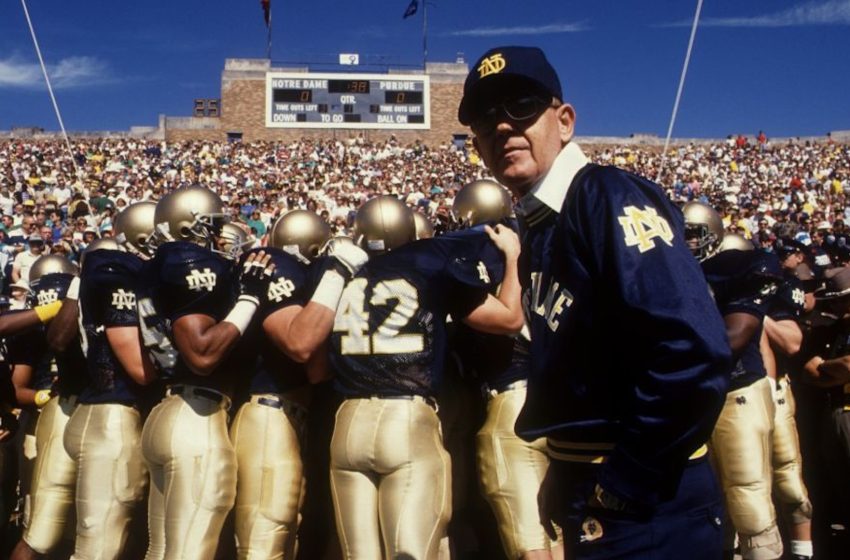
Lou Holtz Lisped Like A Champion
When old guys who played for Lou Holtz talk about him, from my experience, they don’t bring up schemes or X’s and O’s. They bring up speeches from the crusty but legendary coach, TV pundit, and rah-rah guy who died Wednesday at 89 years old. No, not loathsome political speeches. Football speeches.
“That guy could talk,” said Bruce Hanson. He played for Holtz at William & Mary from 1969 through 1971, his first three seasons as a college head college coach. Hanson remembers that Holtz, even as a 32-year-old rookie who’d previously held only assistant jobs at W&M, Iowa, Connecticut, South Carolina and Ohio State, was already as great a motivator as the game had ever seen.
“When he was done with his pregame speech, you woulda wanted to go beat the Chicago Bears,” Hanson said.
No Holtz team ever got to play the Chicago Bears. But he fared poorly against almost all the other NFL teams he did face in 1976, when Holtz went 3-10 with the New York Jets in his not-quite-one-and-done run as an NFL head coach. Holtz’s methods and gridiron know-how didn’t work so well with grownups. It didn’t help having Joe Namath as his starting quarterback so far past his prime; Namath had a career-worst 39.9 passer rating that season, and was banished from New York. Holtz was already gone by then, having left the Jets and gone back to college when his team still had one game left to play.
Holtz quickly got back to proving that his routine sure worked with kids. Warren Winston, Hanson’s roommate at W&M and a defensive back for all three of Holtz’s years at the school, is among the former players who’ll tell you that more than play designs took Holtz to the top of the coaching heap. Winston recalled an early interaction with Holtz to make that point. His position coach at W&M was future San Diego Chargers head coach Bobby Ross. Winston remembers one day at the beginning of summer camp where Ross, only recently elevated to defensive coordinator, began installing a new defensive scheme. While Ross explained each player’s role, Winston wasn’t getting it. His confusion became obvious even to Holtz, who back then served as his own offensive coordinator, but watched the defense from the top row of field-side bleachers and only got involved when things were going bad.
“I must have just had a mysterious look on my face,” Winston said, “and Holtz sees it and comes down from the bleachers to talk to me. And I tell him it sounded like Coach Ross wants me to cover the tight end, who could be going across the middle of the field, and also the wide receiver, who could be running a post pattern, and also he wants me to cover the running back out in the flats. ‘That’s three receivers,’ I said. And Holtz looks at me and said, ‘We want you to cover the guy that the ball is thrown to!’ And that was it! ‘If that’s what you want, Coach!’ I said. I think Coach Holtz was more of an offensive genius than a defensive genius.”
But he really was a genius, Winston insists.
“And he’s a hero to me,” Winston said.
Winston was the first black scholarship athlete in the history of W&M, which was founded in Williamsburg, Va., in 1693. He’d originally been recruited there by future Buffalo Bills head coach Marv Levy, who then left for the NFL, making way for Holtz. Winston was the only black guy in the recruiting class his first year on varsity. Holtz’s future lousy politics notwithstanding, Winston remembers the coach speeding up the school’s emergence from the dark ages in the late 1960s by emphasizing the recruitment of black players. During his introductory address to W&M players, Holtz interrupted a talk about how the team rules would be applied strictly and to everybody on the roster to spend a couple minutes making sure all players knew of the special place that Winston, who was the only black guy in the room, held in the history of the program and college. Then he never brought it up again. “I appreciated that,” Winston said. And he remembers getting an emotional call from his father back in Richmond, who said he wanted to go over a hand-written letter that had just arrived in the mail that Holtz had authored.
“I’m going, ‘What did I do wrong now?'” Winston said, getting teary himself at the memory, “and he starts to read the letter, talking about how important I was to the team, what a great guy I was, and how he knew I’d grow into a great citizen. All the things a parent would want to hear about their son, just laid on thick. Coach didn’t tell me he was writing that letter. That was special. I love the guy.”
In Holtz’s second year at historically academically rich but football poor W&M, he took the team to a Southern Conference title and appearance in the 1970 Tangerine Bowl. They lost, 40-12, to Toledo. Holtz got hired a year later by N.C. State of the relatively big league Atlantic Coast Conference.
Danny Meier, a defensive lineman at N.C. State throughout Holtz’s years in Raleigh, also loved the guy.
“Playing for him was like growing up in a religious family,” Meier said. “You heard the same message over time, until it finally took hold and you were a confirmed believer that you could be successful regardless of the circumstances. And beat anyone.”
Proof’s in the pudding: Meier was a member of the Wolfpack team under Holtz that brought N.C. State an ACC Championship in 1973, and the teams that beat Penn State in both 1974 and 1975. Those are the only two wins over the Nittany Lions in school history.
Then came the Jets debacle. Holtz slinked back to the college game, and soon enough was taking Arkansas and Minnesota to great heights before landing the dream job in his profession: head coach of Notre Dame.
Back to me: I saw Holtz speak at an insurance convention in Atlanta that I covered around 1990. On the whole, the gathering was at least as boring in the flesh as it seems on paper. Then Holtz got up and gave the keynote address. He was at the peak of his commercial powers at the time, not far removed from leading the Fighting Irish to a perfect 12-0 season and a national championship; a buddy of mine in the public speaking business told me Holtz was getting $50,000 a speech. When he first started talking, with his heavy West Virginia drawl and a lisp so heavy that when he talked about being born with a “silver spoon” in his mouth or how the “lessons my parents taught me were priceless,” it almost seemed affected. I was wondering what the fuss was about. But pretty soon I was mesmerized by all the motivational musings, and hell yeah, I got why young men would be willing to run through a wall for the guy. Hell, I woulda run through a wall for the guy. (This Holtz speech, from about 20 years after the stunning auto convention address, has all the cornpone gags and goshdarnit charm I remember, though the decades have removed a good bit of oomph. I’d only run through a real thin wall for that guy.)
Long before I saw him in the flesh, Holtz already played a very indirect but weirdly profound role in my life. National celebrity came his way in his first year at Arkansas, when his Razorbacks earned a berth to the 1978 Orange Bowl against heavily favored Oklahoma, with Coach Barry Switzer and future Heisman winner Billy Sims. In the run-up to the game, Holtz suspended several players, including two key offensive starters, following what was originally called a “violation of team rules.” It later came out that they’d been accused of assaulting another student in a dorm. Before news of the seriousness of the allegations had been made public, some players threatened to boycott the game if he didn’t reinstate their teammates. Holtz let the punishment stand anyway. Then his allegedly diminished Razorbacks shocked the world by crushing the prohibitively favored Sooners, 31-6. No charges were filed against the accused players and they were invited back to the team for the next season.
An adolescent version of the same story hit my own high school team the following fall. Several of my far more talented but less sneaky Falls Church Jaguars teammates, including our best receivers, a senior running back, and a future All-American kicker, got caught drinking after an appreciation dinner at an assistant coach’s house in the days before our season-ending game against our crosstown rival. Unluckily for them, our head coach, Wally Ake, was yet another Holtz disciple in the high school ranks, having been a star linebacker on his first William & Mary teams. (My junior varsity coach, Bob Herb, also played for Holtz at W&M. And Meier and Hanson both coached high school football in Northern Virginia back then, too. Yeah, Holtz’s local coaching tree was absurd.) And Coach Ake, taking a page out of his mentor’s handbook, suspended everybody who got busted, stars and all.
Before we took the field for our final game, he talked to the team about how life is bigger than one football game, and how rules are rules and have to be obeyed, and punishments applied equally to stars and backbenchers. If it means we play shorthanded, he said, then we’ll play shorthanded, and we’ll do our best. It was a righteous speech.
So we ran out of the locker room as fired up as we’d been all year. And we lost, 16-6. I had to look up the score of that game just now, but I have very clear thoughts about what went on that week, the lessons of which I’ve mulled through the decades whenever I think about Lou Holtz, and did so again when I heard he’d died. For all the giggling the beery angle of those memories brings, I still think Coach Ake, who left our school a couple months later to join Holtz’s staff at Arkansas (and start a fine college coaching career of his own), did right by the team. If only we’d been playing the Chicago Bears.
First Appeared on
Source link






