


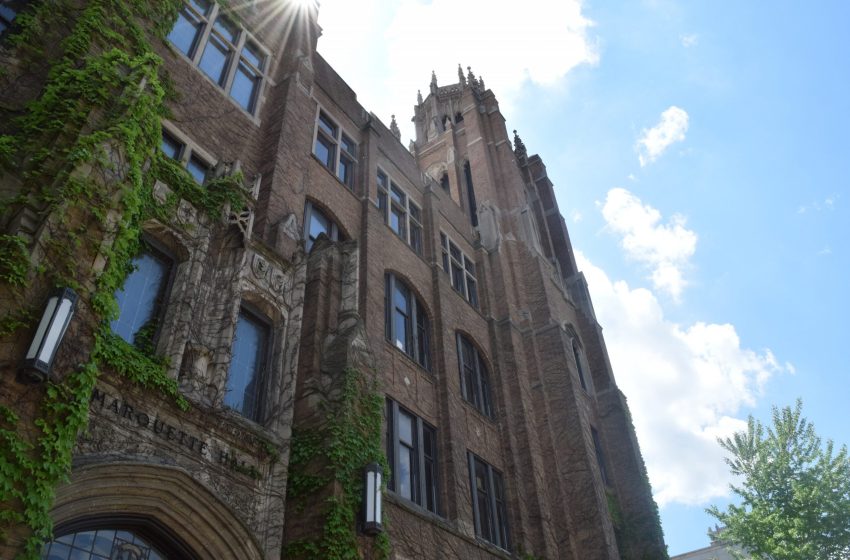
Marquette University accused of pushing lower-income families toward risky loans
Marquette University allegedly offers wealthier families scholarships while pushing lower-income families into high-interest student loans.
Marquette was one of 41 colleges named in a report by the progressive think tank New America, which alleges the schools encourage low-income families to take out Parent PLUS loans while at the same time offer financial aid to upper-income students.
“Each year, tens of thousands of low- and lower-middle-income families are encouraged to borrow hefty Parent PLUS loans they likely won’t be able to repay to send their children to selective public and private research universities,” says the report released Feb. 12.
News with a little more humanity
WPR’s “Wisconsin Today” newsletter keeps you connected to the state you love without feeling overwhelmed. No paywall. No agenda. No corporate filter.
The report found 34 percent of Marquette Pell Grant recipients who graduated or left the university in 2020 or 2021 also borrowed money through Parent PLUS loans. Those families owed an average of $30,089 on those loans.
At the same time, Marquette gave out an average of $22,000 in grants that are not based on financial need.
Pell Grants go to low-income students and do not need to be paid back. Parent PLUS loans are considered risky because borrowers are allowed to take out the full cost of tuition, and because interest rates on the loans are often high.
“The cash-strapped families often have little choice but to take out these risky loans because these schools spend the bulk of their financial aid trying to lure affluent students to campuses to help them raise their rank and revenue,” the report found.
Undergraduate tuition at Marquette University is currently $53,890. Housing, food and fees bring the total annual cost to between $69,470 and $73,880, according to the university.
According to Marquette’s website, 99 percent of undergraduate students received “some form of financial aid last year, and we distributed more than $170 million in scholarships.”
When contacted by WPR last week, a Marquette University spokesperson said no one was available for an interview on the report. In a statement to WPR, Marquette said the PLUS loan option is presented separately on a financial aid offer to help ensure families understand their choices.
“No family should take on debt they cannot repay,” the statement says. “We counsel families on pursuing other options before borrowing to allow due diligence on their part.”
Marquette pointed to a Price-to-Earnings Premium report that shows the median Marquette graduate recoups their college cost in premium earnings in under three years — and for low-income students, this period is under two years.
“Part of our commitment to affordability is a strategy to reduce net cost for low- and middle-income families, and we are working continuously with our generous benefactors to increase scholarship funds so we can award even more scholarships to those in need,” the statement says.
Marquette is the only Wisconsin school listed in the New America report.
College rankings are driving financial aid leveraging
Author Stephen Burd looked through public records of more than 300 selective colleges. He found colleges use a practice called “financial aid leveraging,” in which they work with consultants to determine the price point they can enroll different groups of students without spending a dollar more than necessary.
“We went from a system where the point of student aid was to help students who could not afford to go to college, to one in which they’re trying to figure out exactly what price to bring you in,” Burd said. “Almost like an airline does when they’re selling their seats.”
Burd said there’s intense competition among colleges to get more revenue and rise in college rankings.
“They use their financial aid to try to attract students who have higher test scores, or because a family is wealthy,” Burd said. “Because maybe those families will make donations.”
Peter Granville, a fellow at the Century Foundation who studies college affordability, said the study sheds light on the important issue of how families pay for college and how colleges decide who gets financial help.
“This report argues that Marquette could have given families more grant aid, which would reduce their need for Parent PLUS loans. But the school didn’t,” Granville said. “One-third of Marquette Parent PLUS recipients also received the Pell Grant, which means their incomes are lower than average.”
Starting in July, borrowers will no longer be able to be enrolled in income-based student loan plans.
“If a parent borrows a loan that they can’t repay, they’re sort of stuck,” Granville said. “Parent PLUS loans are a tempting source of revenue for colleges, because parents can borrow so much (with) them so easily without necessarily understanding the true cost.”
Burd said many of the colleges on his list are wealthy. As of mid-2025, Marquette University’s endowment was valued at approximately $1.13 billion.
When the Wall Street Journal did a similar study to Burd’s on Baylor University in 2021, it resulted in the university creating a tuition-free program for families making $50,000 or less.
The New America study looked at both private and public universities. The University of Alabama at Birmingham topped the list with 64 percent of low-income students also being PLUS loan borrowers.
Burd commended Wisconsin for not having any public universities on the list.
Wisconsin offers several “tuition promise” programs to cover the tuition and fees for low-to-moderate-income residents. These include programs across the Universities of Wisconsin System and at private schools including Lakeland University, Ripon College and Carthage College.
“Wisconsin, relative to the rest of the country, is more affordable, and they still have put a premium on helping financially needy students and families,” Burd said.
Wisconsin Public Radio, © Copyright 2026, Board of Regents of the University of Wisconsin System and Wisconsin Educational Communications Board.
First Appeared on
Source link






