



Men’s health impacts pregnancy and child outcomes, and should be included in guidelines, experts say
Experts say putting a spotlight on sperm — and men’s pre-conception health more broadly — can improve pregnancy outcomes and the health of future children.
But it’s not just about conception — it’s also about the ongoing impact men and partners can have on children after they’re born.
In a review published today in The Lancet, a group of international researchers looked at the role of men and partners in terms of the health of future generations.
The review considered clinical factors such as sperm health, as well as behavioural factors, including the level of support given to pregnant people before and after birth.
Lead author Jonathan Huang, an epidemiologist at the University of Hawai’i, said his team believed there should be more awareness about the role of men and partners, arguing they should be included in future pre-conception health and support guidelines.
“The benefit is that we are also setting up the systems for healthier relationships and parenting,” Dr Huang said.
Tim Moss, developmental physiologist and content manager with national men’s organisation Healthy Male, said the Australian health system “does not cater well for fathers”.
“We’ve focused — and rightly so — for a long time on the health of women in reproduction,” he said.
“It’s not that long ago it was very common for women to die in childbirth.
“What we have not had our eye on, is how the health of the father impacts pregnancy and child health.”
Men and partners are important contributors to the health of future generations. (Getty image: Thanasis Zovoilis)
Dr Moss, who did not contribute to the Lancet review, also noted that not all partners identify as male, and we should look at supporting these partners too.
“While we aren’t talking about men, we’re also not talking about people of diverse genders, and we are letting fall through the cracks a whole bunch of people who don’t fit the mould.”
So how exactly can the health of a man or partner help improve pregnancy outcomes?
Spotlight on sperm health
Studies highlighted in the Lancet review suggested factors such as smoking, obesity, high blood pressure, high consumption of alcohol and age might alter sperm, which in turn could influence pregnancy outcomes and the health of future children.
There needed to be a greater understanding of how a man’s lifestyle choices and overall health influenced his fertility, the authors said.
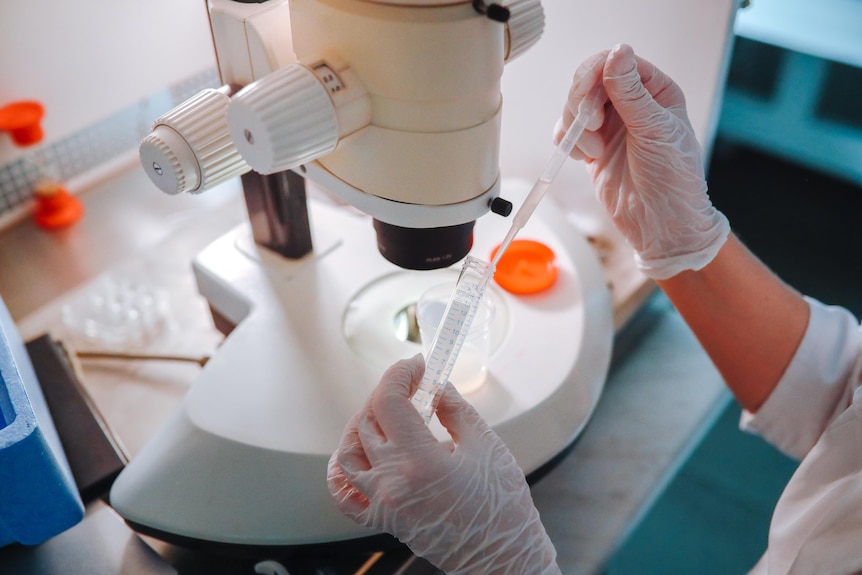
The review considered clinical factors such as sperm health. (Getty image: Natalia Lebedinskaia)
Dr Moss said although more research was needed, there were ample studies that showed chronic diseases and lifestyle factors impacted a man’s ability to make sperm.
“A man’s health affects his whole body, including his testes, his testes are making the sperm,” he said.
“If the man’s health is not optimal, then his sperm production will not be optimal.“
Men who were keen to add to their families should be motivated to make “the healthiest possible sperm”, said Rob McLachlan, director of andrology services at the Hudson Institute of Medical Research and medical director of Healthy Male.
Professor McLachlan, who did not contribute to the study, advises clients wanting to maximise their chance of conception to exercise, maintain a healthy weight, avoid alcohol and quit smoking and vaping.
“You do everything, because why wouldn’t you, if there was a possibility it might help?” he said.
According to the Lancet review, global sperm counts halved between 1973 and 2018, but Professor McLachlan said this figure was hard to quantify.
He takes a precautionary approach in his work as a clinician and reproductive scientist.
“It seems to be possible that sperm quality is declining [and] if it might be true, then you treat it as true and you act accordingly,” he said.
‘Wellbeing’ of pregnant people affected by partner’s behaviour
Dr Huang and his team are calling for more awareness about the role of partners, arguing they should be included in future pre-conception health and support guidelines.
Researchers found practical help, such as attending prenatal appointments, and emotional support from partners could be linked to healthier pregnancies.

Researchers say pregnant people benefit from practical support, including partners who attend medical appointments. (Getty image: Svetlana Repnitskaya)
Dr Moss pointed out that including men’s health within a broader reproductive context benefited the entire family unit.
“These aren’t zero-sum games either, we don’t lose from men’s health when we improve the health of women, and we’re not going to lose from women’s health if we can improve the health of men,” he said.
Globally, families want the same things
A study tracking changes in health before pregnancy was also published in the Lancet today.
This second study was led by Danielle Schoenaker, a University of Southampton senior research fellow who also contributed to the men’s pre-conception health study.
Dr Schoenaker’s team asked more than 5,000 people from low-, middle- and high-income countries around the world — including Australia — about what matters to them when planning and preparing for pregnancy.
She said researchers found respondents from across the world had very similar priorities, with people citing physical health, mental health, physical stability and partner support as most important.
“One of the surprising things was that these [priorities] were very consistent across all the countries,” she said.
“We thought perhaps in low- or middle- income countries, things might be different to high-income countries.”
Dr Schoenaker’s study identified indicators — such as medication and environmental exposures — that can be used internationally to monitor the health of people of reproductive age.
She said these indicators could then be used to track where support was missing and advocate for policy and guideline change.
First Appeared on
Source link






