


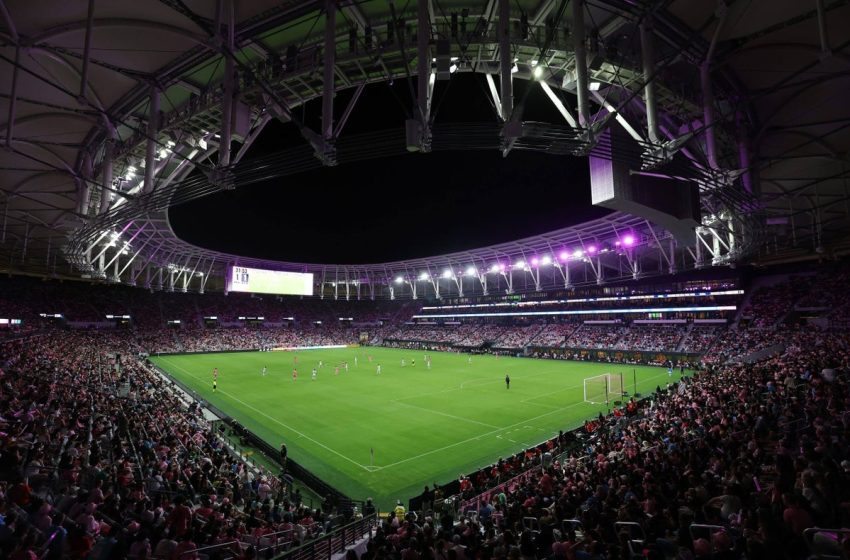
Messi’s Inter Miami opens new stadium that’s befitting of MLS’s glitziest club
MIAMI — In many ways, Nu Stadium, Inter Miami’s sparkling, canopied new home arena, mirrors the club it will be housing.
The road to completion has been filled with promises, detours and red tape. Even now, it’s still not completely a finished product, to the point that after a social media onslaught boasting the opening of the facility, Saturday’s inaugural event came perilously close to needing to take place under restrictive conditions. The rush to open has included another round of political conflict.
Despite all that, there’s an inevitability that Nu Stadium will be spectacular and grow in stature. It has taken time and come at cost, but oozes potential and could well become a standard-bearer for MLS and American soccer. That is, in essence, the Inter Miami story.
Following a mad dash to meet its scheduled unveiling and with plenty more work in and around the stadium still to be done, the $350 million crown jewel of the grand Miami Freedom Park renovation opened its doors Saturday night, filling nearly all of the 26,700 seats, some of which were installed as late as Thursday and Friday of this week. The Leo Messi stand was complete with pink- and black-clad fans, the first to experience the rarity of sitting in a section named after an active player they were watching.
In the end, Saturday’s 2-2 draw against Austin FC on a pristine Bermudagrass surface will go down as one of 34 regular season results in Inter Miami’s 2026 season. It’s a season that has already delivered massive disappointment in the form of a premature Concacaf Champions Cup exit. It could yet end in triumph: no club has repeated as MLS Cup champion since 2012, and even though there are clear flaws, you’d still like Miami’s chances of rounding into shape come November and December and being among the best. No matter what transpires on the field, though, the cementing of the club’s foundation in Miami proper should be the first line of its year in review.
Before the uneven performance, manager Javier Mascherano claimed it was a “great day for the club … a dream day,” while owners David Beckham and Jorge Mas marked the occasion by delivering on-field addresses to the fans, thanking them and celebrating the overall achievement.
Beckham, in particular, highlighted the long road from exercising his ownership option to Saturday’s opening day, with MLS commissioner Don Garber praising the former English international for doing the grunt work and going to lightly attended city council meetings to pitch the stadium.
Inter Miami owners open Nu Stadium with a pregame ribbon-cutting ceremony (Megan Briggs / Getty Images)
Saturday’s occasion was a truly Miami affair, from a lengthy pregame line to enter the stadium’s VIP area, to Marc Anthony’s rendition of the national anthem (a nice bookend for the renowned recording artist, who carried MLS Cup on to the Chase Stadium field last December), to the pink glow sticks that flashed around the stadium at the start of a pregame hype video and all throughout the match. Pink fireworks and smoke accompanied the pregame introductions. Even Brazilian legend Ronaldo, fresh off buying an $8 million Miami penthouse, was a guest of honor.
As for the stadium itself, it is not complete. There are whole sections of the lower bowels that are not finished. Stadium stairwells haven’t been fully swept of debris. Not all concession sites were fully operational and the immediate surroundings are tantamount to a construction site. That didn’t stop Garber from calling the venue “breathtaking” in comments before the game, while there’s general acknowledgment that it will take more time before the stadium is fully optimized.
“Obviously, the second game will be better, and the third and fourth as you grow into any new facility, the experiences will get smoother and better, but I’m very, very happy with what’s happened in the time period we’ve had to complete the stadium,” Mas told The Miami Herald this week, during a season-ticket holder and media walkthrough of the venue.
Todo listo ✨ pic.twitter.com/2VcNbj3aDm
— Inter Miami CF (@InterMiamiCF) April 4, 2026
With so much fanfare, it was easy to overlook that there was actually a game to be played, but a reminder came six minutes after the opening whistle, as Austin FC’s Guilherme Biro scored off a Facundo Torres corner kick before Miami could even threaten once in the Austin half. Messi rectified that four minutes later, with a header in front of La Familia, the raucous supporters’ section, and all was temporarily right again before Jayden Nelson and Luis Suárez exchanged second-half goals to account for the scoring.
“I knew the fans would be here and show out, and the atmosphere was definitely rocking,” said Miami goalkeeper Dayne St. Clair, who pointed out that the first game with his previous team was also a stadium opener (Minnesota United’s Allianz Field). “The atmosphere and vibes in the stadium, we felt it on the field.”
While the fan culture was evident throughout, so was Messi’s presence, just as it is in the stadium’s two-story team store and on signage and imagery all around the arena.
It’s most apparent at The Messi Stand, which encompasses sections 117-121 in the lower bowl and 217-223 in the upper bowl on the stadium’s east side. It’s no different from a seating perspective to any other section, save for the supporters’ standing area behind one of the goals. There may be some who may think it’s odd or even in poor form to name a stadium feature after an active player like Miami has done for Messi (for what it’s worth, Newell’s Old Boys, his youth club, already named a stand for him last year, and he never even played for the senior team). Perhaps there’d be more heft behind that argument if he were a fleeting presence for the club, a star who came, conquered and left.
But Messi, beyond delivering on the field in the form of multiple trophies and unprecedented back-to-back MVP showings, renewed his contract through 2028 and will be attached to this club long after his playing days are done, with an ownership stake due to be activated upon his retirement. He has brought global appeal to the club in the form of shirt sales and eyeballs. And if there were ever anyone to be the exception to the rule in matters of the sport and stadium procedure, it would be him.
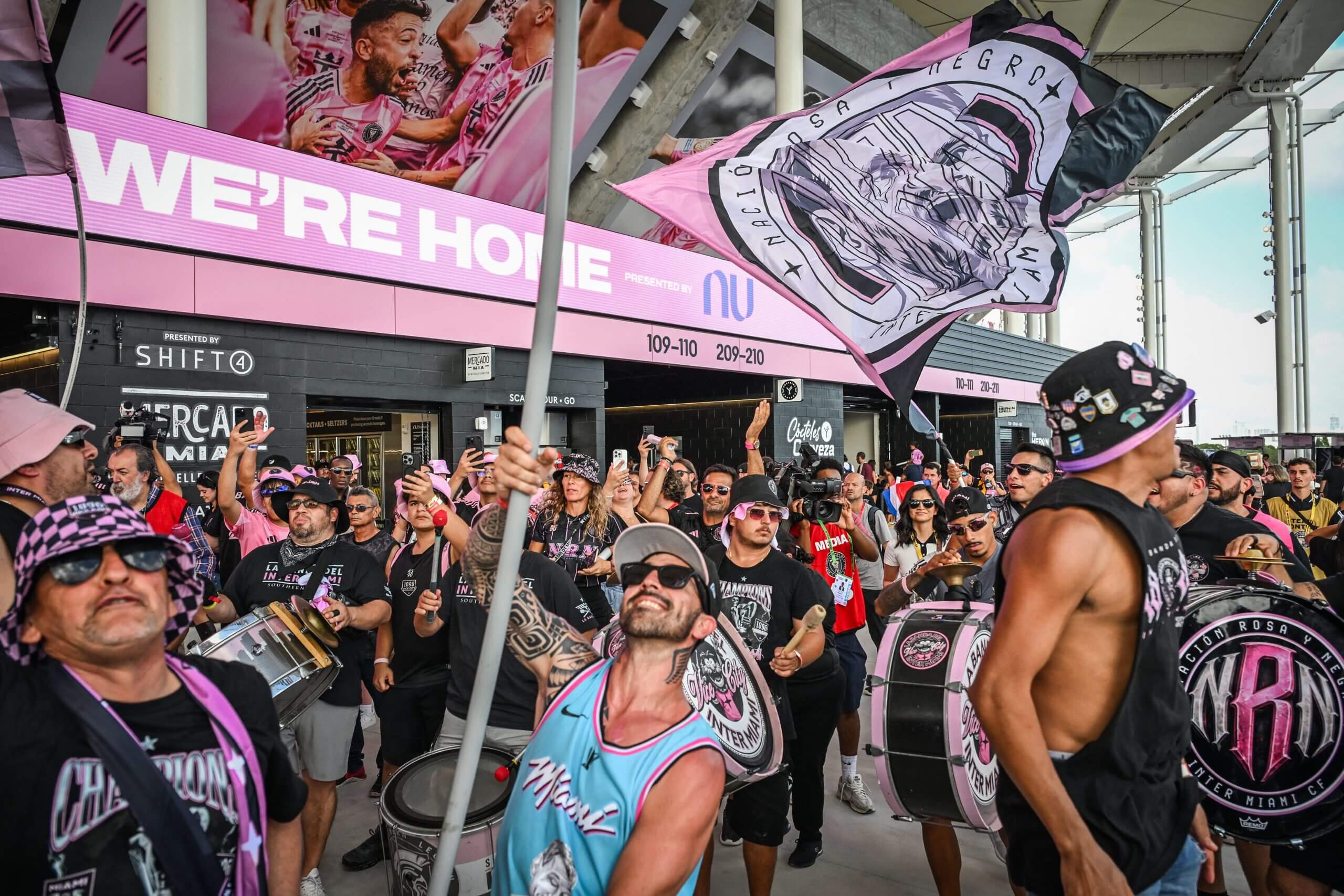
Inter Miami fans in the Nu Stadium concourse (Giorgio Viera / AFP / Getty Images)
Long before the Messi Stand was branded last month and before construction began in August 2023, there were times when it seemed Nu Stadium would remain imagination fodder. Multiple desired stadium sites and projects fell by the wayside. Beckham, who launched his Miami MLS expansion project in 2014, infamously made a 2019 appearance on a weed-ridden, decrepit Lockhart Stadium site to announce the club would be tearing it down and building its temporary home in Fort Lauderdale. It was a far cry from the promises and statements of grandeur attached to the club since its inception.
Nevertheless, that venue was ready in time for the 2020 inaugural season and certainly served its purpose, hosting multiple memorable moments and events, from Messi’s storm-delayed unveiling — yet another planned opening that went a bit awry — to a 2025 MLS Cup triumph. In the end, there’s symbolism to Inter Miami having steamrolled a vestige of American soccer past before making way for a fixture of its future.
While it’s been anything but a consistently smooth road, major projects take time and don’t always go according to plan. With enough clout, persistence, financial support and brazenness, though, the vision can be achieved.
Miami is not the first MLS club to find out that simply attaching a mega-name to something won’t result in instant and linear success. That, like any ambitious roster and/or stadium project, needs to be built gradually.
It took multiple hiccups and setbacks before Beckham’s LA Galaxy became the league’s predominant team. Zlatan Ibrahimović’s Galaxy earned plenty of headlines and viral views, but didn’t win anything of note. Numerous other big-name designated players have come to MLS and promptly flopped, failing to deliver on expectations. Even Miami was a bottom-feeder until Messi arrived, and even then — yes, after 2024 Supporters’ Shield and 2023 Leagues Cup successes — the club suffered a first-round playoff exit in his first full season.
More clubs will be experiencing a night like Miami just did in the coming years. New York City FC will open the $780 million Etihad Park in 2027, finally having a place to call its own after rotating between local baseball stadiums, a chief MLS rival’s park and even calling Connecticut “home” through its first 11 years of existence. The Chicago Fire just broke ground on their new $750 million South Loop stadium, which will open in 2028.
It’s not fully apples-to-apples, but for $182 million, FC Dallas is renovating Toyota Stadium and will have a vastly improved home, also in 2028. In New England, it’s a classic case of waiting until there’s a shovel in the ground, but things do seem to finally be progressing toward a more urban, MLS-specific stadium for the Revolution after three decades of sharing a home with the Patriots in Foxboro.
Miami’s wait ended Saturday night. Its new stadium is not a finished product, but it’s not a pipe dream anymore, either. It’s no longer long-term calendar fodder.
As homegrown midfielder Santi Morales said this week: “To finally see the stadium in person and see it be a reality is what struck me the most. We’ve been waiting for this stadium for a long time, and now that we have it, it’s time to enjoy it.”
First Appeared on
Source link






