


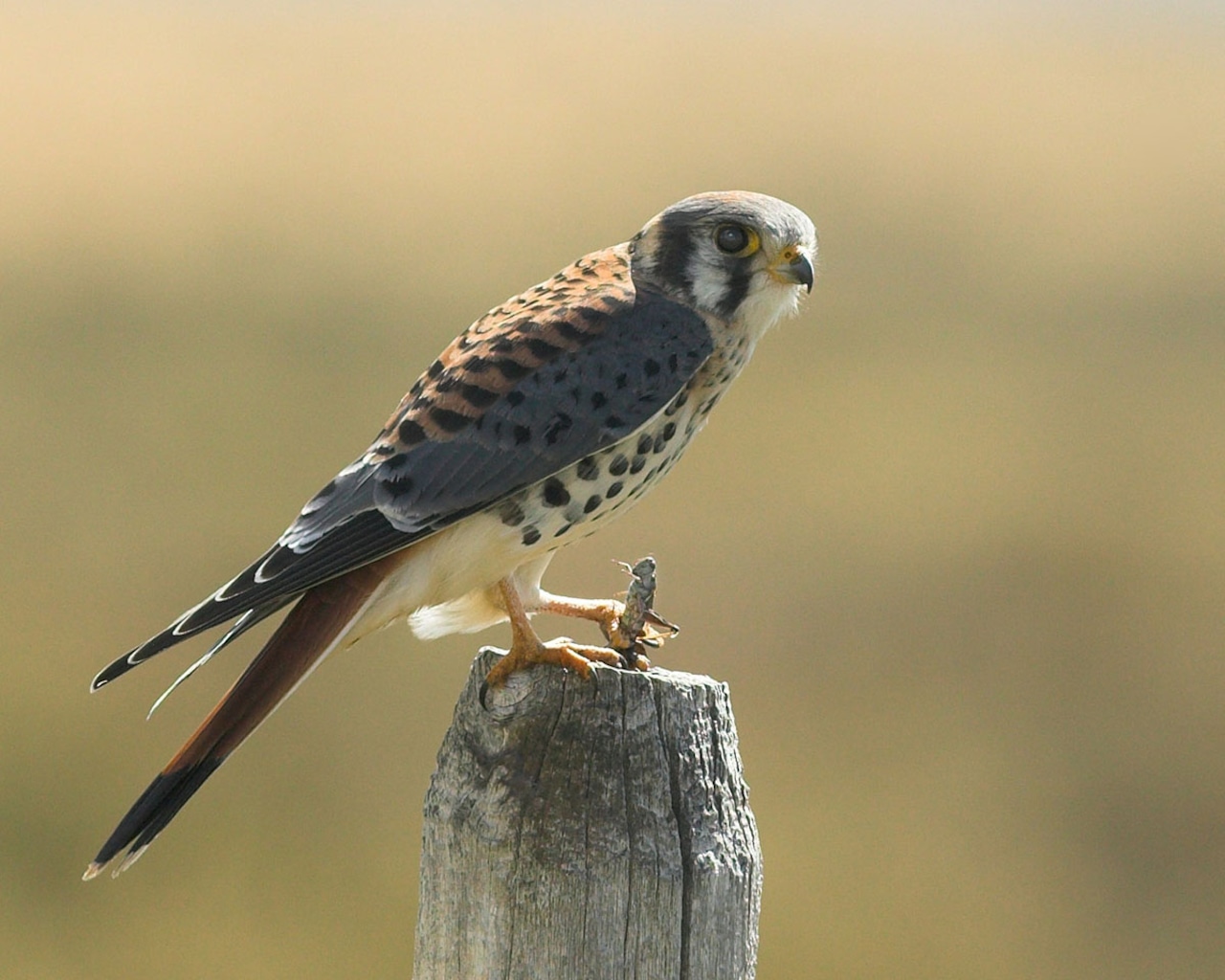
Michigan cherry growers found nature’s perfect orchard guardian, and it has talons
TRAVERSE CITY, Mich. – Northern Michigan fruit growers could achieve multiple benefits within their cherry orchards by helping to conserve American kestrels.
Researchers at Michigan State University have found that by adding kestrel boxes to rows of cherry trees, the small raptors scare away other birds that feast on the ripe fruit each summer. New findings show the birds of prey also offer additional food safety benefits.
Scientists at MSU specifically looked at the impact of bird droppings on Michigan’s signature fruit commodity and how conserving North America’s smallest and most common raptor reduces the risk of fecal contamination in the orchards.
Assistant Professor Olivia Smith said for years scientists have been studying how kestrel conservation within cherry orchards reduces crop-damaging pest birds.
Crop losses to birds generally range from 5% to 30% in cherry orchards across Michigan, Washington, California and Oregon. Growers have used nets, noise makers, scarecrows and sprays to keep birds away, but those approaches can be expensive and don’t always work.
However, MSU researchers found that for every dollar spent on kestrel nest boxes in northwest Lower Michigan, farmers saw between $84 and $357 worth of cherries saved from the bellies of fruit-eating songbirds.
Now researchers have found further evidence that by shooing away hungry birds like robins, grackles and starlings from the cherry orchards, kestrels can reduce foodborne pathogens impacting the crop before harvesting. It’s another benefit of the bio-control method.
The research was recently published in the Journal of Applied Ecology, which is a peer-reviewed scientific journal for ecological and biological studies.
“Kestrels are territorial, and they do eat birds. Birds aren’t a huge percentage of their diet, but they’ll certainly chase them away if they’re not going to eat them,” Smith said.
“If they’re deterring the pest birds – and that is what we found that typically kestrels can scare away the other birds – then that’s less poop. And then, at the same time, they can reduce the crop damage,” she said.
Researchers inspected both harvested fruit and how much bird feces appeared on the branches of trees in the orchards with kestrel boxes compared to those without. The 16 research sites were nearly all in Leelanau County, save for one of the control sites in Grand Traverse County.
Related: Mercenary wasps battle fruit flies in Michigan cherry orchards, blueberry patches
Scientists found that kestrels were associated with a three-fold reduction in bird waste found on cherry tree branches. They also discovered trees closer to the kestrel nest boxes were less likely to be dusted with bird droppings.
Smith said this biological method works particularly well in the cherry orchards of northwest Lower Michigan, but not in the blueberry fields. It’s a matter of timing between the fruit ripening and the kestrel nesting season, she said.
“Cherries are just perfectly timed where their peak ripeness is when the kestrels are nesting,” Smith said.
“It’s not something that’s going to work for every farmer, and some areas in Michigan and other states don’t have as many kestrels either, so you might not get as much benefit. But if you’re in the Traverse City area and you’re growing cherries, it seems to be pretty effective,” she said.
The researchers have even observed the kestrel boxes in cherry orchards being used by screech owls to roost during winter months. That’s expected to subsequently keep pest rodent numbers in check, Smith said.
The Cornell Lab of Ornithology offers details about how to properly build and establish kestrel nesting boxes.
First Appeared on
Source link






