


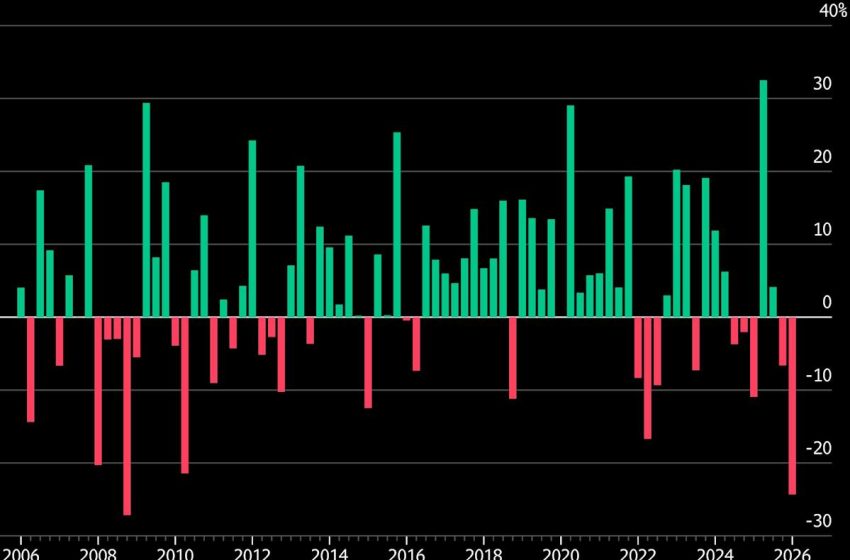
Microsoft Set for Worst Quarter Since 2008 as AI Fears Converge
(Bloomberg) — Microsoft Corp. is at the intersection of two troubling trends roiling the technology sector, which has the stock on track for its worst quarterly performance since the global financial crisis two decades ago.
First, the software giant is doubling down on capital expenditures as Wall Street increasingly asks when investments in artificial intelligence infrastructure will produce more dramatic payoffs in revenue growth. And second, investors are selling software stocks over fears that AI startups like Anthropic and OpenAI are creating agents that can replace products made by companies like Microsoft.
“There is this concern that rather than paying Microsoft, we’ll see more customers go directly to AI vendors, which could disrupt the core business, or at least pressure pricing and margins,” said Jonathan Cofsky, portfolio manager at Janus Henderson Investors, which holds the shares.
The company’s stock is down 25% in the first quarter, on pace for its biggest loss since its 27% drop in the fourth quarter of 2008. It’s by far the weakest performer among the Magnificent Seven tech giants to start the year, with an index tracking the group falling 14% over that time.
Microsoft fell 1.7% after the market opened on Friday, putting it on track for a fourth straight session in the red.
“Microsoft has become a lot more capital intensive,” Cofsky said. “For the shares to perform better going forward, we need to become more comfortable that software growth won’t materially decelerate.”
The selloff has the stock looking relatively cheap, trading at less than 20 times earnings over the next 12 months, the lowest since June 2016. Microsoft’s multiple is slightly above the S&P 500 Index’s, and it recently traded at a discount to the broad equities benchmark for the first time since 2015.
Although Wall Street remains optimistic that it will emerge as a long-term winner from AI, Microsoft still has to keep up with the hyperscaler spending race, a posture that could complicate any near-term sentiment reversal. The company’s capital expenditures, including leases, are projected to reach $146 billion in fiscal 2026, which closes at the end of June. That’s up about 66% from $88 billion in fiscal 2025, and the figure is expected to swell to $170 billion in fiscal 2027 and $191 billion in fiscal 2028, according to the average of estimates compiled by Bloomberg.
Investors are increasingly taking a jaundiced view of that kind of spending, especially without a more pronounced acceleration in growth. In its most recent quarterly results, Microsoft’s closely watched Azure cloud-computing division posted a slight deceleration in growth from the prior quarter. Meanwhile, Microsoft’s Copilot AI offering has gotten limited traction from users, leading it to shake up its AI operations to improve the service.
First Appeared on
Source link






