


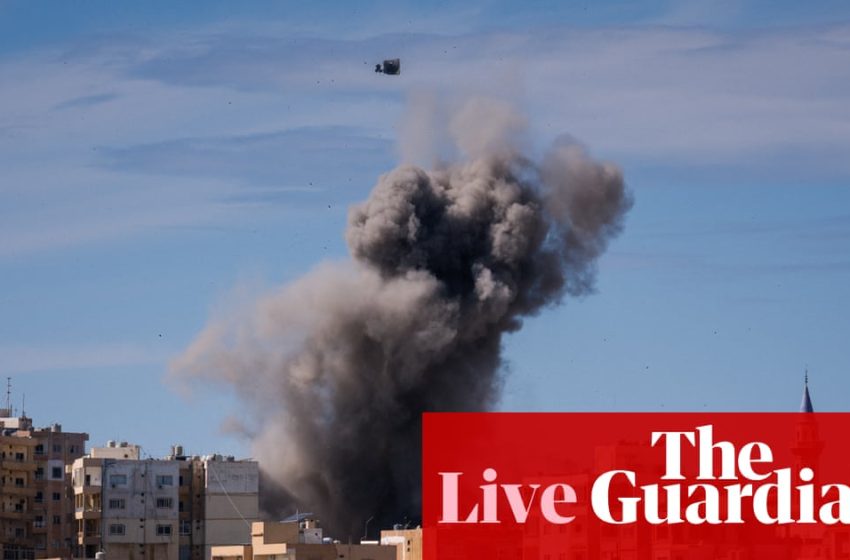
Middle East crisis live: Fire at Kuwait airport after drone attack; elite US airborne division reportedly headed to region | US-Israel war on Iran
Oil prices drop more than 5% after Trump reportedly sends peace plan
Brent crude oil, the global market benchmark, dropped close to six percent on Wednesday after Donald Trump sent a peace plan to Iran, Agence France-Presse reports.
At around 0030 GMT, a barrel of Brent crude was down 5.92% at $98.30.
Benchmark US oil contract, West Texas Intermediate, was down 5.01% at $87.72.
As reported earlier, the US reportedly sent Iran a 15-point plan to end the US-Israel war on Iran, a source familiar with the matter told Reuters.
News of the US plan was reported earlier by the New York Times, which, citing two officials, said the plan was delivered by way of Pakistan.
Per the NYT’s report, it is unclear how widely the plan had been shared among Iranian officials and whether Iran was likely to accept it as a basis for negotiations.
Key events
Kuwait air defences are responding to missile and drone attacks, its army said on Wednesday.
In a post to X, the army said “any explosions that may be heard are the result of air defense systems intercepting hostile targets”.
Earlier, a drone attack hit a fuel tank and sparked a fire at Kuwait airport, according to Kuwait’s civil aviation authority.
Emergency procedures were activated immediately, with firefighting teams responding to the blaze, it said, adding that initial reports indicated only material damage.
South Korean shares rose 3% on Wednesday, after reports the US was making progress in its efforts to negotiate with Iran.
The benchmark KOSPI was up 170.27 points, or 3.07%, at 5,724.19 as of 0135 GMT, Reuters reported.
“At this point, it is appropriate to lower the possibility of the war escalating and stock markets going through a correction for a longer time,” said Han Ji-young, an analyst at Kiwoom Securities.
Philippines seeks US waivers to import oil from sanctioned countries after emergency declared
The Philippines is seeking waivers from the US state department so it can obtain oil from US-sanctioned countries — possibly including Iran and Venezuela — to ensure its fuel supply, the country’s ambassador to the US, Jose Manuel Romualdez, told Reuters.
The Pacific nation, which relies heavily on imported fuel, declared a state of national energy emergency on Tuesday as the fallout from the Middle East war continues.
As of 20 March, the government said the country has about 45 days of fuel supply remaining and is seeking to procure another 1m barrels of oil to build its buffer.
Manilla has temporarily increased coal-fired power generation in response to the crisis. Washington has previously issued 30-day waivers for Russian crude oil and Iranian oil from tankers already at sea.
Asked if Washington had responded, Romualdez said the matter was a “work in progress”.
Read more background here.
About 1,000 US soldiers to depart for Middle East in coming days – reports
Further to our earlier post, at least 1,000 troops from the 82nd Airborne Division will be sent to the Middle East in the coming days, three people with knowledge of the plans told Associated Press.
Earlier, Sky News and NBC News reported that Trump had approved the deployment.
The 82nd airborne is an elite infantry division that can typically be deployed on short notice and specialises in forcible entry parachute assaults.
It is the latest addition of American troops after US officials last week said thousands of Marines aboard several Navy ships will be heading to the region.
The Marine deployment to the region raises speculation the US may try to seize Kharg Island, which is vital to Iran’s oil network, AP reported.
The US bombed the island more than a week ago, hitting its defences but saying it had left oil infrastructure intact.
Iran has threatened to mine the gulf if the US appears to be on the verge of landing troops.
Colombia is seeking to lead the formation of a global coalition of nations that want to end the use of fossil fuels, at an international meeting in April, Agence France-Presse has reported.
On Tuesday, the country’s environment minister, Irene Vélez Torres, told journalists the meeting comes as the world faces “an extreme energy crisis” due to the the war in the Middle East. Colombia’s goal is to establish a “coalition of those of us who possess the will to eliminate fossil fuels”, she said.
Velez said 45 countries had confirmed their attendance for April’s international conference on the transition away from fossil fuels, organised by Colombia and the Netherlands during last year’s Cop30 meeting in Brazil.
Here are the latest images from the crisis in the Middle East.
Oil prices drop more than 5% after Trump reportedly sends peace plan
Brent crude oil, the global market benchmark, dropped close to six percent on Wednesday after Donald Trump sent a peace plan to Iran, Agence France-Presse reports.
At around 0030 GMT, a barrel of Brent crude was down 5.92% at $98.30.
Benchmark US oil contract, West Texas Intermediate, was down 5.01% at $87.72.
As reported earlier, the US reportedly sent Iran a 15-point plan to end the US-Israel war on Iran, a source familiar with the matter told Reuters.
News of the US plan was reported earlier by the New York Times, which, citing two officials, said the plan was delivered by way of Pakistan.
Per the NYT’s report, it is unclear how widely the plan had been shared among Iranian officials and whether Iran was likely to accept it as a basis for negotiations.
Israeli strikes kill six in Lebanon – state media
Israeli strikes killed at least six people in a town and a Palestinian refugee camp in the southern Sidon area, Lebanese state media reported on Wednesday.
Citing the health ministry, the official National News Agency said four people were killed in an “Israeli enemy raid” on the town of Adloun, and another two in a strike on an apartment in the Mieh Mieh refugee camp.
Drone attack sparks fire at Kuwait airport – reports
A drone attack has hit a fuel tank and sparked a fire at Kuwait airport, Kuwait’s civil aviation authority said on Wednesday.
Emergency procedures were activated immediately, with firefighting teams responding to the blaze, it said, adding that initial reports indicated only material damage.
Roughly 290 US troops wounded in Iran war so far – reports
Approximately 290 US service members have been injured during operations targeting Iran, a spokesperson for US central command told CNN on Tuesday.
Of those 290 injured, 255 have returned to duty, the spokesperson said. Ten US troops remain seriously wounded.
Thirteen US troops had been killed in action, CNN reported.
More than 1,500 Iranians have been killed, Iran’s state broadcaster said on 21 March, as well as over 1000 people in Lebanon, according to its health ministry.
US now an ‘unpredictable ally’ – France’s army chief
The general chief of staff of France’s armed forces, Fabien Mandon, has called the US an “unpredictable ally” that is impacting France’s interests and security, Reuters reports.
Speaking to a security and defence forum in Paris on Tuesday, Mandon said:
We were surprised by an American ally, who remains an ally, but who is becoming increasingly unpredictable and doesn’t even bother to inform us when they decide to launch military operations.
It has an impact on our security and it has an impact on our interests.
France and the US are close Nato allies, but tensions have been mounting over Washington’s decision to launch its war on Iran.
Mandon said France intervened in Afghanistan at the US’s request and then the US withdrew without informing France.
They have now decided to intervene in the Middle East without informing us.
Cyprus demands new security deal for UK bases – reports
Cyprus has asked the UK to negotiate stronger security arrangements following Iranian drone attacks on the island’s UK military bases, the Telegraph reports.
President Nikos Christodoulides raised the issue during a lengthy call with the British prime minister, Keir Starmer, on Saturday, the report said.
The Akrotiri and Dhekelia bases, comprising 256 sq km (99 sq miles), remained UK sovereign territory when Cyprus became independent in 1960. The British government uses them as training areas and staging posts for operations in the region.
Fears Cyprus would become a de-facto target for Iran because of the bases were realised earlier this month when an unmanned attack drone – said to have been launched by the Iranian proxy Hezbollah from Lebanon – crashed into RAF Akrotiri’s runway on 2 March. Two other drones were intercepted heading in the direction of the base the next day.
The Telegraph said Christodoulides wants a renegotiation of security arrangements of the 1960 treaty, when the Iran war ends, though that would not include asking Britain to give up the bases.
We need to have an open and frank discussion with the British government with regard to the status of the British bases.
A UK Ministry of Defence spokesperson told the Telegraph the status of the bases was not up for negotiation and that the “long-standing friendship” between the UK and Cyprus remained strong “in the face of Iranian threats”.
US sent Iran 15-point plan aimed at ending war – reports
The US has sent Iran a 15-point plan to end the US-Israel war on Iran, a source familiar with the matter has told Reuters.
News of the US plan was reported earlier by the New York Times, which, citing two officials, said the plan was delivered by way of Pakistan.
Per the NYT’s report, it is unclear how widely the plan had been shared among Iranian officials and whether Iran was likely to accept it as a basis for negotiations.
Nor is it clear whether Israel, which has been bombing Iran with the US, was on board with the proposal. (Israeli officials have previously said strikes would continue on Iran – and Lebanon – even as the US considers ceasefire possibilities).
According to Israel’s Channel 12 news, the 15 points were:
-
Iran dismantling its nuclear capabilities;
-
Iran committing to not pursuing further nuclear weapons;
-
Iran not enriching any more nuclear material;
-
All enriched material will be delivered to Saba on a schedule to be determined by the US, Israel and Iran;
-
The Natanz, Isfahan and Fordow nuclear facilities will be decommissioned;
-
The Atomic Energy Agency will get access to all nuclear information with regard to Iran’s programme;
-
Iran will abandon its proxy model;
-
Iran will stop its actual funding and arming of proxies in the region;
-
The strait of Hormuz will remain open, as a free maritime zone and unblocked in the future;
-
Iran will limit the number and range of its missiles;
-
Any further use of its missiles will be for Iranian self-defence only;
-
All sanctions on Iran will be lifted;
-
Iran will be assisted in developing a civil nuclear project in Bushehr;
-
The snapback threat against Iran will be removed,
-
The US and Israel will assist Iran in promoting and developing a civil nuclear project in Bushehr (electricity generation).
France urges Iran to ‘engage in good faith’ in negotiations to end war
French president Emmanuel Macron has said he’s spoken on the phone to Iran’s president Masoud Pezeshkian and urged Tehran to “engage in good faith” in talks to end the US-Israeli war on Iran.
“I called on Iran to engage in good faith in negotiations,” Macron said in a post on X, adding this would “open a path towards de-escalation”.
He said that he had also urged Tehran to end the “unacceptable” attacks on Gulf countries, to “restore freedom of navigation” in the strait of Hormuz, and had emphasised the importance of “preserving energy and civilian infrastructure”.
IDF issues evacuation threats for Beirut’s southern suburbs
The Israeli military issued a fresh warning to residents in Beirut’s densely populated southern suburbs to evacuate on Tuesday night.
In a social media post, IDF spokesperson Avichay Adraee said the military is continuing its operations and attacks on what it describes as “Hezbollah infrastructure” in the region.
Residents in seven neighbourhoods including Haret Hreik, Laylaki, Haddad and Borj el-Branjeh, must “evacuate immediately” to avoid harm, he said.
The day so far
-
Donald Trump claimed negotiations to end the Iran war are happening “right now” and that Tehran had agreed to “never” have a nuclear weapon. “We can say this is regime change,” he told reporters in the Oval Office, adding: “We’ve won this war.” He also said members of his administration are negotiating with “the right people” in Iran and claimed that Tehran gave him a “gift” which was “oil and gas related” and related to the strait of Hormuz, without giving any further detail.
-
A reminder that Trump’s claims come a day after Iranian officials denied that any contact with the US had taken place, and called such claims of talks “fake news” designed to “manipulate” oil markets.
-
Indeed, Iran’s military today vowed to fight on until it had achieved “complete victory”. Major general Ali Abdollahi Aliabadi mocked the United States as a “hollow” nation that has been “brought down in front of the world”, with Trump left “trying to escape from the war” it started.
-
Further undermining Trump’s repeated claims that there are talks happening and that they are pointing towards a possible peace, the US is sending more than 1,000 extra troops to the Middle East, multiple outlets reported. Trump approved the deployment last night, and the extra troops, from 82nd Airborne Division, have not yet left the US, but could be sent overseas in the coming days. The elite infantry division specialises in forcible entry parachute assaults.
-
Meanwhile, Lebanon faces an “existential crisis” after Israel announced plans to seize and occupy swathes of the country’s south to create a so-called “security zone”, officials warned. Israel’s defence minister, Israel Katz, had earlier said he had instructed the IDF to establish control over a so-called “buffer” south of the Litani River, about 20 miles from the current Israel-Lebanon border – and the remaining bridges it hadn’t yet destroyed. Many Lebanese fear that the Israeli occupation of a large part of southern Lebanon could become long-term. Indeed, Katz said the hundreds of thousands of south Lebanon residents who were displaced by the war this month “will not return south of the Litani River until security is guaranteed for the residents of the north” of Israel. On the hundreds of thousands of Lebanese people who have had to flee the south, one Lebanese politician said:
For the first time, there is no more life. There’s no more human presence. So, it’s much more dangerous than occupation. It’s really the destruction of an entire area.
Qatari emir Sheikh Tamim bin Hamad al-Thani thanked Turkish president Recep Tayyip Erdoğan in a phone call for efforts aimed at regional de-escalation, according to a statement from the emir’s office on Tuesday.
Erdoğan said earlier in the day that Turkey would continue working with all its resources to establish peace in the US-Israel war on Iran, which he said has hit the Turkish economy and the whole world.
The Turkish president also said his government is considering a number of measures to protect the economy, as the war has engulfed the region and sent energy prices soaring.
IAEA confirms projectile struck Iran’s Bushehr plant and no harm reported
Since my last post on this, the International Atomic Energy Agency (IAEA) has confirmed that it has been informed by Iran that a projectile struck the premises of the Bushehr nuclear power plant.
The IAEA said in a post on X that according to Iran there was no damage to the facility or injuries to staff and that conditions at the plant remain normal.
The UN watchdog’s director general Rafael Mariano Grossi reiterated the call for maximum restraint to avoid nuclear safety risks during conflict.
Trump approves deployment of more than 1,000 extra soldiers to Middle East – reports
We’re getting more reports now of Donald Trump approving the deployment of more than 1,000 soldiers from the 82nd Airborne Division to the Middle East.
Sky News and NBC News are reporting that Trump approved the deployment last night and the orders are being written today for the headquarters, staff, and some ground forces, but not the full brigade.
The full brigade consists of over 3,000 troops, but this deployment will be fewer than half that — under 1,500 soldiers, which clears up earlier reports that thousands of additional troops would be sent.
The extra troops have not yet left the US, but could be sent overseas in the coming days.
The 82nd airborne is an elite infantry division specializing in forcible entry parachute assaults.
First Appeared on
Source link






