


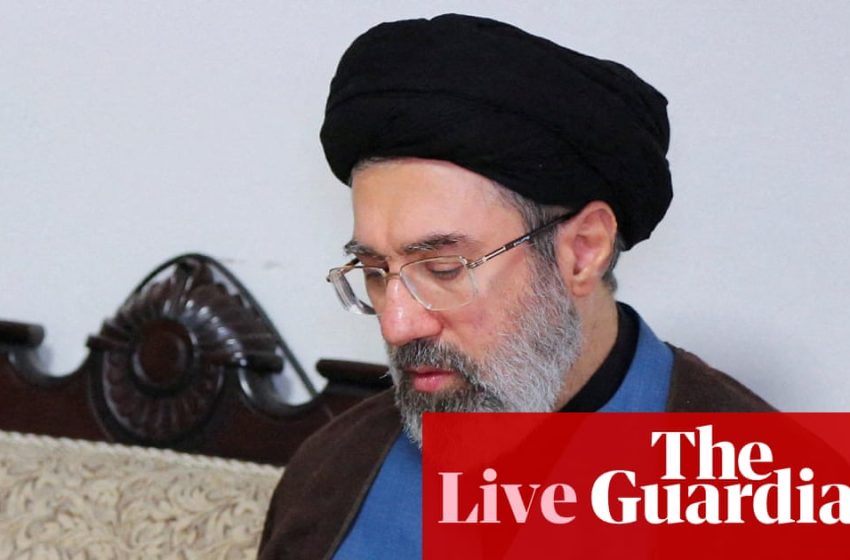
Middle East crisis live: Mojtaba Khamenei chosen as Iran’s new supreme leader; oil prices soar past $100 a barrel | US-Israel war on Iran
Key events
Donald Trump envoys Steve Witkoff and Jared Kushner are planning to travel to Israel on Tuesday and meet Israeli prime minister Benjamin Netanyahu, according to an Axios reporter.
Barak Ravid’s post on X cited a “US official and a source with knowledge”.
The plan is yet to be officially verified.
Saudi Arabia condemns ‘reprehensible’ Iranian attacks on Gulf states
Saudi Arabia has condemned what it calls Iran’s “reprehensible” and unjustifiable aggression against the kingdom and other Gulf states.
The Saudi foreign ministry said in a statement on X:
The Ministry of Foreign Affairs renews the Kingdom of Saudi Arabia’s categorical condemnation of the reprehensible Iranian aggressions against the Kingdom, the Gulf Cooperation Council states, a number of Arab and Islamic countries, and friendly nations, which cannot be accepted or justified under any circumstances.
The Kingdom affirms its full right to take all measures that ensure the protection of its security, sovereignty, and the safety of its citizens and residents, and to deter aggression.
Nick Visser
More than 2,200 Australians have arrived back home since Middle East conflict started.
As of this morning, more than 2,200 Australians have returned to the country via commercial flights from the Middle East.
Multiple flights from the United Arab Emirates and Qatar are arriving or expected to arrive each day into various Australian airports, after a series of long airspace closures.
The government is still encouraging Australians abroad to register with the Department of Foreign Affairs and Trade’s crisis portal if they are in Bahrain, Iran, Israel, Kuwait, Qatar, Lebanon or the UAE.
Vietnam is considering a plan to scrap tariffs on fuel imports, the government said, as the US-Israeli war with Iran disrupts oil supplies and pushes prices to their highest level since 2022.
The ministry of finance said it had drafted a decree that would slash import tax rates to zero on some petroleum products to “help stabilise the domestic market and ensure national energy security”.
It said in a statement on Sunday:
If the conflict continues and the blockade of the strait of Hormuz persists, alternative supplies on the international market will become scarce and risk driving prices up.
The AFP news agency also reports that since the war began more than a week ago with US and Israeli strikes on Iran, prices of fuel in Vietnam have risen sharply and the government has implemented emergency pricing protocols.
Thick smoke is rising from the direction of the Bapco oil refinery in Bahrain, a witness has just been quoted as saying.
Earlier on Monday Bahrain said an Iranian drone attack on the island of Sitra injured 32 people overnight.
Gulf countries have been reporting new strikes as Iran continues retaliatory attacks across the region.

Jack Snape
Their forward was once suspended when her head scarf slipped off during a goal celebration. They are the women of the Iran football team, who are at the centre of an international diplomatic incident, even as the US and Israel rain missiles down on their family back home.
The team remains in a hotel on Australia’s Gold Coast, where they played their third and final match of the Women’s Asian Cup on Sunday. Their departure from Australia is imminent, even if it’s not clear whether they want to go.
Fears are held for their safety if they return to Iran. The players were dubbed “wartime traitors” by a state-linked commentator, who called for them to be “dealt with more severely”, after they failed to sing the national anthem in their first Asian Cup game.
In subsequent matches not only have the players sung – or at least mouthed the anthem’s words – they have saluted.
Were they to stay in Australia, they face cutting off ties from their family and friends, who may be then vulnerable living under a regime that has already killed tens of thousands. Backlash might extend to teammates, other footballers, and out through community networks still living in Iran.
It is a torrid choice, but one the players may have for only hours more.
The full story is here:

Callum Jones
Continued from previous post:
My colleague Rebecca Ratcliffe reported last week on efforts by the Philippines to conserve energy. Government offices have been told to adopt flexible work arrangements, and to set air conditioning units no lower than 24 degrees. A presidential palace spokesperson said a four-day working week could also be considered, especially if the Middle East crisis worsened, local media reported.
Other south-east Asian countries are also introducing energy-saving measures, Rebecca noted. In Thailand, the defence ministry advised agencies under its control to cut back on the use of air conditioning, and to use video conferencing to avoid unnecessary travel.
In Myanmar, meanwhile, military rulers have banned half of private vehicles from the roads, announcing that from this weekend even-numbered plates will be permitted to drive only on even dates and odd-numbered plates only on odd dates.
Callum Jones
Why does the massive rise in oil prices actually matter? The surge to $100 per barrel might feel a bit abstract – unless you’re in a country scrambling to deal with an energy supply crunch.
Concerns over the strait of Hormuz, which has now been in effect closed for a week, have been compounded by reports of oil production cuts across the Middle East. Asian markets are particularly vulnerable here: they relied on the Middle East for 59% of their crude oil imports last year, according to analytics firm Kpler.
In Bangladesh, Reuters reports that all universities will be closed from Monday, bringing forward the Eid al-Fitr holidays as part of emergency measures to conserve electricity. Officials said the move would not only reduce electricity consumption but also ease traffic congestion, which leads to fuel wastage.
In South Korea, the country’s president has just announced a move to cap domestic fuel prices for the time in almost three decades. The current crisis “is a significant burden on our economy, which is highly dependent on global trade and energy imports from the Middle East”, said Lee Jae Myung.
Continued next post
Qatar arrests more than 300 over alleged ‘misleading information’
Qatar says 313 people of different nationalities have been arrested over allegations of inciting public concern amid the US-Israeli war on Iran.
The arrests were carried out as part of “ongoing efforts to monitor and address the misuse of social media platforms”, the Qatari interior ministry said in a press release posted on X.
It said:
The arrests were made for filming and circulating unauthorized video clips, spreading misleading information and rumours, and disseminating content intended to incite public concern, in violation of official directives.
The interior ministry also said it “stresses the importance of refraining from filming, publishing video clips or circulating rumours related to the current situation, and calls on the public to obtain information solely from approved official sources”.
Trump says when to end war will be ‘mutual’ decision with Netanyahu – report
Donald Trump has said a decision on when to end the war with Iran will be a “mutual” one he’ll make together with Benjamin Netanyahu, the Times of Israel has reported.
It said Trump also claimed in a brief telephone interview on Sunday that Iran would have destroyed Israel if he and Netanyahu had not been around. The US president said:
Iran was going to destroy Israel and everything else around it … We’ve worked together. We’ve destroyed a country that wanted to destroy Israel.
The report said Trump was asked whether he alone would decide when the war with Iran ends or if Netanyahu, the Israeli prime minister, would also have a say. Trump responded:
I think it’s mutual … a little bit. We’ve been talking. I’ll make a decision at the right time, but everything’s going to be taken into account.
The report said that when Trump was asked whether Israel could continue the war against Iran even after the US decided to halt its strikes, he said he declined to entertain the possibility before adding: “I don’t think it’s going to be necessary.”
Callum Jones
After crossing $100 per barrel for the first time in four years, global oil prices are still rising.
A short time ago Brent crude, the international benchmark, was 23.1% higher, at $114.13 per barrel. The West Texas Intermediate benchmark price of US crude was up 23.5% at $112.26 per barrel.
Donald Trump insisted overnight that this extraordinary spike was a “short term” effect of the US-Israel war on Iran. Over the weekend his energy secretary, Chris Wright, also predicted the disruption would not last long, telling CNN: “In the worst case, this is a weeks, this is not a months thing.”
Such statements appear to have fallen on deaf ears.
Stock markets across Asia remain under pressure – Japan’s Nikkei 225 is down 7%, South Korea’s Kospi is down 7.3% and Hong Kong’s Hang Seng index is down 2.6% – as Australia’s ASX 200 endures its worst day in almost a year.
We have a while to wait before Wall Street opens for trading, but pre-market trading data currently puts the Dow Jones industrial average and the benchmark S&P 500 on course to open deep in the red.
Read more from my colleague Jillian Ambrose:
Iranian attack injures 32 in Bahrain, it says, amid fresh strikes on Gulf states
More on Bahrain now: the country said on Monday that an Iranian drone attack on the island of Sitra injured 32 people overnight, as Gulf nations reported new attacks with Tehran pressing its retaliatory strikes across the region.
All of the wounded were Bahraini citizens and there were four “serious cases”, including children, the health ministry said in a statement carried by the state news agency.
The wounded included a 17-year-old girl who suffered severe head and eye injuries, and a two-month-old baby, according to the ministry.
The report from Agence-France Presse said several explosions were also heard on Monday in the Qatari capital of Doha, while Qatar, Saudi Arabia and Kuwait all reported new attacks.
Qatar’s defence ministry said on Monday that its forces had intercepted a missile attack.
Saudi Arabia’s defence ministry said the kingdom intercepted and destroyed two drones heading towards the Shaybah oil field in the country’s south-east.
Kuwait’s defence ministry said the country’s air defences were working to intercept a missile and drone attack on Monday.
Rocket and drone attacks have targeted a US diplomatic facility near Baghdad international airport and been intercepted by defence systems, police sources are being quoted as saying.
Who is Iran’s new supreme leader Mojtaba Khamenei?
The man who has been chosen as the successor to Iran’s slain supreme leader is a 56-year-old cleric who has never held elected office or formally occupied a senior position in the Iranian government.
Mojtaba Khamenei has spent much of his life at the centre of Iranian power while mainly staying out of public view.
Khamenei is the second son of the slain Ayatollah Ali Khamenei, and the clerical body responsible for selecting Iran’s highest authority announced the decision on Sunday, calling on Iranians to rally behind him and preserve national unity.
But Donald Trump had already said Khamenei would be an “unacceptable” choice, while Israel warned it would also pursue Iran’s next supreme leader.
Mojtaba Khamenei was born in 1969 in the north-eastern Iranian city of Mashhad and was raised within the political and clerical world that emerged after the 1979 revolution.
As the Guardian’s Lorenzo Tondo has also written:
As a young man he studied theology in the seminaries of Qom and reportedly took part in the final stages of the Iran-Iraq war.
Unlike many figures in Iran’s leadership, Khamenei never pursued elected office or a prominent government role. Instead, he gradually became an influential presence inside his father’s office, where he was widely seen as part of a small circle managing political access to the supreme leader.
Over the years he cultivated close relationships with conservative clerics and elements of the Islamic Revolutionary Guards Corps.
His name surfaced publicly during the disputed 2009 presidential election, when reformist figures accused him of playing a role in supporting the security crackdown that followed mass protests. But he has never discussed the issue of succession publicly.
An Iranian drone attack that targeted the Bahrain island of Sitra overnight has wounded 32 civilians, the country’s health ministry is being quoted as saying.
The wounded were all Bahrain citizens and there were four serious cases, including children, the ministry said in a statement reported by the state news agency.
Australian shares plunge as oil price spike sparks global inflation fears

Jonathan Barrett
The Australian share market plunged on Monday, wiping about $13obn from the value of the ASX midway through the trading session, after a sharp rise in oil prices caused by the Middle East conflict sparked concerns of a breakout in global inflation.
The benchmark S&P/ASX 200 was down 4% in lunchtime trading to dive below the 8,500 point mark, marking the single biggest one-day drop since the announcement of Donald Trump’s “liberation day” tariffs last year.
The selldown is linked to disrupted oil supplies, the single biggest contributor to global inflation, which make almost all goods and services more expensive, from petrol and groceries to utilities and travel.
Global oil prices surged past $US100 a barrel shortly before the Australian share market opened for the week, spooking investors.
A loud explosion was heard in Beirut’s southern suburbs a short while ago.
Plumes of smoke were seen rising from the Lebanese capital’s southern suburbs after the blast was heard, a journalist with Agence-France-Presse reported.
The area – a Hezbollah stronghold whose residents the Israeli military ordered to evacuate – has been pounded by Israel over the past week but had not suffered any strikes since Saturday.
The Israel military is reportedly saying it has begun a wave of attacks in central Iran, and that it has also struck Hezbollah targets in Beirut.
We’ll bring you more on this shortly.
Opening summary
Hello and welcome to our continuing live coverage of the war on Iran.
Here are the main developments:
-
Iran has named Mojtaba Khamenei as the country’s new supreme leader after the killing of his father Ayatollah Ali Khamenei in US-Israeli strikes, state-run media announced. He was selected by Iran’s Assembly of Experts, an 88-member body of elected senior clerics tasked with choosing the supreme leader.
-
Donald Trump warned that Iran’s new leader “is not going to last long” if the Iranians do not get his approval first for the theocratic posting. “He’s going to have to get approval from us,” the president told ABC News. “If he doesn’t get approval from us he’s not going to last long. We want to make sure that we don’t have to go back every 10 years, when you don’t have a president like me that’s not going to do it.”
-
The Iran war has driven the price of crude oil above $100 per barrel for the first time since 2022.
-
Trump brushed aside concerns about the surging price of oil caused by the US-Israeli airstrikes on Iran, even as the price of crude topped $100 per barrel for the first time since 2022. “Short term oil prices, which will drop rapidly when the destruction of the Iran nuclear threat is over, is a very small price to pay for U.S.A., and World, Safety and Peace,” Trump wrote, adding all in capitals that “only fools would think differently”.
-
Another US military service member has died from wounds sustained during Iran’s initial counter-attack a week ago, bringing the number of US troops killed in action so far in the war with Iran to seven, the US military said on Sunday.
-
Lebanon’s health ministry said the number of people killed from Israeli airstrikes in the past week had increased to 394, including many women and children.
-
The Iranian army said on Sunday that at least 104 people were killed and 32 were wounded in an attack by the US on an Iranian warship off Sri Lanka’s coast last week.
-
The Israel Defense Forces began “extensive strikes” against the “infrastructure” of the Iranian regime in Tehran and across other areas in Iran. Despite Israel saying it is striking military or “terror” targets in its war on Iran, many civilians have been killed in its attacks.
-
Overnight strikes by the US and Israel hit five oil sites around Tehran, according to an Iran official. The official said the five facilities “were damaged” but the “fire was brought under control”. “If you can tolerate oil at more than $200 per barrel, continue this game,” a spokesperson for Iran’s Revolutionary Guards said on Sunday.
-
Iranian foreign ministry spokesperson Esmaeil Baghaei said the US-Israeli aerial bombardment of Iranian energy infrastructure sites marked a “dangerous new phase” of the conflict and amounted to a war crime.
First Appeared on
Source link






