


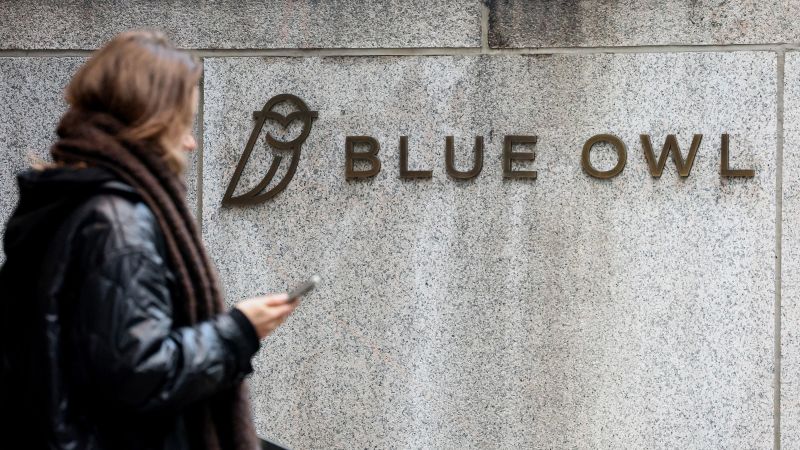
More investors flee Blue Owl funds as private credit fears deepen
A version of this story appeared in CNN Business’ Nightcap newsletter. To get it in your inbox, sign up for free here.
New York
Until recently, Blue Owl Capital’s name was synonymous on Wall Street with the booming business of private credit, a lightly regulated area of finance in which non-banks lend money to risky companies. Lately, though, its name has come to embody the $1.8 trillion industry’s vulnerabilities.
Blue Owl has shed 40% of its market value this year, and its stock (OWL) sank again on Thursday after it revealed a massive surge in requests from investors wanting to yank their money, forcing the firm to cap withdrawals. Blue Owl said in a letter that it received requests to pay out 41% of its $6 billion tech-focused fund (up from 15.4% the previous quarter) and 22% of its $36 billion flagship fund (up from just 5%). The lender is honoring just a fraction of those requests, paying out 5% from each fund.
Blue Owl shares fell 9% early Thursday before recovering and ending the day down 1.5%. Shares of other big players in private credit, such as Apollo Global and Ares Management, also fell.
Blue Owl executives said in investor letters seen by CNN on Thursday that they believed “market perception” had driven the surge of redemption requests but stressed that “underlying credit fundamentals across our portfolio have remained resilient.” They also blamed “heightened market concerns around AI-related disruption.”
A spokesperson for Blue Owl declined to comment beyond the shareholder letters.
Major players in private credit have reported a similar rush of redemption requests from investors, and most have responded with similar caps on redemption requests.
Proponents of private credit see the sudden exodus of capital as more of a sign of growing pains than a systemic flaw. Investors have flocked to private markets in droves in recent years, drawn to promises of higher returns than they can typically find in the public bond market.
But investor anxieties about the sector didn’t just emerge out of thin air, and the nature of modern financial markets means turmoil in one corner can quickly spill over into others.
Private credit has been around for decades, but it went from a relatively small, niche asset class to a nearly $2 trillion behemoth after the 2008 financial crisis, when traditional banks were forced to tighten lending standards.
“When you see some segment of the financial sector that is kind of coming out of nowhere and growing very fast, that’s an indication that maybe there is some risk building up,” said Itay Goldstein, a finance professor at the University of Pennsylvania’s Wharton School.
That rapid growth combined with the industry’s opacity — the terms of private loans are, as the name implies, not public — has long made the sector a subject of concern for policy makers and academics, Goldstein notes.
Anxieties spiked on Wall Street last fall with the bankruptcies of First Brands and Tricolor, both of which had significant private financing.
At the same time, worries that artificial intelligence could eventually torpedo software companies compounded concerns around private credit, which has aggressively marketed itself to middle-market tech companies. And while many fund managers have sought to play down the sector’s concentration in software, the Wall Street Journal reported this week that four of the biggest funds, including Blue Owl, have far more exposure to software than their public filings suggest.
Blue Owl’s Credit Income Corp. fund, for example, stated that 11.6% of its portfolio consisted of loans to “internet software and services” companies at the end of the fourth quarter. But the Journal’s own analysis found the fund’s software exposure to be around 21%.
The risk to everyday consumers may not be immediate, but it’s not zero. Big US banks that offer consumer loans also work with private lenders. If banks are hit with huge losses from their exposure to private credit, they will likely tighten credit across the board, making it harder for businesses and consumers to borrow.
“We shouldn’t underestimate what could be the impact of these small problems, because once the uncertainty starts, and you don’t really know which bank is holding what, then there is kind of this general panic taking over the financial system,” Goldstein said.
First Appeared on
Source link






