


Museum display found to be entirely new species after 26 years: ‘Difficult to decipher’
A famous 300-million-year-old fossil, believed to be the remains of the oldest-known octopus, was revealed overnight to be an entirely different animal.
Published 26 years ago, the original description of the creature, Pohlsepia mazonensis, rewrote the history of the octopus — suggesting the genus evolved 150 million years earlier than first thought.
Its discovery was even written into the Guinness Book of Records.
But leading paleontologists, including Dr Thomas Clements from the University of Reading, were “perplexed” by its classification as an octopus, so they decided to take a look inside its body using a high-powered X-ray.
Dr Clements told Yahoo News two key issues made him “suspicious” about it being an octopus.
An illustration shows Pohlsepia mazonensis decaying in Mazon Creek, Illinois, before it was preserved. Source: Franz Anthony
Firstly, its age conflicted with the “clear picture” of octopus evolution, which had been researched using high-quality samples found in Lebanon.
The second issue was the creature’s appearance.
“Its anatomy — fins, arms, and lack of an internal shell — points to a cirrate octopus, yet these features are notoriously difficult to interpret, and many scientists have struggled to resolve it as an octopus in their analyses,” Dr Clements said.
“It is frequently excluded from modern studies of octopus evolution altogether.”
Scientists ‘stopped in tracks’ after fossil scanned
It’s common for fossils to be re-examined as technology improves.
In 2024, researchers at the Museum and Art Gallery Northern Territory discovered that a turtle specimen held in its collection for decades was a completely new species.
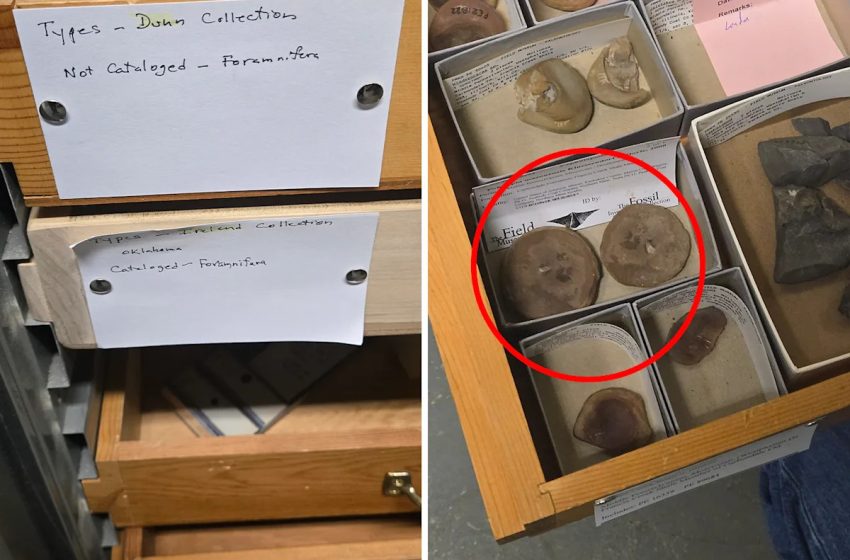
Pohlsepia mazonensis was found in the United States and housed in the collection of the Field Museum of Natural History in Chicago.
Dr Clements and his team borrowed the fossil, then delivered it to a micro-X-ray synchrotron facility in Paris, where it was left overnight to create a high-quality internal scan.
“The next morning, the images stopped us in our tracks — beneath the rock surface lay a beautifully preserved, 300-million-year-old radula, seen by human eyes for the very first time,” he said.
Radula are a type of ribbon-like tongue, covered in rows of microscopic teeth, which are common in all cephalopods, but those used by octopus are completely different in appearance.
“By analysing the tooth count and shape, we could categorically confirm that Pohlsepia is not an octopus — the one anatomical character that was beyond dispute,” Dr Clements said.
“That discovery also explained why the fossil had been so difficult to interpret: the soft tissues are ambiguous because the animal had partially decomposed on the seafloor before fossilisation.”
It’s possible the animal decayed for several weeks before it was preserved, and so, like modern beach finds of dolphins, seals, or whales, it had been difficult to decipher what sort of animal it was.
Excitement after fossil discovered to be incredibly rare
Dr Clements said resolving the problem specimen after months of study left him feeling “relieved”.
“There were points where we feared we might not be able to add anything new to the debate,” he confessed.
The findings support that the origin of octopuses is more recent, with the genus likely evolving during the Jurassic period after a split from other creatures like squids, which have 10 appendages instead of eight.
The team concluded their fossil was another type of cephalopod, a nautilus.
Dr Clements is the lead author of a paper on their discovery, which was published in the journal Proceedings of the Royal Society B.
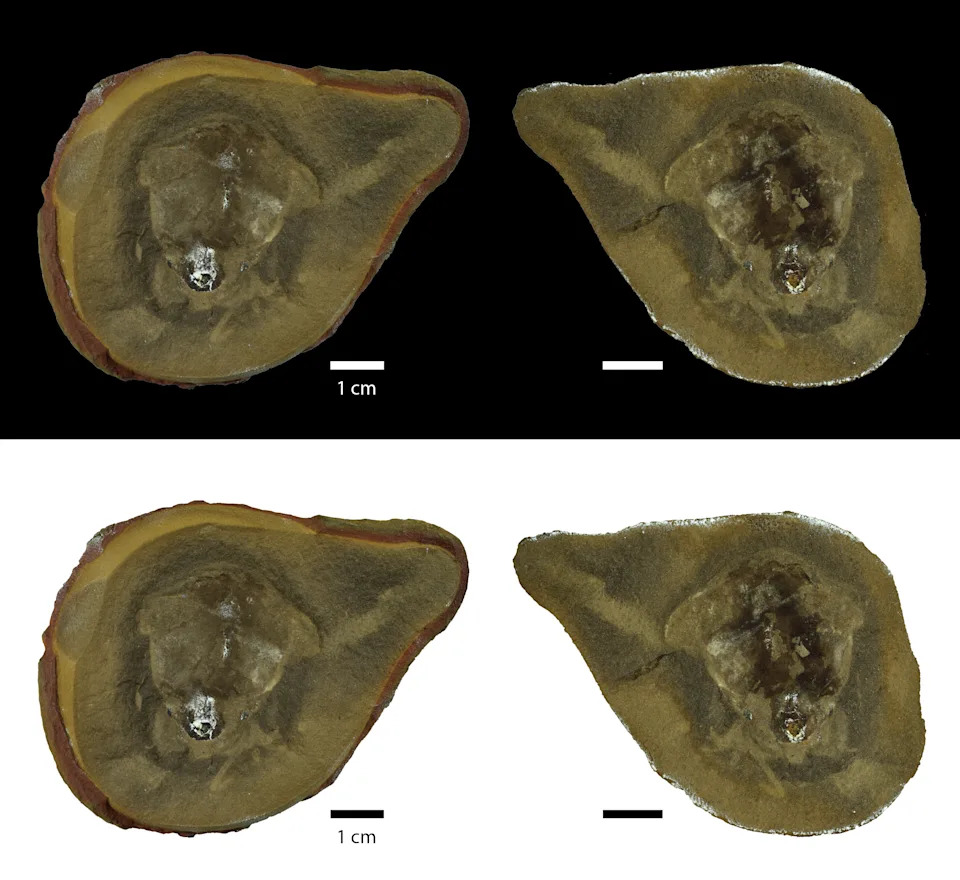
Close-up pictures of the holotype of Pohlsepia mazonensis. Source: Clements, T. et al. / Royal Society
Nautilus ancestors survive today, and their shells are found on tropical beaches, primarily in northeastern Australia, Indonesia, the Philippines, Fiji, and Papua New Guinea.
And while they’ve been swimming in the ocean for 490 million years, it’s rare to find the fossilised remains of one. However, it’s common to find those from closely related ammonites.
“When we saw the scans, relief gave way to genuine excitement… This discovery opens a remarkable new window into studying nautilus soft tissue and to understand fossil cephalopods,” Dr Clement said.
Museum surprised by Nautilus revelation
Paul Mayer is responsible for managing and caring for the 2 million invertebrate specimens at the Field Museum, where Pohlsepia mazonensis is housed.
He told Yahoo News he was “a little surprised” that it was a nautilus, but he noted “people have been questioning” whether it was an octopus since the first paper was published in 2000.
Mayer explained there has been renewed interest in the discoveries of Mazon Creek, where the fossil was found.
Another creature dug up nearby was the Tullimonstrum, known locally as the “Tully Monster”.
Because of its odd appearance, it has been the subject of heated debate since the first specimen was unearthed in the same area in 1958.
It was originally described as having a soft body, sharp teeth and an extremely long proboscis, and some have described it as the “strangest creature ever found”.
While it was recently re-examined using 3D lasers, the study hasn’t convinced all scientists about its classification, with some believing it was actually a vertebrate, similar to a lamprey.
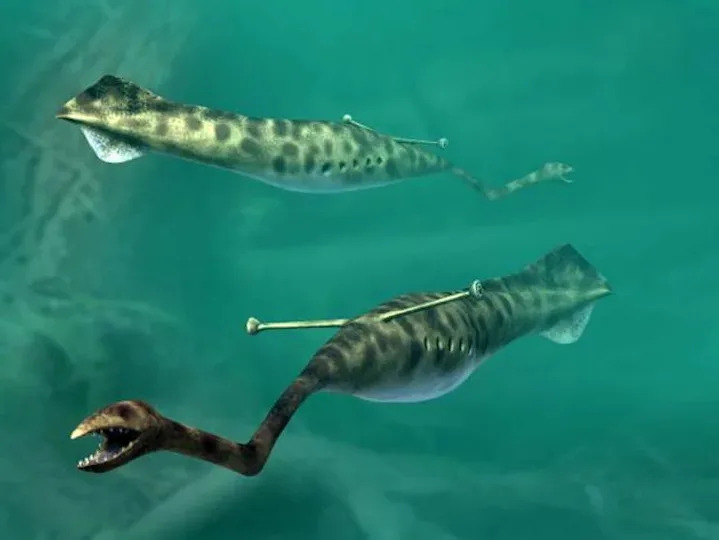
The appearance of the Tully Monster continues to be debated. This is one interpretation. Source: Nobu Tamura/Wikimedia, CC BY-SA
Other invertibrates in the collection, like marine worms and shark egg cases, are on the list to study next.
“Lots of new technology is being used to try and gather more information from these ancient fossils,” he said.
Do you have a story tip? Email: [email protected].
You can also follow us on Facebook, Instagram, TikTok, Twitter and YouTube.
First Appeared on
Source link






