


Musk says SpaceX focus is on the moon rather than Mars
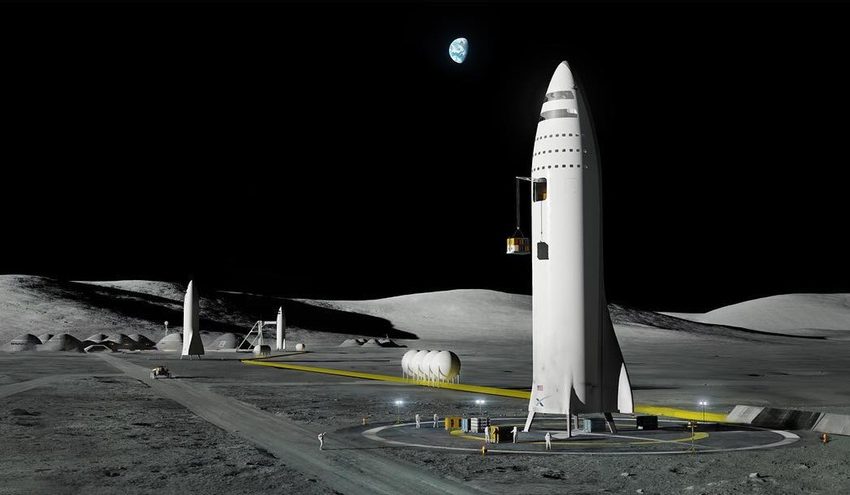
WASHINGTON — A little more than a year after dismissing the moon as a “distraction,” Elon Musk says SpaceX will focus on lunar settlement before sending humans to Mars.
In a social media post Feb. 8, Musk said SpaceX was deferring its long-held ambitions of establishing a permanent human presence on Mars, instead devoting resources to creating a “self-growing city” on the moon.
“For those unaware, SpaceX has already shifted focus to building a self-growing city on the Moon, as we can potentially achieve that in less than 10 years, whereas Mars would take 20-plus years,” he wrote.
Neither Musk nor SpaceX has discussed detailed plans for such a settlement on the moon. The company has instead long been associated with establishing a large-scale human presence on Mars using the Starship vehicle SpaceX is developing.
“Progress is measured by the timeline to establishing a self-sustaining civilization on Mars,” Musk said in a presentation last May at SpaceX’s Starbase facility in Texas, where Starship vehicles are built and launched.
In that presentation, Musk discussed Starship development as a means to create a large-scale human settlement on Mars that would require thousands of launches. “Every roughly two years we are dramatically increasing the number of ships that go to Mars,” he said, referring to launch windows that open about every two years, “and ultimately try to get to a thousand or two thousand ships per Mars rendezvous.”
Under the plan outlined in that speech, missions could begin with the next Mars launch window, opening in late 2026. “We’ll try to make that opportunity if we get lucky,” he said. “I think we probably have a 50-50 chance right now because we’ve got to figure out orbital refilling in order to have enough capability to go to Mars.”
SpaceX has yet to demonstrate in-space propellant transfer, a capability critical not only for Mars missions but also for lunar missions, including the lunar lander version of Starship SpaceX is developing for NASA’s Human Landing System program. There was widespread industry skepticism that SpaceX would be ready to carry out a Mars mission by the end of this year, and Musk himself recently had been increasingly doubtful a Mars mission could launch this year.
The Wall Street Journal reported Feb. 6 that SpaceX had abandoned plans for a Mars mission in 2026, instead turning its attention to an uncrewed lunar landing demonstration as soon as March 2027.
In his social media post, Musk said focusing on the moon allows for faster development than Mars.
“It is only possible to travel to Mars when the planets align every 26 months (six-month trip time), whereas we can launch to the Moon every 10 days (two-day trip time),” he wrote. “This means we can iterate much faster to complete a Moon city than a Mars city.”
While Musk has long been interested in human missions to Mars, his interest in the moon has waxed and waned over the years. “If you want to get the public really fired up, you’ve got to have a base on the moon,” he said in a July 2017 speech.
Later that year, he unveiled updated designs for his BFR rocket — a precursor to Starship — that included a concept for a lunar base he called Moon Base Alpha. “It’s 2017. I mean, we should have a lunar base by now,” he said at the International Astronautical Congress.
By early last year, however, Musk was focused almost exclusively on Mars. “No, we’re going straight to Mars. The Moon is a distraction,” he wrote in a January 2025 social media post, responding to a proposal to use liquid oxygen produced on the moon to fuel Starship missions to Mars.
That stance mirrored early policy signals from the second Trump administration that appeared to emphasize Mars exploration at the expense of lunar programs. Those included proposals to end the Space Launch System and Orion programs after Artemis 3, along with NASA budget requests for Mars exploration technologies and capabilities.
Congress rejected efforts to end SLS and Orion, as well as the lunar Gateway. An executive order issued by President Trump in December called for a human return to the moon by 2028 and the establishment of the first elements of a permanent lunar outpost by 2030.
At the same time, SpaceX and Musk have shown growing interest in orbital data centers, an effort that could compete for resources with Mars ambitions. SpaceX has filed an application with the Federal Communications Commission for up to 1 million satellites to serve as orbital data centers. The company also announced Feb. 2 that it would acquire Musk’s artificial intelligence company, xAI, in a deal reportedly valuing the combined company at $1.25 trillion.
Musk said he remains interested in sending humans to Mars, but as a secondary objective to lunar settlement.
“That said, SpaceX will also strive to build a Mars city and begin doing so in about five to seven years,” he wrote, “but the overriding priority is securing the future of civilization, and the Moon is faster.”
Related
First Appeared on
Source link






