


NASA Drops Stunning New Saturn Images From Webb And Hubble
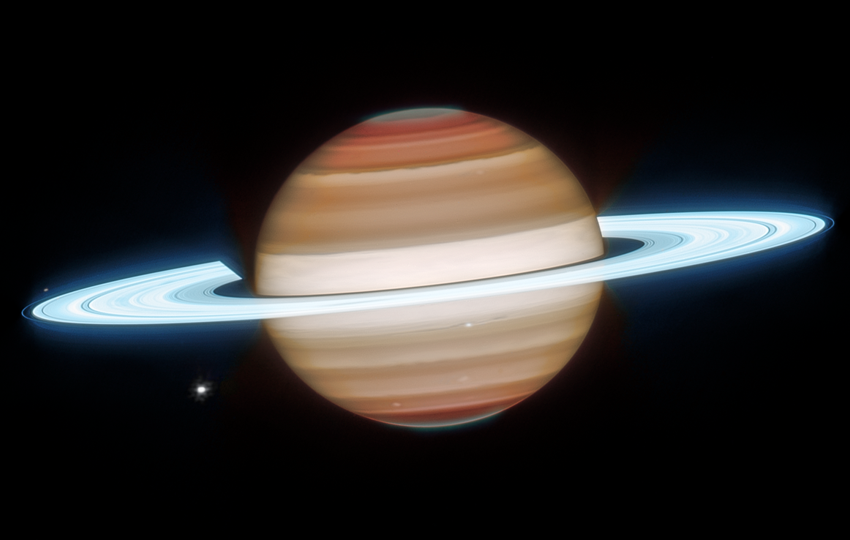
NASA’s James Webb Space Telescope has produced a striking new infrared image of Saturn, a planet famed for its iconic ring pattern.
Webb — launched on Christmas Day 2021 — uses infrared cameras that allow scientists to peer deeper into a planet’s atmosphere than ever before, revealing structures and dynamics that were previously hidden.
The Hubble Space Telescope conducts an annual grand tour of the outer solar system — Jupiter, Saturn, Uranus and Neptune — as part of its OPAL initiative, which has already provided a decade of atmospheric data. However, Webb is now adding advanced infrared measurements, helping researchers track seasonal shifts, storm evolution, and atmospheric changes with new levels of precision.
In these new views of Saturn published today by NASA, but taken 14 weeks apart in late 2024 by Webb and Hubble, the planet is captured as it transitions toward its 2025 equinox. As the planet moves into southern spring — and eventually summer in the 2030s — Webb and Hubble will get better, clearer views of its southern hemisphere.
This visible-light image of Saturn, captured on 22 August 2024, by the NASA/ESA Hubble Space Telescope as part of its long-running Outer Planet Atmospheres Legacy (OPAL) program.
NASA, ESA, A. Simon (NASA-GSFC),
Rings Of Saturn
In the images, the sixth planet from the sun’s iconic rings appear exceptionally bright. That’s down to their highly reflective water-ice particles that scatter sunlight. They also show broad cloud bands and subtle atmospheric variations driven by temperature shifts, winds and high-altitude hazes. Webb’s ability to detect infrared light allows scientists to analyze how gases, clouds and aerosols interact across different altitudes. That’s vital for Saturn, where powerful winds and wave patterns beneath its clouds create a complex weather system.
Saturn’s Moons
The image also captures several of Saturn’s moons — Janus, Dione and Enceladus.
Enceladus is particularly interesting for planetary scientists because of its subterranean ocean and active plumes that eject water vapor and ice grains into space. That makes it one of the most promising locations in the search for extraterrestrial life within our solar system.
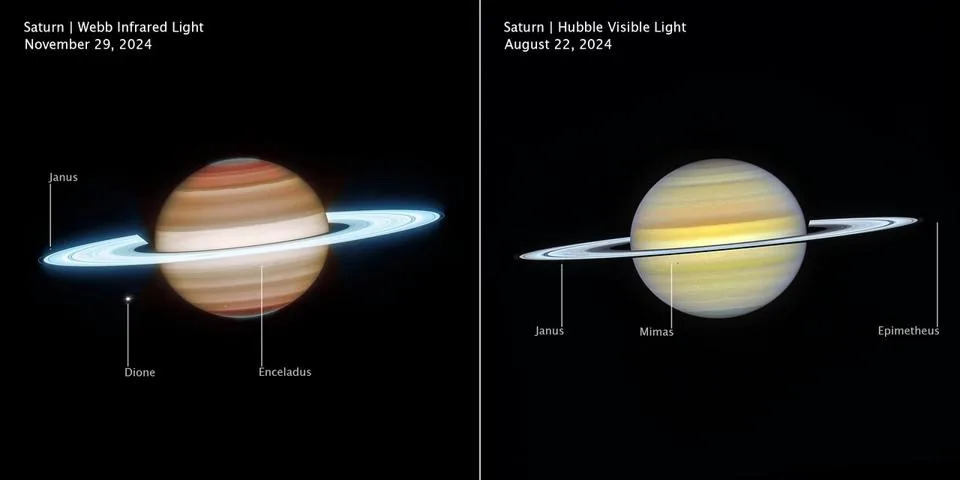
Side-by-side views of Saturn from the NASA/ESA/CSA James Webb Space Telescope (left) and the NASA/ESA Hubble Space Telescope (right) reveal the planet in infrared and visible light.
NASA, ESA, CSA, STScI, A. Simon
Saturn’s Mysterious Hexagon
One of Saturn’s most fascinating features — its hexagon-shaped jet stream at its north pole — is faintly visible in the images. First discovered by NASA’s Voyager spacecraft in 1981, this persistent weather pattern has remained stable for decades. Scientists believe these may be the last high-resolution views of the hexagon until the 2040s, as the region enters a prolonged winter darkness.
Also within Webb’s observations is a grey-green glow at Saturn’s poles, which is probably linked to high-altitude aerosols or auroral activity. These emissions may result from charged particles interacting with Saturn’s magnetic field, offering clues about the planet’s upper atmosphere.
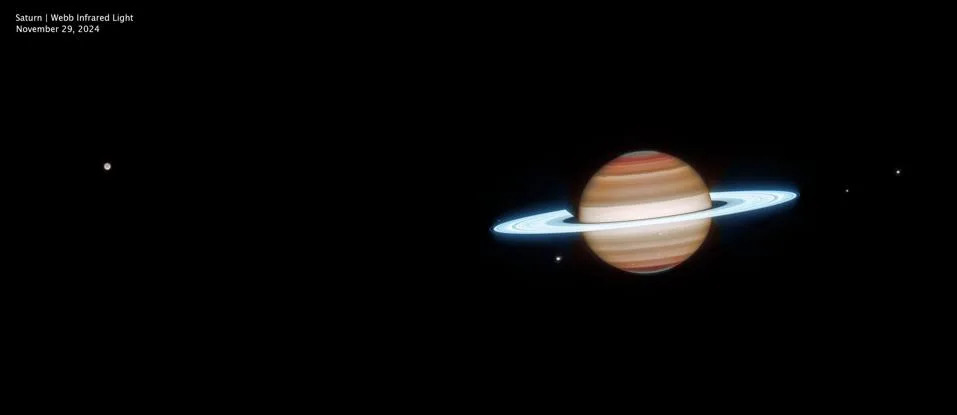
This wider infrared view of Saturn was captured on 29 November 2024 by the NASA/ESA/CSA James Webb Space Telescope. Saturn’s bright rings glow in reflected sunlight, and Webb’s observations reveal structures at different altitudes throughout the planet’s banded atmosphere.
NASA, ESA, CSA, STScI; Image Pro
How To See Saturn In 2026
Saturn sank into the evening twilight back in February and will emerge into the morning sky during June. By August, it will be visible around midnight, and on Oct. 4, it will reach its bright annual opposition, when it rises in the east during dusk, shines brightly all night, and sets in the west during dawn.
Wishing you clear skies and wide eyes.
First Appeared on
Source link






