


Netflix’s Lucy Letby documentary is shocking in familiar ways and whole new ones.
In 2015 and 2016, an unusually large number of babies in a neonatal unit in northern England died. In two trials, one lasting 10 months over 2022 and 2023 and the other concluding in July 2024, a young nurse on the ward named Lucy Letby was convicted of murdering, or attempting to murder, those children.
The case has made international headlines, and Letby has become a household name here in the U.K. The case has captured the public imagination in Britain for a variety of reasons. There is the maximally emotive nature of Letby’s supposed crimes. The potential murder of multiple tiny babies by a person who was tasked with their care is chilling. There is also Letby’s superficial appearance as an unremarkable young woman, someone who didn’t fit the stereotypical image people might have in their minds of a cold-blooded killer of children. But had the investigation into their deaths and the subsequent trials of Letby gone differently, it might have been that this incredibly dark incident could now be put out of mind, with the perpetrator placed behind bars for the rest of her life for crimes that she unquestionably committed. That is not what happened.
In the time since Letby’s initial conviction in 2023, several international medical experts have come forward to say that there was “no medical evidence” that Letby murdered the babies, by supposed injection of insulin or air embolisms, prompting a significant muddying of the waters of public opinion about the case. Only last week, a headline in the Sun, which previously ran stories about Letby under headers like “Poison Nurse Killed 7 Babies,” from last week, reads “Letby: The greatest miscarriage of justice this century,” quoting a retired police detective who has been reviewing the files. Despite Letby facing a life in prison and currently serving 15 whole-life orders, the death of these children has not been put to bed. So, as surely as the sun rises, there is now a Netflix documentary about it, which was released yesterday under the title The Investigation of Lucy Letby.
There was a strange period, starting about two years ago, when two separate, very long pieces of journalism were published in the U.S. about the case. The first was by Rachel Aviv for the New Yorker, and the second was by William Ralston in Vanity Fair. In both cases, the pieces were available to read online or in print in America but blocked for readers in the U.K. This was because a retrial on one of the murder counts that the jury didn’t reach a verdict on was still to come, and the U.K. has prohibitive laws about media coverage of unresolved legal cases that will go before a jury. Vanity Fair’s U.K. edition ran with the pages left blank. But of course, the internet exists, and people interested in the case here—of whom there are very, very many—were able to find and read the articles anyway if they wanted to. The stories reached opposite conclusions, Aviv leaning toward Letby’s innocence, and Ralston toward her guilt. This is a case that has divided the opinion of even those who have spent significant time reviewing it.
And so I didn’t expect this documentary to offer much in the way of clarity about whether Letby had been rightfully convicted. In a complex case like this, with a lack of concrete, smoking-gun evidence, that clarity may never come. It’s roughly a film of two halves, the first putting forward the prosecution’s case, and the second outlining the arguments that have been put forward pointing to her innocence. It covers all the ground that has already been covered in the press: that Letby was on duty as a nurse during the death of all the children, that, on the advice of a therapist to help her deal with the accusations against her, she wrote notes saying “I killed them on purpose because I’m not good enough,” that she maintains her innocence, that there are those who believe that the babies died due to NHS underfunding and terrible but routine errors made in their care.
Protecting the identities of the people involved was plainly at the front of the filmmakers’ minds. The producers have made the jarring decision to “digitally anonymize” the only one of the dead children’s mothers who appears in the production, and a university friend of Letby’s, who still believes in Letby’s innocence. This was done in the name of privacy, although why uncanny A.I. representations with out-of-sync lip movements was thought to be preferable to your standard silhouette interview in these circumstances I can’t say I understand. But the film is an interesting and uncomfortable document of whose privacy is deemed important in a case like this.
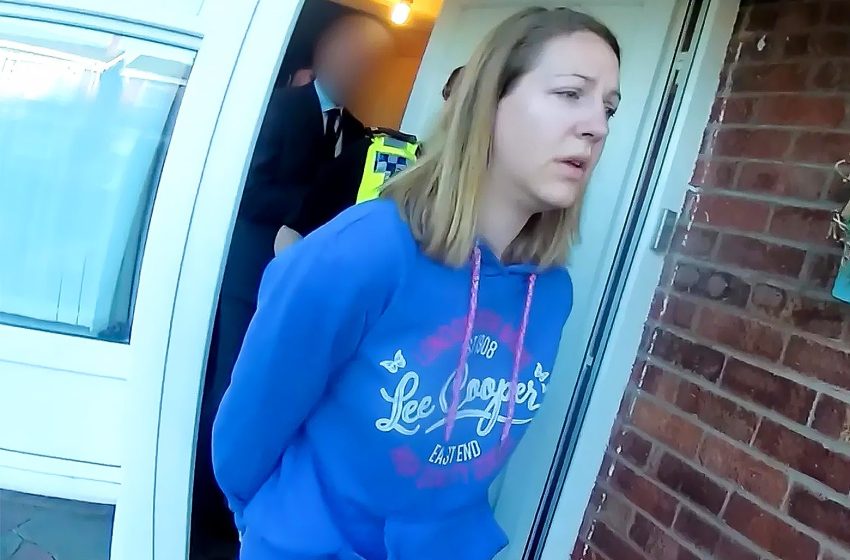
The documentary features a few glaring privacy violations, which Netflix perhaps not so coincidentally promoted in the lead-up to the film. This footage, provided to filmmakers by Cheshire Police, turned out to be body camera recordings taken of Letby being arrested on three separate occasions. Footage of officers entering Letby’s family home is the very first thing we see in the documentary. Her mother is heard wailing, “Please, no, not again, no, no!” Then, after Letby is escorted downstairs by police in her dressing gown, she hugs her cat goodbye and tells her parents, “You know I didn’t do it,” and her mother wails again, “I know you didn’t! We know that!,” then we hear the mother sobbing as Letby is placed in handcuffs on their doorstep. “Just go in, Mum, don’t—don’t look, Mum, just go.”
Letby’s parents told press this week that they had no idea that this footage had been given to Netflix for use in a documentary. Footage taken inside their home of the worst moments of their lives. Regardless of whether Lucy Letby is guilty of the terrible crimes she has been convicted of, her parents certainly didn’t do it. And still, against their will or knowledge, these clips of their pain have been packaged for strangers all over the world to view, inevitably, as entertainment. The only justification for including this footage is that it is shocking and will therefore draw more eyes to the program. In retelling a well-known event, journalists often have to ask themselves how their contribution moves the story forward. This footage may have been the documentarians’ answer to that question. But as with so much lurid true crime masquerading as a morally upstanding attempt to “spread awareness” or whatever, their answer here feels thin.
First Appeared on
Source link






