


Netflix’s The Stringer questions the story behind Vietnam’s most famous photo.
You know the image so well even a few words can conjure it in your mind: A 9-year-old girl, naked, runs down the middle of the road, her face contorted in pain, arms outstretched. The photograph, taken outside the Vietnamese village of Trang Bang in 1972, changed the course of the Vietnam War and, according to some of the subjects in Bao Nguyen’s documentary The Stringer, permanently altered the way we understand war itself. When Zach Cregger, the writer-director of Weapons, was searching for a way to embody the trauma left when children fall victim to inexplicable violence, he knew just what to evoke. As the movie’s third graders slip out of their parents’ houses in the middle of the night, in the grip of forces they will never understand, he writes in the film’s script, “they run like the naked Vietnamese girl covered in napalm from that iconic photo.”
That photo, sometimes called “The Terror of War,” or simply “Napalm Girl,” changed other things too, namely the life of Nick Ut, the 21-year-old photographer who won the Pulitzer Prize for getting the shot, and Phan Thi Kim Phuc, the photograph’s central subject, who survived to become a pharmacist and peace activist. But Nguyen’s documentary, which debuts on Netflix today, casts doubt on whether it was Ut who actually captured that image, which vaulted him into the ranks of the world’s top conflict photographers almost literally overnight.
The movie tracks an investigation by the photojournalist Gary Knight, also laid out in a lengthy Rolling Stone article, whose primary source is former Associated Press photo editor Carl Robinson. Robinson claims to have been in the AP’s Saigon office when the photo was being chosen from the dozens of shots, taken by several different photographers, of a ghastly instance of friendly fire—a South Vietnamese plane, attempting to target Viet Cong troops, inadvertently dropped napalm on a group of civilians who were attempting to flee to safety. There were plenty of strong images, including some offering a more discreet side view of the screaming girl. But Robinson’s boss Horst Faas, who had already won the AP two Pulitzers, one as a photographer and one as a photo editor, knew that what would become “The Terror of War” was the strongest choice, and ordered it to be sent over the wire. According to Robinson, who was responsible for keeping track of submissions, the image in question came from a stringer—a freelance photographer, and not Ut, who was on the AP’s staff. But as Robinson was finishing up the photo caption and arrived at the credit line, he says, Faas leaned over and issued another instruction: “Make it Nick Ut.”
Knight can’t offer more than speculation about why Faas, who died in 2012, might have made that fateful choice—perhaps he was just looking after the AP’s reputation, or perhaps he felt guilty about being indirectly responsible for the death of Ut’s older brother, also a photojournalist, who was killed on an AP assignment. In From Hell to Hollywood, the 2021 documentary that accompanied the AP book recounting Ut’s 50-plus-year career, Ut describes Faas struggling to keep him away from dangerous areas, while Ut kept pressing even after he was wounded several times. The movie also has trouble with the fact that Robinson left the incident out of his 2019 memoir The Bite of the Lotus, because, as he explains to the filmmakers, he didn’t want the allegation to overwhelm the rest of his book. And it doesn’t help that apart from Robinson, Ut’s colleagues lined up in his defense, including refusing to take part in the documentary. (Peter Arnett, another of the AP’s Pulitzer winners, warned Robinson in 2009 that “the AP with all its resources … will do everything possible to discredit you and your assertions.”)
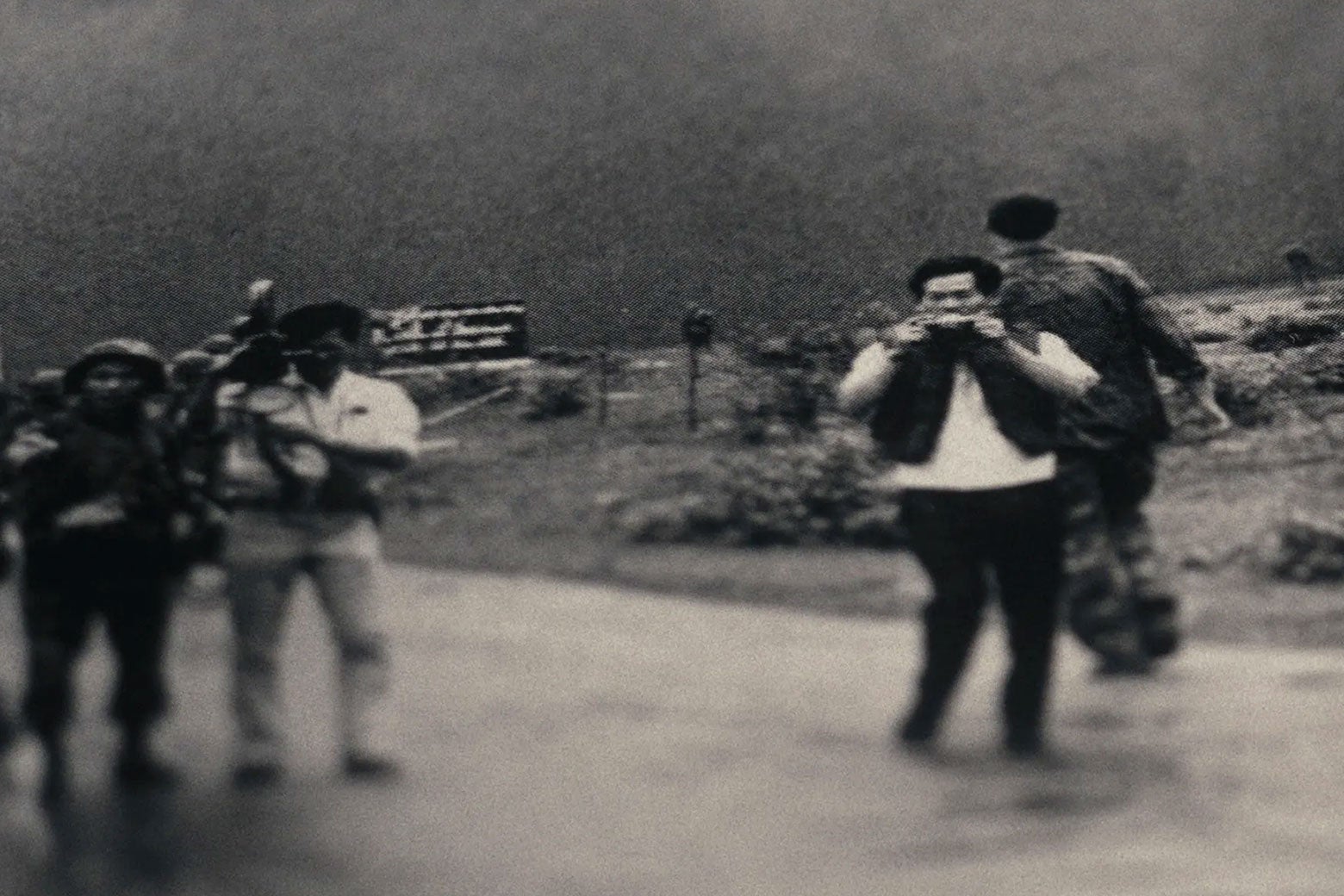
Then there’s the more fundamental question: How do you know who took a photograph, especially once the chain of custody has been broken? There’s no doubt that Ut was on the road in Trang Bang, as were numerous other photographers and camerapeople. There are even several visible in “The Terror of War,” including one you can see stuffing fresh film into his camera as the screaming children run by. Though much material has been lost over the decades, a good deal remains: still photographs and moving images, in color and black and white, documenting the moment the planes showered fire on the town, the sight of an older woman cradling the charred body of her 3-year-old grandson in her arms, instants before his death. Those images are shocking and sickening; they prick the conscience and embody the horrors of war. And yet none of them is the shot, the one you can picture without even closing your eyes.
The Stringer goes to great lengths to investigate the question of where Nick Ut was on that road, constructing a timeline of events and plucking his blurry silhouette out of the background of photos focused on other subjects. And it concludes, compellingly if not decisively, that it was a freelance photographer named Nguyen Thanh Nghe who was in the right place at the right time—the first and only time he sold photos to the AP. (“I knew I got the money shot,” he says in a recently filmed interview, but what he actually got was a $20 bill.) The process involves 3D simulations and forensic analysis, similar to the investigative methods that led the World Press Photo Foundation, which awarded Ut Photo of the Year in 1973, to remove his credit, and for the AP to deduce that the evidence, while raising doubts, was not definitive enough to warrant a change. (One particular calculation, the AP report determines, allows “a great margin of error.”) The conclusions are expressed in terms of possibilities and likelihoods, and though The Stringer itself admits no doubts, it’s possible to come away with them—and perhaps impossible not to.
The Stringer never makes any suggestion that Ut himself was involved in or even aware of the substitution of credit, and the closest to an accusation that he has knowingly perpetrated a falsehood comes from Knight’s own voice-over: “There’s always some mystery, but what you do know is what you didn’t take.” In From Hell to Hollywood, Ut describes seeing the famous image line up in his viewfinder, precisely as we know it now, so much so that it’s hard to believe he’s not remembering the photograph itself. In his great essay film Sans Soleil, Chris Marker talks about how photographs don’t just capture our memories but supplant them—we remember the photos we took instead of the moments we took them. “The Terror of War” has become part of how we remember Vietnam, whether we were there or not.
First Appeared on
Source link






