


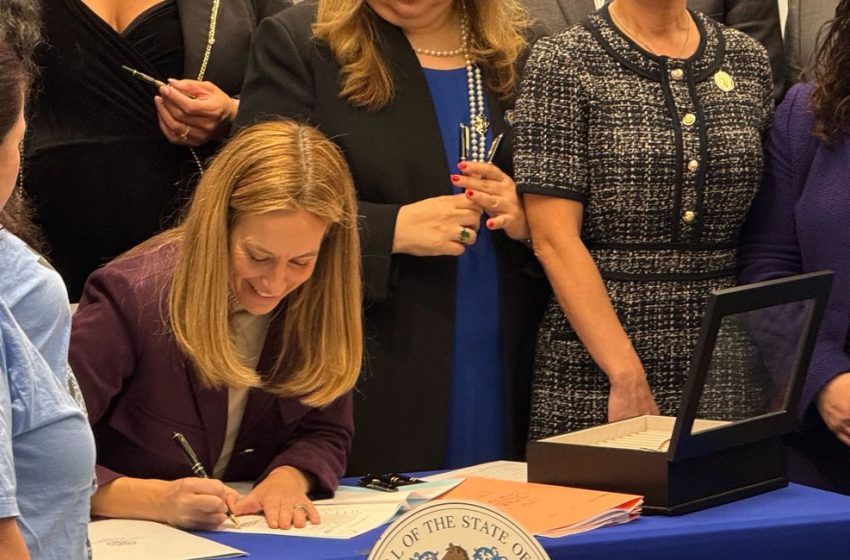
NJ Gov. Mikie Sherrill signs immigrant protections, police mask ban
New Jersey Gov. Mikie Sherrill signed three new laws Thursday restricting how state and local police can interact with federal immigration authorities and barring law enforcement from wearing face masks.
The new laws are the latest move by New Jersey leaders to fight back against President Donald Trump’s immigration enforcement policies, and they set the stage for potential court fights or retribution from the White House.
A Department of Homeland Security spokesperson called the mask ban — at least the third passed by a state government this year — unconstitutional, and said federal agents would ignore it.
“ We know the administration has challenged some of these measures in the past. We beat them in court then, and we’re happy to meet them in court again if they decide to sue now,” Sherrill said at the signing event in Newark. “Nothing is going to stop us from standing up for New Jersey and against Donald Trump’s overreach.”
The first law codifies the state’s Immigrant Trust Directive, a policy set by the state attorney general’s office in 2018 that limits local police’s role regarding immigration matters, including prohibitions on making stops or arrests based on suspected immigration status, or asking about a person’s immigration status unless that detail is relevant to investigating an indictable offense.
Officials in then-Gov. Phil Murphy’s administration said at the time that the goal was to build trust with immigrant communities and ultimately encourage them to cooperate with local cops trying to keep those communities safe. Sherrill stressed the same priority during her signing ceremony.
“In this state, we want all victims and witnesses to feel safe reporting violent crimes without worrying that they’ll be deported for it,” Sherrill said. “We want to build trust with all of our state and local police officers, and we want all of our taxpayers to be served.”
The second law, the Privacy Protection Act, restricts local and state government agencies, as well as health care providers, from sharing sensitive personal data like tax information or medical records with federal immigration authorities. Sherrill said the protections come with new urgency with the Trump administration using Medicaid data as part of immigration enforcement work.
“ Undocumented people do not receive Medicaid benefits, but some of their family members might, and ICE appears to have been using that data to track them. Not here,” Sherrill said. “No one in our state should ever be afraid to seek medical care, and this law protects them.”
Murphy pocket-vetoed versions of both bills in the final days of his administration. He said he supported the privacy bill, but had identified what he called a “drafting oversight” with language that could create conflicts with federal law.
Codifying the Immigrant Trust Directive was a different story. State lawmakers last year passed a bill called the Immigrant Trust Act, which would have codified the directive while also creating new protections. Murphy said the bill was unnecessary because the directive had already survived legal challenges, and he feared a new law with additional provisions would mean new court cases and possibly federal retribution.
Sherrill had said during her campaign that she shared Murphy’s concerns about the original Immigrant Trust Act. The new bill simply codifies the existing directive into law and does not include any additional measures.
The White House blasted the new laws and the state leaders who enacted them. Abigail Jackson, a White House spokesperson, said the Trump administration “will not waver on enforcing federal immigration law no matter how much Democrat politicians try to obstruct us.”
Immigration rights advocates praised Sherrill for codifying the directive, but said they hoped it would be a first step toward more protections.
“ We need to make sure that we are doing whatever we can to uphold due process and the rule of law and protect immigrant New Jerseyans,” said Amol Sinha, the executive director of ACLU-NJ. “However, the step that Gov. Sherrill took today and that the lawmakers sponsored brings us in the right direction, and it’s definitely going to strengthen the fabric of law here in New Jersey for protecting immigrants and protecting all New Jerseyans.”
The final law signed Wednesday morning bans law enforcement agents at any level of government from wearing masks, with some exceptions for undercover work or for health concerns in specific situations.
They must also identify themselves and the agency they work for before making an arrest.
New Jersey now joins at least two other states — California and Washington — in banning law enforcement officers from wearing masks. New York lawmakers and counterparts in several other states. are considering similar measures.
The Trump administration sued California over its mask ban. A federal judge last month put California’s law on hold because it included a carveout for state police.
The judge in that case indicated the ban itself was constitutional, but needed to be applied equally to all levels of government.
All three of the new laws were passed by state lawmakers on Monday in votes that split along partisan lines. Democratic lawmakers praised Sherrill for quickly enacting the new policies.
“I am just so proud to be part of the Garden State,” said state Senate Majority Leader Teresa Ruiz. “I’m so proud to send a message that when the federal government continues to fail, that the state will continue to stand up, to lean in, to have uncomfortable conversations, and more importantly, to protect humanity at a time where there is so much that’s going against the grain.”
“ We’ve got to guard our state in every way, shape, or form that we have and leverage every single right in our Constitution in order to stand up against fascism,” said state Sen. Britnee Timberlake, a Democrat from East Orange. “That’s what we’re doing today.”
Republicans have heavily criticized the bills. Assemblymember Paul Kanitra, a Republican from Point Pleasant Beach, led a rally outside the State House against the bills ahead of the final votes. He was joined by activists from conservative groups, including Wake Up NJ, Moms for Liberty and Turning Point USA.
State Senate Minority Leader Anthony Bucco proposed a failed amendment to create new exceptions in the Immigrant Trust Directive.
“Siloing law enforcement and restricting their ability to communicate with our federal partners is where this bill fails to protect public safety,” Bucco said after Monday’s vote. “We offered a straightforward amendment that would simply require federal law enforcement to be notified when individuals convicted of serious violent offenses are released from custody. Rejecting that reasonable safeguard made this bill impossible to support.”
First Appeared on
Source link






