


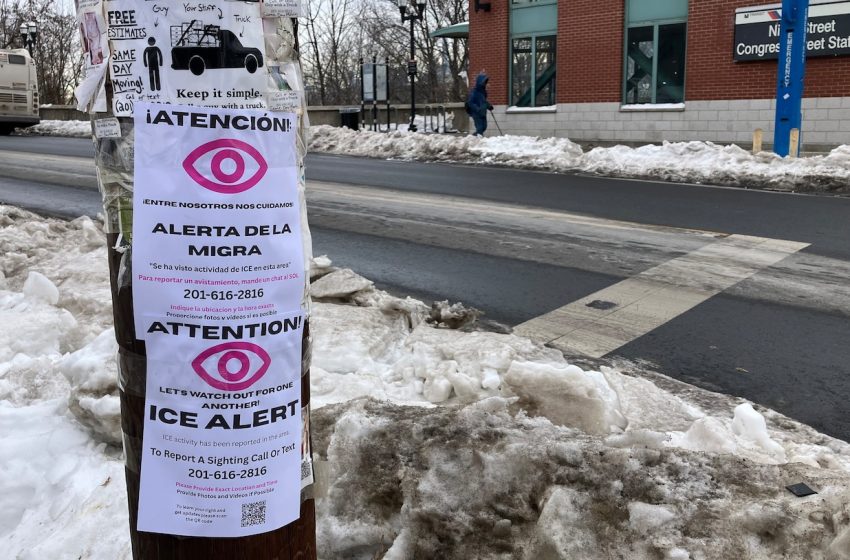
NJ Transit says it will follow Sherrill’s ICE order after riders plead for protection
NJ Transit will follow Gov. Mikie Sherrill’s executive order prohibiting U.S. Immigration and Customs Enforcement agents from accessing the agency’s non-public property without a warrant signed by a judge.
Comments from riders at NJ Transit’s Wednesday night board of directors meeting included 10 who asked for policies barring ICE agents from trains, buses and stations without a judicial warrant.
The requests followed ICE arrests on Feb. 2 at the 9th and Congress Street light rail station, which straddles Hoboken and Jersey City.
Hoboken Mayor Emily Jabbour said in a statement multiple witnesses confirmed they saw several people being apprehended from the light rail train and around the station. Some shot video of one of the arrests.
Riders also asked the agency to train employees how to handle situations when an individual claiming to be an ICE agent boards a train or bus or is in stations.
The request came on the same day Sherrill signed an executive order barring ICE agents from accessing non‑public areas of state property without a judicial warrant.
“Rest assured we will follow the executive order and I’ll leave it at that,” said NJ Transit CEO Kris Kolluri.
Speakers said policies are needed after reports of ICE agents arresting people in light rail stations and taking people off buses.
“I’ve seen video of ICE agents going on NJ Transit buses and light rail station elevators,” said Ron Bautista of Hoboken. “It creates fear and legal uncertainty for riders.”
He was one of the 10 speakers who asked the board for a policy.
“I’m a citizen — public transit should not be a place of intimidation, it should be a place of safety,” he said. “That’s why I’m asking the board to adopt a clear policy, similar to what Greyhound bus lines have done.”
On its website, Greyhound said the company “does not consent to, or provide permission for, warrantless and/or suspicion-less immigration enforcement activities on its buses or to access non-public areas of Greyhound property.”
The company bars employees from allowing agents to board Greyhound buses or access Greyhound non-public property at bus stations without a judicially enforceable warrant.
“In the event immigration enforcement agents make a verbal request or demand, the Greyhound employee or agent receiving the request or demand must document it in writing,” the company policy said.
“This is not to obstruct federal law, it clarifies property right and constitutional standards,” Bautista said. “You have the authority to set standards for entry.”
Other speakers referenced Sherrill’s order and said it should include NJ Transit buses and other vehicles because they are private spaces that require a ticket to enter.
“If you have melanin in your skin, you are fair game,” said Angelisha Chanhani. “The federal government has taken an unhinged and violent approach to immigration enforcement. No decent person feels safe when masked agents can pull someone off a train or bus because of their skin color.”
She called on NJ Transit to do the right thing.
NJ Transit officials didn’t say whether its compliance with the governor’s executive order would follow Greyhound’s example, but riders and some board members urged them to do so.
“As an agency and staff we should do everything to protect our riders and I ask the agency look into it,” said Vice Chairperson Kiabi Carson.
Sherrill’s executive order also prevents agents from using state property as staging areas for operations. Sherrill also unveiled a statewide portal for residents to upload photos and videos of ICE agents in action to document their activities.
The Democratic governor’s push comes after heightened ICE activity in New Jersey and a series of high‑profile incidents in other states that have drawn national scrutiny.
First Appeared on
Source link






