


No to Another Manufactured “Savior” for Iran
From Khomeini to Reza Pahlavi: Why Iranians must resist the recycling of dictatorship under a new brand.
Iran today stands at a historic crossroads. The political atmosphere bears unsettling similarities to the months preceding the fall of the Shah’s dictatorship on February 11, 1979. Back then, a narrative was carefully shaped around a single figure — Ruhollah Khomeini — elevating him into an untouchable symbol before many fully understood the consequences.
For the first time, many Iranians heard the title “Ayatollah” not from a cleric, but through international broadcasting. BBC Persian service became a primary source of updates about Khomeini during his exile. Night after night, people gathered to hear news of a man portrayed as the embodiment of salvation. What followed is now history.
The “Ayatollah” that emerged from that moment did not usher in freedom. Instead, Khomeini’s ideology metastasized into a rigid theocratic system that devastated Iran. Tens of thousands of students, intellectuals, and young activists were executed or imprisoned in the 1980s, culminating in the 1988 massacre of political prisoners. The consequences did not stop at Iran’s borders. Revolutionary fundamentalism spread across the region, fueling conflicts in Iraq, Syria, Yemen, Lebanon, and beyond. The ideology born in Tehran exported instability, violence, and repression throughout the Middle East — and even targeted Western nations that had once amplified its voice.
Today, Iran faces another decisive moment. Once again, familiar hands and familiar megaphones appear to be attempting to manufacture a new “savior.” This time, the figure is not a turbaned cleric but Reza Pahlavi, son of the former Shah, Mohammad Reza Pahlavi.
The packaging has changed. The imagery is modern. The rhetoric invokes democracy, secularism, and human rights. But the core question remains: is this genuinely about democratic self-determination, or is it another attempt to recycle authoritarian rule under a new brand?
Unlike 1979, today’s information landscape is not limited to a handful of radio broadcasts. Social media platforms and digital networks amplify narratives at unprecedented speed. The campaign surrounding Pahlavi is no longer confined to isolated outlets; it saturates online discourse. The tone has shifted from religious sermons to anti-clerical messaging, yet the method is strikingly similar: personalization of power, myth-building, and emotional mobilization centered on a single figure.
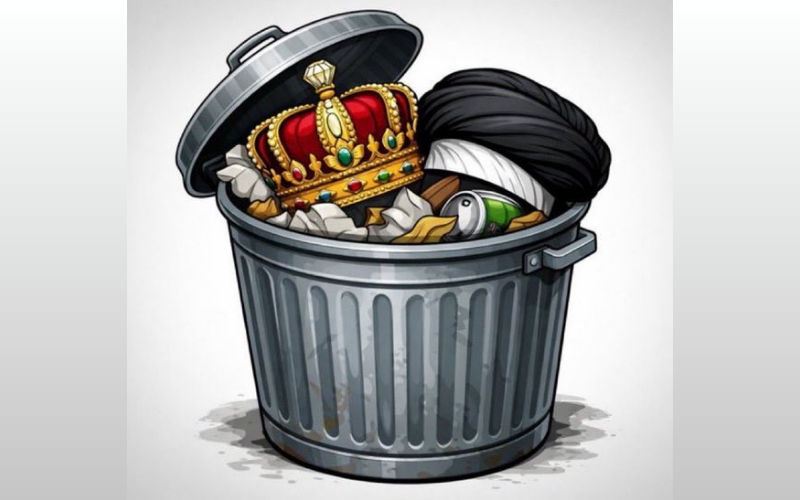
The irony is profound. In 1979, a religious strongman replaced a monarch. Now, amid widespread disillusionment with the theocracy, some attempt to present monarchy as the cure. History risks becoming a pendulum swinging between two forms of concentrated power — turban and crown — while bypassing genuine democratic sovereignty.
There are crucial differences between past and present. Khomeini returned to Iran with an established clerical network and a consolidated religious base. The Shah’s opposition forces had been decimated; many genuine democratic leaders were imprisoned or executed. Khomeini stepped into a political vacuum.
Today, that vacuum does not exist. Iran’s political landscape includes organized opposition movements with decades of experience confronting both monarchy and theocracy. These forces, having endured repression under both systems, explicitly reject any return to dynastic rule. They argue that Iran’s revolution was stolen once before — and must not be stolen again.
The central lesson of 1979 is not merely about the fall of one regime. It is about the danger of entrusting a nation’s future to a personality cult, whether religious or royal. Democracy cannot be imported through foreign amplification, nor restored through nostalgia. It requires institutional guarantees, pluralism, and accountability — none of which are compatible with hereditary power.
Iran’s younger generation, which has borne the brunt of repression and economic collapse, is increasingly aware of this distinction. Their protests in recent years have rejected both “Shah” and “Mullahs,” signaling a demand for a republic grounded in equal citizenship and popular sovereignty.
The stakes are immense. A second miscalculation could condemn another generation to authoritarianism disguised as salvation. The path forward must not revolve around creating another larger-than-life figure. It must center on dismantling structures of dictatorship — permanently.
Iran does not need a new “Ayatollah.” It does not need a restored monarch. It needs a democratic republic where no individual, family, or clerical establishment can monopolize power again.
First Appeared on
Source link






