


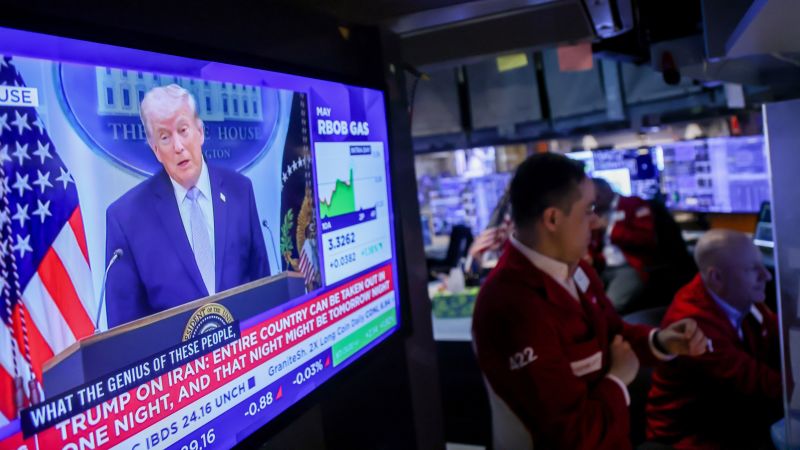
Oil prices drop and stocks rally after Trump’s ceasefire announcement
Oil prices plummeted and stocks surged Wednesday after US President Donald Trump agreed to a two-week ceasefire with Iran, spurring hopes that more oil tankers would soon be able to transit the key Strait of Hormuz.
WTI, the US crude benchmark, tumbled almost 16% to $95 a barrel – still well above the $67 level it settled at on February 27, before the war began. Brent crude futures, the global oil benchmark, dropped 14% to $93.8 a barrel.
Despite the sharp moves, uncertainty surrounds the ceasefire, in particular about a quick resumption of transits through the strait, through which about 20% of the world’s oil supply normally passes.
The war in the Middle East – and the effective closure of the crucial Strait of Hormuz – has caused the biggest oil supply shock on record, choking off roughly 12 million to 15 million barrels of crude oil a day.
“The market has been eager to get good news but it remains to be seen if the Strait of Hormuz opens fully,” Bob McNally, founder and president of Rapidan Energy Group, told CNN. “That’s the whole ball of wax and so far Washington and Tehran seem to be talking past each other on that.”
The terms under which tankers will be allowed to pass through the strait remain unclear, with Iran’s semi-official Tasnim news agency reporting that Iran and Oman plan to charge transit fees — a situation unlikely to be acceptable to the United States and its allies, particularly if any of that revenue flows to Iran’s Islamic Revolutionary Guard Corps (IRGC), designated a terrorist organization by many Western countries.
Iran also emphasized that the ceasefire was only temporary. “This is not the end of the war but all military branches should follow the Supreme Leader order and cease their fire,” according to a statement read out on state-run news channel IRIB.
Iran said its military would regulate passage through the Strait of Hormuz, granting the country “unique economic and geopolitical standing,” according to a statement from Iran’s Secretariat of the Supreme National Security Council.
Tehran has in recent weeks charged some shipping companies a reported $2 million fee to guarantee safe passage through the strait.
Transit fees of $1-2 million per tanker would add roughly $1 per barrel to the cost of oil transported through the Strait, according to Neil Shearing, group chief economist at Capital Economics. That amounted to a “modest impact on global energy prices,” though in practice could mean a “de facto partial nationalisation of the shipping route,” he added.
“There are significant hurdles to overcome before the ceasefire agreement between the US, Israel and Iran can translate into a lasting end to the war.”
Traders will now look for evidence that the large volume of oil and natural gas stranded in the Gulf region is beginning to move through the strait.
There are “early signs” of this happening, MarineTraffic, a ship-tracking platform, said on X. It said that a Greek-owned bulk carrier and a Liberia-flagged vessel had transited the strait early Wednesday.
As of Tuesday, 187 tankers laden with 172 million barrels of seaborne crude and refined oil products remained inside the Gulf, according to Kpler, a global trade intelligence firm.
That backlog won’t clear overnight, with potential lasting consequences for energy markets.
“Beyond the near term, Iran’s ruling regime has (arguably) solidified its political control, and has demonstrated its capacity for bringing global oil and gas markets to their knees,” Karl Schamotta, of Corpay Currency Research, wrote in a note Tuesday evening.
Beyond oil, news of the ceasefire has sparked a relief rally in stock markets around the world. South Korea’s Kospi led gains in Asia to close 6.87% higher. Japan’s Nikkei and Hong Kong’s Hang Seng gained 5.39% and 3.09% respectively.
In Europe, Germany’s Dax jumped 4.6% in morning trade, with indexes in Paris and London also posting healthy increases. US stocks looked set to open sharply higher, with Dow futures surging by 1,200 points, or 2.6%. Futures tied to the S&P 500 gained 2.7% and Nasdaq 100 futures rose by 3.5%.
Trump agreed to the ceasefire less than two hours before his 8 p.m. ET deadline to destroy a “whole civilization.” He said the agreement hinged on the reopening of the Strait of Hormuz.
“We received a 10 point proposal from Iran, and believe it is a workable basis on which to negotiate,” Trump posted on Truth Social on Tuesday night.
First Appeared on
Source link






