



Oldest wooden structure predates Homo sapiens by 200,000 years
Nearly half a million years ago – far earlier than researchers once believed – early humans were already building wooden structures.
A research team from the University of Liverpool and Aberystwyth University, reporting in Nature, excavated remarkably well-preserved wood at Kalambo Falls in Zambia.
The finds date to at least 476,000 years ago, long before modern humans, Homo sapiens, evolved.
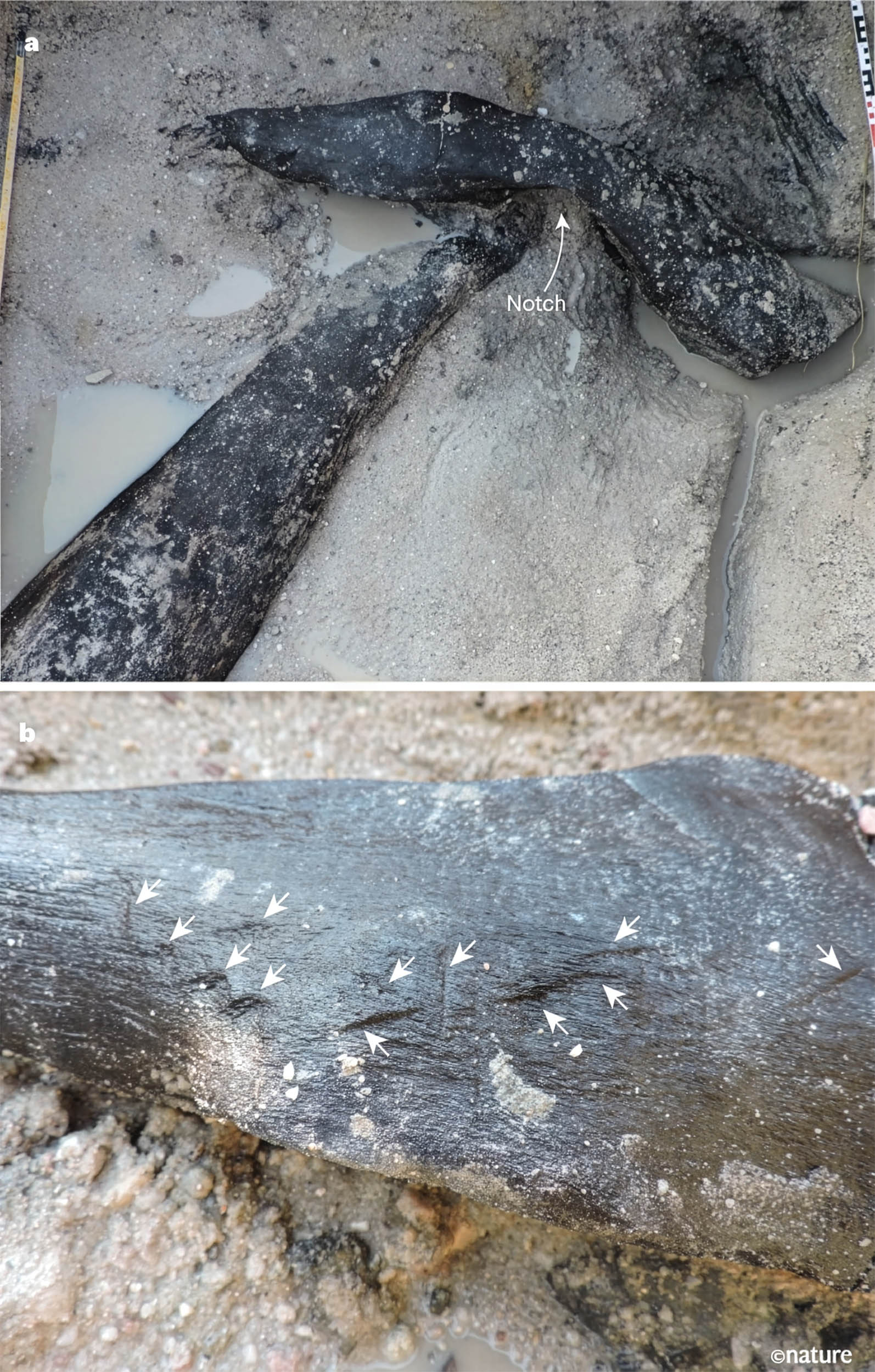
Shortly after making this discovery, Professor Larry Barham from the University of Liverpool and his team identified a wedge, a digging stick, a log cut with the help of tools, and a branch with a deliberate notch.
Such woodworking extends far beyond what was once thought possible of early humans living so long ago. These artifacts were preserved thanks to the waterlogged conditions at Kalambo Falls.
Early humans and the “wooden age”
Most knowledge of early humans comes from stone artifacts because stone survives the ages. Wood usually decays, leaving no trace.
Until now, evidence of early human wood use, or woodworking tools, had been limited to fire, digging sticks, or spears. The Kalambo Falls finds add a new dimension.
They show that some early hominins, perhaps Homo heidelbergensis, understood how to shape and join logs. This changes what we know about their abilities and creativity.
“This find has changed how I think about our early ancestors. Forget the label ‘Stone Age,’ look at what these people were doing: they made something new, and large, from wood,” Professor Barham enthused.
“They used their intelligence, imagination, and skills to create something they’d never seen before, something that had never previously existed.”
How to date ancient wood
Wood from nearly half a million years ago is rare. The team needed methods beyond traditional approaches to confirm the age.
“At this great age, putting a date on finds is very challenging and we used luminescence dating to do this. These new dating methods have far reaching implications – allowing us to date much further back in time, to piece together sites that give us a glimpse into human evolution,” explained Professor Geoff Duller from Aberystwyth University.
“The site at Kalambo Falls had been excavated back in the 1960s when similar pieces of wood were recovered, but they were unable to date them, so the true significance of the site was unclear until now.”
These dating techniques show that the wooden structures belong to a distant era.
By accurately placing these artifacts in time, the team can see how early humans selected materials, planned projects, and adapted to their environment long before modern humans appeared.
Why does any of this matter?
Some earlier views imagined a steady line of progress from simple to complex. They suggested that early hominins were not as inventive.
The Kalambo Falls discovery challenges that idea. Here are ancient people who didn’t just pick up whatever lay around.
They shaped wood with purpose and turned it into something with structure. This implies planning and the ability to think ahead.
The focus is not just on the tools they used but on the final product. They took logs and worked them into forms that required understanding material properties.
They recognized that certain pieces of wood, cut and fitted together, could create stable surfaces or supports. This level of planning and action was happening far earlier than many had believed possible.
“Stone Age” label no longer applies
Calling that period the “Stone Age” may have unintentionally downplayed other materials. The reason stone dominates our understanding of prehistory is that it lasts.
Wood rots, leaving open questions about what was once common. Only under special conditions, like those at Kalambo Falls, can wood survive for so many thousands of centuries.

This site makes it clear that the old labels may need revisiting. Early humans likely exploited a broad range of materials to get by. Perhaps many wooden inventions were lost through time because they decayed.
Now, with direct evidence, we see that early hominins didn’t rely solely on stone. They used wood to make tools, platforms, and other things that shaped their world.
How early humans worked with wood
Wood is not as durable as stone, but it has its advantages. It can be worked into different shapes and is easier to manipulate. For these ancient builders, wood would have been a familiar resource.
They knew which pieces to cut, how to notch branches, and how to create useful items. This knowledge hints at a long tradition of using wood for more than just simple objects.
Their approach to wood may have influenced how they hunted, gathered food, or constructed living spaces.
The find at Kalambo Falls highlights actions that usually remain invisible, locked away in times too old to remember.
Wood, tools, and early human history
To sum it all up, this new study shows us that human technology and culture did not simply move along one narrow track. People found ways to solve problems long before anyone thought possible.
The Kalambo Falls wood structure nudges us to think about human capabilities in a more flexible way.
Even when brains were smaller and modern humans had not yet appeared, early hominins were still clever enough to shape their environment to meet their needs.
This single discovery does not rewrite the entire story, but it adds details that help round it out. Early humans did more than chip stones — they worked with what was around them, including wood, to create something purposeful and enduring.
In a world that often underestimates these distant ancestors, the Kalambo Falls find proves they deserve more credit than we once gave them.
The full study was published in the journal Nature.
—–
Like what you read? Subscribe to our newsletter for engaging articles, exclusive content, and the latest updates.
Check us out on EarthSnap, a free app brought to you by Eric Ralls and Earth.com.
—–
First Appeared on
Source link






