


One of the Most Powerful Cosmic Rays Ever Detected May Have Come from This Nearby Starburst Galaxy
Detected in 2021, the Amaterasu particle ranks among the most energetic cosmic rays ever observed, carrying an estimated 244 exa-electronvolts. Its apparent arrival from a nearly empty region of space left astronomers perplexed. A new statistical analysis now points instead toward a nearby star-forming galaxy.
Recorded in May 2021 by Utah’s Telescope Array Project, the Amaterasu particle delivered an energy roughly 40 million times greater than that generated at the Large Hadron Collider. According to the detection team, its incoming direction aligns with the Local Void, a largely empty stretch of space near the Local Group, raising fresh questions about where such ultra-energetic particles are born.
An Extreme Detection From An Unlikely Direction
As stated in an EurekAlert report, ultra-high-energy cosmic rays are exceedingly rare and are believed to originate in some of the most energetic environments in the universe. When Amaterasu entered Earth’s atmosphere, TAP recorded an estimated energy of 244 EeV, placing it just below the highest-energy cosmic ray ever observed.
At the time, scientists could not determine whether the particle was a proton, a light nucleus, or a heavier nucleus such as iron. According to the Telescope Array Project’s reported findings, its trajectory seemed to point back to the Local Void, a sparsely populated region with few candidate sources capable of accelerating matter to such energies. That apparent mismatch quickly turned the event into a puzzle.
Simulating Particle Motion
Reconstructing the origin of a charged cosmic ray is complicated by magnetic fields that bend its path across intergalactic and galactic space. Even small deflections can obscure the true source.
According to a study published in The Astrophysical Journal addressed this challenge using physics-based simulations combined with Approximate Bayesian Computation, a modern statistical method. Their approach generated three-dimensional maps of cosmic-ray propagation and their interactions with magnetic fields in the Milky Way.
The researchers noted that reconstructing the energy of such particles is already difficult, which makes statistical source identification particularly demanding. By integrating simulations with observational constraints, they sought to evaluate a wider range of possible origins rather than rely solely on the initial directional estimate.
A Nearby Galaxy Emerges As a Candidate
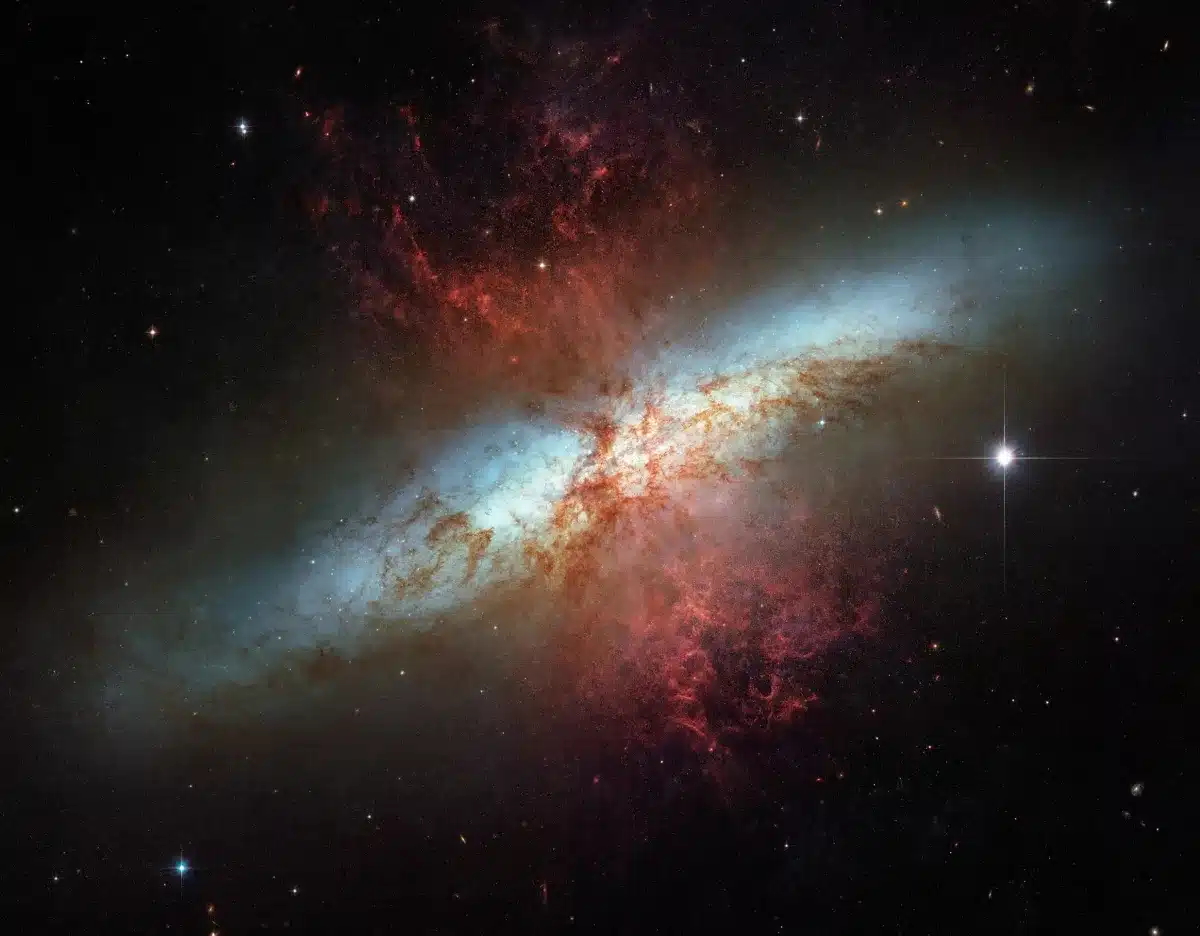
The analysis suggests that Amaterasu’s source may not be confined to the Local Void. Instead, it could lie within a broader nearby cosmic environment. One candidate identified in the study is M82, also known as the Cigar Galaxy, located about 12 million light-years from Earth.
According to Nadine Bourriche from the Max Planck Institute for Physics, the results indicate that the particle is more likely to have been produced in a nearby star-forming galaxy such as M82 than in a low-density region of space. The study presents a framework that connects simulations and observations more closely.
As Francesca Capel, who leads the Astrophysical Messengers group at MPP, explained in the study, exploring these particles helps scientists understand how the universe accelerates matter to such extreme energies and identify environments where matter can be studied under those conditions.
“Our goal is to develop advanced statistical analysis methods to exploit the available data to its full potential and gain a deeper understanding of the possible sources of these energetic particles,” she said.
First Appeared on
Source link






