


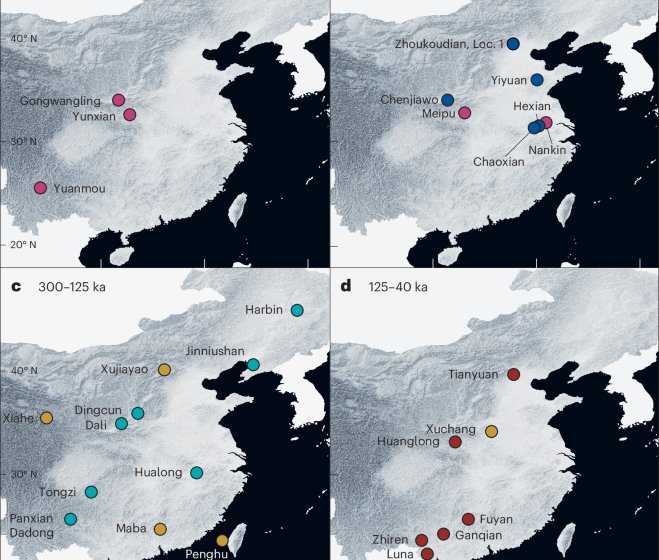
Palaeoanthropological evidence from China is changing the picture of hominin evolutionary history
Dubois, E. On Pithecanthropus erectus: a transitional form between man and the apes. J. Anthrop. Instit. Gr. Brit. Irel. 25, 240–255 (1896).
Darwin, C. The Descent of Man, and Selection in Relation to Sex (John Murray, 1871).
Bae, C. J. & Wu, X. Making sense of eastern Asian Late Quaternary hominin variability. Nat. Commun. 15, 9479 (2024).
Ji, Q. et al. Late Middle Pleistocene Harbin cranium represents a new Homo species. Innovation 2, 100132 (2021).
Stringer, C. The origin and evolution of Homo sapiens. Phil. Trans. Royal Soc. B 371, 20150237 (2016).
Krause, J. et al. The complete mitochondrial DNA genome of an unknown hominin from southern Siberia. Nature 464, 894–897 (2010).
Meyer, M. et al. A high-coverage genome sequence from an archaic Denisovan individual. Science 338, 222–226 (2012).
Slon, V. et al. The genome of the offspring of a Neanderthal mother and a Denisovan father. Nature 561, 113–116 (2018).
Fu, Q. et al. The proteome of the late Middle Pleistocene Harbin individual. Science 389, 704–707 (2025).
Tsutaya, T. et al. A male Denisovan mandible from Pleistocene Taiwan. Science 388, 176–180 (2025).
Weidenreich, F. The skull of Sinanthropus pekinensis: a comparative study on a primitive hominid skull. Palaeontolog. Sin. New Ser. D 10, 1–278 (1943).
Rightmire, G. P. Homo erectus and Middle Pleistocene hominins: brain size, skull form, and species recognition. J. Hum. Evol. 65, 223–252 (2013).
Xing, S. et al. The fossil teeth of the Peking Man. Sci. Rep. 8, 2066 (2018).
Pan, L. et al. Early Pleistocene hominin teeth from Gongwangling of Lantian, Central China. J. Hum. Evol. 168, 103212 (2022).
Xing, S. et al. Early Pleistocene hominin teeth from Meipu, southern China. J. Hum. Evol. 151, 10924 (2021).
Vialet, A. et al. Homo erectus from the Yunxian and Nankin Chinese sites: anthropological insights using 3D virtual imaging techniques. C. R. Palevol. 9, 331–339 (2010).
Feng, X. et al. The phylogenetic position of the Yunxian cranium elucidates the origin of Homo longi and the Denisovans. Science 389, 1320–1324 (2025).
Ni, X. et al. Phylogeny of Homo and its implications for the taxonomy of the genus. Paleoanthropology 2, 398–412 (2025).
Bermúdez de Castro, J. M. & Martinón-Torres, M. What does Homo antecessor tell us about the origin of the ‘emergent humanity’ that gave rise to Homo sapiens? J. Anthrop. Sci. 97, 209–213 (2019).
Meyer, M. et al. Nuclear DNA sequences from the Middle Pleistocene Sima de los Huesos hominins. Nature 531, 504–507 (2016).
Xing, S. et al. Hominin teeth from the early Late Pleistocene site of Xujiayao, Northern China. Am. J. Phys. Anthropol. 156, 224–240 (2015).
Wu, X. J. & Bae, C. J. Xujiayao Homo: a new form of large brained hominin in Eastern Asia. Paleoanthropology 2, 356–369 (2025).
Chen, F. et al. A late middle Pleistocene Denisovan mandible from the Tibetan Plateau. Nature 569, 409–412 (2019).
Scott, R. et al. A more comprehensive view of the Denisovan 3-rooted lower second molar from Xiahe. Proc. Natl Acad. Sci. USA 117, 37–38 (2020).
Prüfer, K. et al. The complete genome sequence of a Neanderthal from the Altai Mountains. Nature. 505, 43–49 (2014).
Dennell, R. Hominins, deserts, and the colonisation and settlement of continental Asia. Quat. Int. 300, 13–21 (2013).
Dennell, R. & Roebroeks, W. An Asian perspective on early human dispersal from Africa. Nature. 438, 1099–1104 (2005).
Wu, X. J. et al. Morphological description and evolutionary significance of 300 ka hominin facial bones from Hualongdong, China. J. Hum. Evol. 161, 103052 (2021).
Wu, X. J. et al. Morphological and morphometric analyses of a late Middle Pleistocene hominin mandible from Hualongdong, China. J. Hum. Evol. 182, 103411 (2023).
Wu, X. et al. The hominin teeth from the late Middle Pleistocene Hualongdong site, China. J. Hum. Evol. 206, 103727 (2025).
Liu, W. et al. Late Middle Pleistocene hominin teeth from Panxian Dadong, South China. J. Hum. Evol. 64, 337–355 (2013).
Wu, X. A well-preserved cranium of an archaic type of early Homo sapiens from Dali, China. Sci. Sin. 24, 530–542 (1981).
Wu, X. Z. in Middle Pleistocene Human Skull from Dali (eds Zhou, Z. Y. & Zhang, M. M.) 1–205 (Science Press, 2020).
Fu, Q. et al. Denisovan mitochondrial DNA from dental calculus of the >146,000-year-old Harbin cranium. Cell 188, 3919–3926 (2025).
Liu, W. et al. The earliest unequivocally modern humans in southern China. Nature 526, 696–699 (2015).
Bae, C. J. et al. On the origin of modern humans: Asian perspectives. Science 358, eaai9067 (2017).
Martinón-Torres, M. et al. Homo sapiens in the East Asian Late Pleistocene. Curr. Anthropol. 58, S17 (2017).
Liao, W. et al. Mosaic dental morphology in a terminal Pleistocene hominin from Dushan Cave in southern China. Sci. Rep. 9, 2347 (2019).
Zhu, Z. et al. Hominin occupation of the Chinese Loess Plateau since about 2.1 million years ago. Nature 559, 608–612 (2018).
Yang, S. X. et al. The Paleolithic in the Nihewan Basin, China: evolutionary history of an early to Late Pleistocene record in Eastern Asia. Evol. Anthrop. 29, 125-142 (2020).
Ma, D. D. et al. Earliest prepared core technology in Eurasia from Nihewan (China): implications for early human abilities and dispersals in East Asia. Proc. Natl. Acad. Sci. USA 121, e2313123121 (2024).
Sun, Y. et al. Diverse manifestations of the mid-Pleistocene climate transition. Nat. Commun. 10, 352 (2019).
Yang, S. X. et al. The lithic assemblages of Donggutuo, Nihewan basin: knapping skills of Early Pleistocene hominins in North China. PLoS ONE 12, e0185101 (2017).
Yang, S. X. et al. Technological innovations at the onset of the Mid-Pleistocene Climate Transition in high-latitude East Asia. Natl Sci. Rev. 8, nwaa053 (2021).
Hou, Y. et al. Mid-Pleistocene Acheulean-like stone technology of the Bose basin, South China. Science 287, 1622–1626 (2000).
Feng, X. Technological characterization of China and Europe Lower Paleolithic industry from 1 Ma to 400,000 years: similarity and difference between the Yunxian hominid culture and European Acheulean. L’Anthropologie 112, 423–447 (2008).
Li, H. et al. The Middle Pleistocene handaxe site of Shuangshu in the Danjiangkou reservoir region, Central China. J. Arch. Sci. 52, 391–409 (2014).
Li, H. et al. The temporal–spatial evolution of handaxe technology in China: recent progress and future directions. Sci. Bull. 69, 2161–2165 (2024).
Zhang, Y. et al. The use of fire at Zhoukoudian: evidence from magnetic susceptibility and color measurements. Chin. Sci. Bull. 59, 1013–1020 (2014).
Huang, C. et al. Evidence of fire use by Homo erectus pekinensis: an XRD study of archaeological bones from Zhoukoudian Locality 1, China. Front. Earth Sci. 9, 811319 (2022).
Hu, Y. et al. Late Middle Pleistocene Levallois stone-tool technology in southwest China. Nature 565, 82–85 (2019).
Li, Z. et al. Engravings on bone from the archaic hominin site of Lingjing (Xuchang, Henan, China). Antiquity 93, 886–900 (2019).
Lin, N. R. et al. Lithic miniaturization and hafted tools in early Late Pleistocene Salawusu, North China. J. Archaeol. Sci. Rep. 48, 103831 (2023).
Liu, J.-H. et al. 300,000-year-old wooden tools from Gantangqing, southwest China. Science 389, 78–83 (2025).
Miller-Antonio, S. et al. Raw material selection and evidence for rhinoceros tooth tools at Dadong Cave, southern China. Antiquity 74, 372–379 (2015).
Zhang, D. D. et al. Earliest parietal art: hominin hand and foot traces from the middle Pleistocene of Tibet. Sci. Bull. 66, 2506–2515 (2021).
Yang, S. X. et al. A Late Acheulean culture on the Chinese Loess Plateau: the techno-economic behavior of the Dingcun lithic industry. Quat. Int. 400, 73–85 (2016).
Otte, M. et al. Panxian Dadong et le Levallois Chinois. Anthropologie 121, 255–269 (2017).
Ruan, Q. J. et al. Quina lithic technology indicates diverse Late Pleistocene human dynamics in East Asia. Proc. Natl Acad. Sci. USA. 122, e2418029122 (2025).
Ma, N. et al. A preliminary study on the stone artifacts excavated from locality 74093 of the Xujiayao site in 1977. Acta Anthropol. Sin. 30, 275–288 (2011).
Pei, S. W. et al. Lithic assemblage and adaptive behaviors of hominins at Hualongdong site. Acta Anthropol. Sin. 44, 765–778 (2025).
Li, H. et al. Technological behaviour of the early Late Pleistocene archaic humans at Lingjing (Xuchang, China). Archaeol. Anthropol. Sci. 11, 3477–3490 (2019).
Yue, J. P. et al. Technological innovations and hafted technology in central China ~160,000–72,000 years ago. Nat Commun. 17, 615 (2026).
Li, J. S. et al. A preliminary application of dental cementum incremental analysis to determine the season-of-death of equids from the Xujiayao site, China. Sci. China Sci. D 60, 1183–1188 (2017).
Doyon, L. et al. A 115,000-year-old expedient bone technology at Lingjing, Henan, China. PLoS ONE 16, e0250156 (2021).
Dennell, R. et al. A demographic history of Late Pleistocene China. Quat. Int. 559, 4–13 (2020).
Yang, S. X. et al. Initial Upper Palaeolithic material culture by 45,000 years ago at Shiyu in northern China. Nat. Ecol. Evol. 8, 552–563 (2024).
Wang, F. G. et al. Innovative ochre processing and tool use in China 40,000 years ago. Nature 603, 284–289 (2022).
Bae, C. J. et al. Hominin distribution and density patterns in Pleistocene China: climatic influences. Palaeogeogr. Palaeoclimatol. Palaeoecol. 512, 118–131 (2018).
Sun, X. F. et al. Hominin distribution in glacial–interglacial environmental changes in the Qinling Mountains range, central China. Quat. Sci. Rev. 198, 37–55 (2018).
Zan, J. et al. Mid-Pleistocene aridity and landscape shifts promoted Palearctic hominin dispersals. Nat. Commun. 15, 10279 (2024).
Zhou, B. et al. Hominin response to oscillations in climate and local environments during the Mid-Pleistocene climate transition in northern China. Geophys. Res. Lett. 50, e2023GL104931 (2023).
Yang, S. X. et al. Hominin site distributions and behaviours across the Mid-Pleistocene climate transition in China. Quat. Sci. Rev. 248, 106614 (2020).
Dennell, R. The Palaeolithic Settlement of Asia (Cambridge Univ. Press, 2008).
Ni, X. et al. Massive cranium from Harbin in northeastern China establishes a new Middle Pleistocene human lineage. Innovation 2, 100130 (2021).
Sawafuji, R. et al. East and Southeast Asian hominin dispersal and evolution: a review. Quat. Sci. Rev. 333, 108669 (2024).
Boivin, N. et al. Human dispersal across diverse environments of Asia during the Upper Pleistocene. Quat. Intl. 300, 32–47 (2013).
Dennell, R. The Nihewan Basin of North China in the Early Pleistocene: continuous and flourishing, or discontinuous, infrequent and ephemeral occupation? Quat. Intl. 295, 223–236 (2013).
Roberts, P. et al. Tropical forests and the genus. Homo. Evol. Anthrop. 6, 306–317 (2016).
First Appeared on
Source link






