


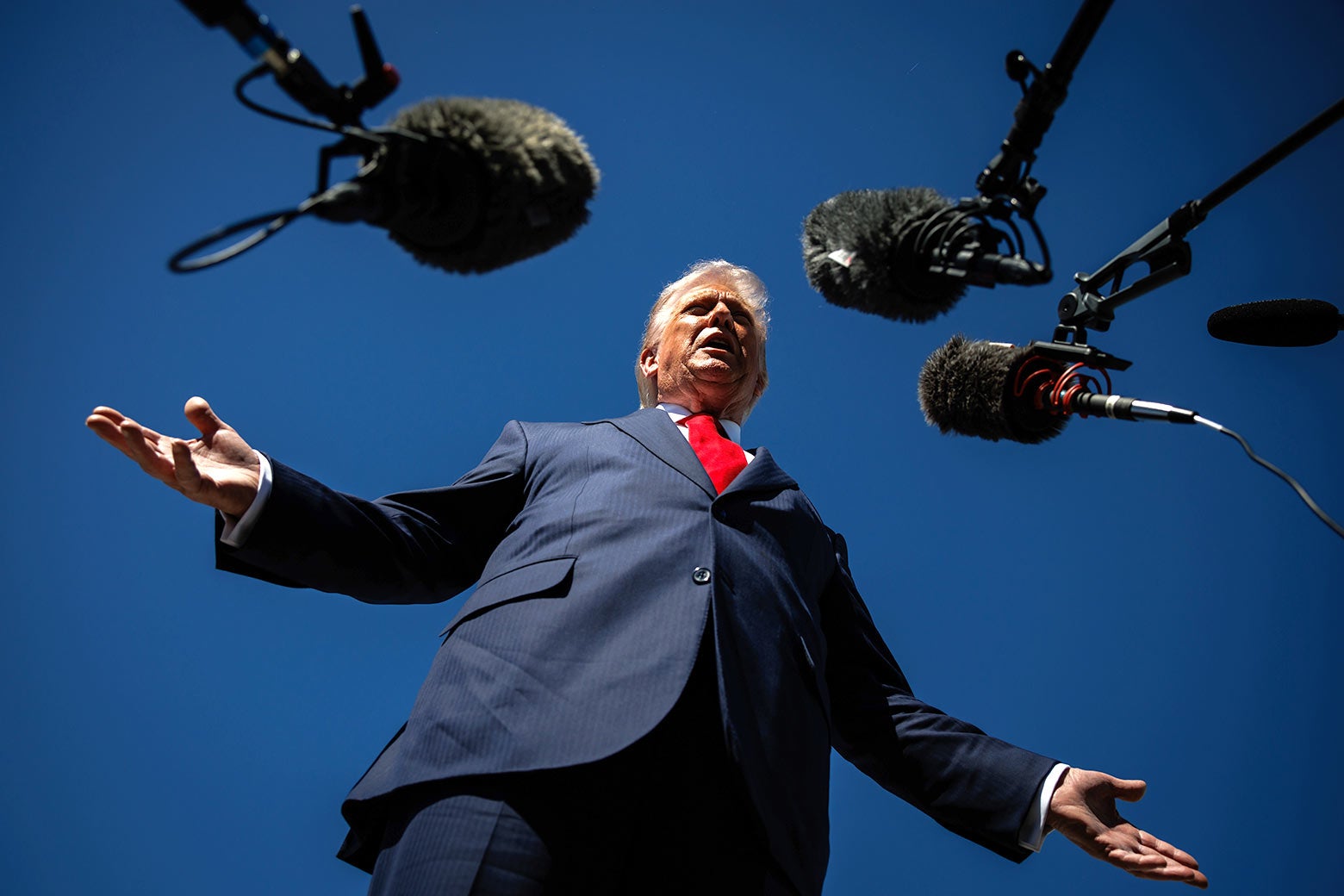
Peace in Gaza may now, unfortunately, come down to Trump.
Sign up for the Slatest to get the most insightful analysis, criticism, and advice out there, delivered to your inbox daily.
In the late 1980s to mid-’90s, when Dennis Ross was Middle East envoy for Presidents George H.W. Bush and Bill Clinton, he would sometimes get phone calls at nights or on weekends from some Israeli security guard at a Palestinian checkpoint. A fistfight was about to break out, and the guard needed Ross to help calm things down.
Some thought, especially in retrospect, that Ross immersed himself too deeply in micromanaging peace, that his approach tended to infantilize the region’s players and made them too dependent on outside powers. But the region was a tinderbox, and one of Ross’ jobs was to put out fires the instant someone lit a match, because fires in the Middle East can spread far if the flames aren’t doused quickly.
The same is true today, and the region’s politics—the range of players and their multiplicity of interests—have only grown more complex.
The point is this: President Donald Trump helped craft a ceasefire in Gaza, in part by pressuring Israeli Prime Minister Benjamin Netanyahu and by persuading Sunni Arab leaders to pressure the leaders of Hamas. But the accord they signed last month was merely Phase 1 of a larger peace proposal, covering just the first few planks of a 20-point plan that Trump had placed on the table. If there is ever to be a Phase 2, Phase 3, and beyond, Phase 1—the ceasefire—must hold. And for that to happen, the pressure from outside powers must persist. It’s probably asking too much for some American to mediate every fracas at a checkpoint from the other side of the planet, but an American has to remain engaged over the long haul.
Given Arab-Israeli politics at the moment, that American must be President Trump. That was the judgment of four veteran correspondents with the Israeli newspaper Haaretz speaking on a subscribers’ webinar last week, and they’re probably right.
Trump has more leverage over Netanyahu than any American president has ever had, in part because Trump is more instinctively supportive of Israeli policies and actions than any president has been. Much of Netanyahu’s domestic support (dwindling though it is) stems from the perception that he has the American president in his pocket—and thus a near guarantee of essential U.S. support. This self-assurance led him to believe he could get away with trying to kill Hamas negotiators while they were on a diplomatic mission in Qatar—perhaps unaware that Trump placed a supreme value on Qatar’s friendship. (The emirate hosts the largest U.S. military base in the Middle East and personally gave Trump a $400 million passenger plane to use as his next Air Force One.) This act deeply angered Trump, who demanded that Netanyahu apologize to the Qatari government and drop his resistance to a ceasefire in Gaza. This pressure, in turn, persuaded other regional leaders—in Qatar, Egypt, Saudi Arabia, Jordan, and Turkey—to hammer Hamas into accepting a ceasefire and hostage release without a full Israeli withdrawal from Gaza.
Trump attended the signing of the deal in Cairo and acted as if the ceremony constituted not just peace but “everlasting peace.” Perhaps he believed it. He didn’t (and still doesn’t) realize that, especially in the Middle East, signing a peace deal is the easiest part of peace—doubly so for a deal that’s only a temporary truce to begin with.
Within days, the ceasefire faltered. Hamas freed all the Israeli hostages on schedule but missed the deadline for returning the remains of all the hostages who had died—though Hamas claimed they were having a hard time finding them. Hamas gunmen also killed two Israeli soldiers in a firefight—though Hamas claimed the culprits were rival radical militias, with whom they were engaged in their own internecine conflict. Netanyahu resumed the bombing of Gaza, including residential areas where civilians had returned, reportedly killing 100 Palestinians. The ceasefire has since resumed, but who can say for how long—or whether negotiations for Phase 2 and beyond will even begin.
When Israel resumed bombing, Trump sent Vice President J.D. Vance and Jared Kushner, his son-in-law, who had played a role in nailing down the ceasefire (as well as his first term’s Abraham Accords), to lean on Netanyahu—though they publicly said their mission was to declare support for Israel. Everyone knew the real reason for the trip, but the mixed message inspired some right-wing members of Netanyahu’s coalition—who don’t want a peace of any sort anyway—to introduce a bill in the Knesset calling for Israel to annex the West Bank. This, even though Trump had promised the Arab leaders that he would personally prevent Israel from doing so. On the plane back to Washington, Vance denounced the bill as a “very stupid political stunt,” but Trump said nothing—not that we know of anyway—and so, Netanyahu’s partners got the message that they could give the finger to Trump’s messengers, that they weren’t the same as Trump.
As the first step of many steps to come, Trump needs to dispel this impression. If he wants to send envoys to lean on Netanyahu (and no president would have the time to do this personally every time it needs to be done), he needs to make clear that the envoys speak for him and that treating them cavalierly will have consequences. Presidents Bush and Clinton did that for Dennis Ross, which is why Arabs and Israelis alike viewed Ross not as a neutral intermediary (the U.S. clearly sided with Israel in the overall conflict) but at least as a fair one. Ross also had extensive background in the region, which is more than can be said for Vance or Trump’s official emissary, the very green real-estate magnate Steve Witkoff. Kushner is no expert either, but at least he has come to know the region’s key players and can credibly claim to speak for Trump.
But Trump himself needs to get more deeply involved. The Haaretz panelists expressed doubt as to whether he has the patience or temperament to do so. As a first step, he needs to realize that the deal he helped strike—though impressive—did not end the conflict, much less sprout everlasting peace. That fact alone might be too unsettling for him to acknowledge, much less act on.

First Appeared on
Source link






