


Phasing out nuclear power was ‘strategic mistake’
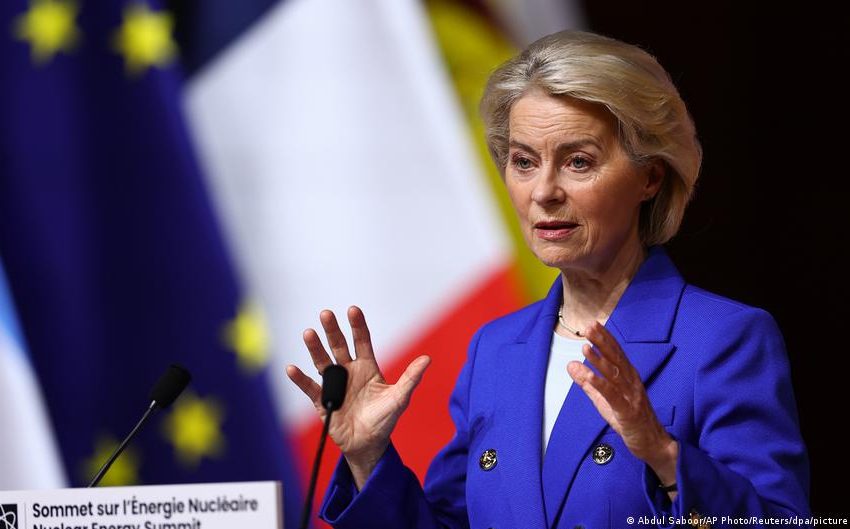
European Commission President Ursula von der Leyen said on Tuesday that Europe’s turn away from nuclear power had been a “strategic mistake” that was now exposed by the Iran war.
“This reduction in the share of nuclear was a choice, I believe that it was a strategic mistake for Europe to turn its back on a reliable, affordable source of low-emissions power,” von der Leyen said at the opening of a nuclear energy summit near Paris.
“For fossil fuels, we are completely dependent on expensive and volatile imports. They are putting us at a structural disadvantage to other regions,” she added.
It comes as the US-Israeli war against Iran has damaged major oil refineries and led to the closure of the Strait of Hormuz — a shipping route that is a major chokepoint for the world’s oil supply.
Von der Leyen called the war “a stark reminder” of the vulnerabilities that come with being dependent on fossil fuel imports.
Von der Leyen, Macron call for energy independence
At the summit, von der Leyen announced a €200 ($230 million) fund for European nuclear innovation.
She said that “while in 1990, one-third of Europe’s electricity came from nuclear, today it’s only close to 15%”.
Germany was one country that aggressively wound down its nuclear generation in the wake of the 2011 Fukushima disaster. Its neighbor, France, continued to embrace the technology which now accounts for more than two thirds of its electricity production.
“Nuclear power is key to reconciling both independence — and thus energy sovereignty — with decarbonization, and thus carbon neutrality,” French President Emmanuel Macron said at the summit.
“We can see it in our current geopolitical context: when we are too dependent on hydrocarbons, they can become a tool of pressure, or even of destabilization.”
France has in recent years sourced much of its natural uranium from Kazakhstan, Australia, Namibia and politically volatile Niger .
According to EU nuclear agency Euratom, Canada provided 34% of the bloc’s natural uranium in 2024, the most recent year on record, followed by Kazakhstan with 24% and Russia with around 15%.
What measures did EU leaders propose?
Von der Leyen announced a goal of rolling out small modular reactors (SMRs) across the EU by 2030 and harmonizing regulations between member states.
Unlike traditional reactors which produce around 1,0000 megawatts (MW), SMRs produce around 300 MW but are more affordable and quicker to build because they can be mass produced in factories.
“The logic is very clear. When it is safe to deploy, it has to be simple to deploy all across Europe,” von der Leyen said.
Macron proposed standardizing reactor designs across Europe — a move that could benefit France’s state-owned nuclear giant EDF which has lost out on contracts in recent years.
In 2024, the Czech Republic awarded a tender to build a new power plant to South Korea’s KHNP, which France’s EDF tried and failed to block in court.
Meanwhile, Greek Prime Minister Kyriakos Mitsotakis said his country plans to “lead the conversation” on using nuclear power to decarbonize shipping.
Anti-nuclear protesters storm stage
Two Greenpeace activists stormed the stage at the start of the summit, interrupting Macron and International Atomic Energy Agency chief Rafael Grossi as they were greeting heads of state.
The protesters held banners that read “Nuclear Power = Energy Insecurity” and “Nuclear power fuels Russia’s war.”
One of them asked Macron, “Why are we still buying uranium from Russia?” to which the president made the claim: “We produce nuclear power ourselves.”
French customs data from 2025 showed that the country imported 39% of its enriched uranium from Russia that year.
Meanwhile, around a dozen Greenpeace activists also blocked vehicles as they arrived at the summit.
Edited by: Rob Turner
First Appeared on
Source link






