


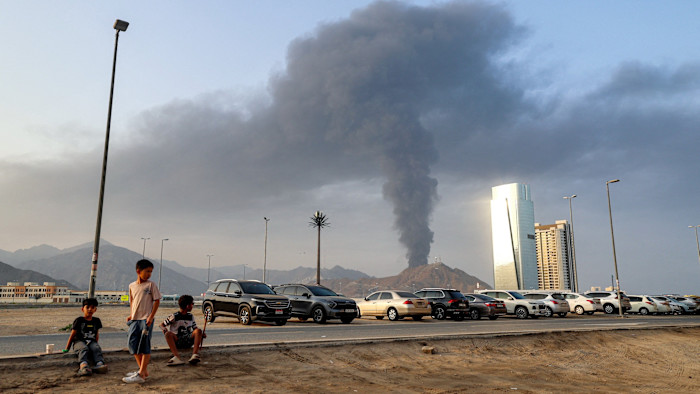
Rate of Iranian ballistic missile launches is declining, western officials say
Unlock the Editor’s Digest for free
Roula Khalaf, Editor of the FT, selects her favourite stories in this weekly newsletter.
A sharp drop-off in Iran’s firing of ballistic missiles since the start of the war is evidence that a US and Israeli air campaign to destroy launchers and weapons stockpiles is working, according to western officials.
The United Arab Emirates said a total of 189 ballistic missiles have been fired by Iran towards the UAE since the start of the war, reflecting Tehran’s efforts to sow chaos across the Middle East.
But while 137 missiles were launched towards the UAE on Saturday, the first day of the war, just three were fired on Wednesday as of noon local time.
Of these three, only one missile landed within UAE territory, the country’s defence ministry said. The UAE publishes the most complete data on missile launches and interceptions of nations embroiled in the war.
Western officials were quick to claim that the US and Israeli strategy of using military aircraft to hunt for and destroy missile launchers and weapons stockpiles on the ground in Iran was working.
“We are starting to see a decline in Iranian missile strikes. That is . . . down to the work that the US and Israel are doing to destroy those launch sites and to attack those systems,” one western official said.
“We assess that Iran has several more days of capability to continue their activity.”
General Dan Caine, chair of the US joint chiefs of staff, said the rate at which Iran was firing ballistic missiles had declined 86 per cent since the start of the war. The rate had dropped 23 per cent in the past 24 hours, he added.
He appeared to be speaking about medium and long-range ballistic missiles capable of reaching Israel, and it was not clear what precise timeframes he was referring to.
Lynette Nusbacher, a former adviser on intelligence to the UK government, said the drop-off in Iran’s firing of ballistic missiles may be a function of it becoming harder.
“The [Iranian] missile commanders are firing, moving, setting up, fuelling and launching as fast as they can. Their problem is ‘as fast as they can’ is getting slower.
“The Americans and Israelis have been destroying launchers, and missiles, fuel for the liquid-fuelled missiles, and diesel for fuelling the launchers . . . It’s all depleted.”
But it is also possible that the drop-off is a conscious strategy by Iran to conserve weapons for a longer war.
Israeli military officials had dubbed Iran’s slow and steady missile launches on Saturday as a “drizzle” strategy, saying that it was evidently designed to use up their interceptors that form part of air defence systems.
During last June’s 12-day war between Israel and Iran, analysts noticed that Tehran saved its best missiles for later in the conflict, after Israeli stockpiles of interceptors had run down.
“The drop in the rate of missiles might point to conservation as we saw at the end of the June war,” one analyst said.
Indeed, the reduced rate of firing may be an attrition strategy, said Decker Eveleth, an analyst at the Centre for Naval Analyses, a non-profit research organisation.
However, he said on X that Iran had little option but to do this. “It should be noted that this is not a strategy of choice. It is the only strategy available under likely launcher shortages and a failure to police their own airspace.”
Iran was judged by the Israeli military to have begun the war with roughly 2,500 medium- to long-range ballistic missiles capable of hitting Israel. It also had many thousands of short-range ballistic and cruise missiles that could be targeted on Gulf states, according to the Israel Defense Forces.
“I tend to agree that very likely the launch capacity of Iran has been heavily degraded,” said Fabian Hoffman, research fellow at the University of Oslo, adding the drop-off in launches — evident in statistics — was too drastic to be tactical.
The US and Israeli focus on hunting down Iran’s missile launchers “appears to be successful”, he said adding: “They’re may not be running out of missiles, they’re running out of launchers”.
Amid Iran’s drop-off in ballistic missile launches, Tehran appears to have grown more reliant on the use of cheap Shahed “kamikaze” drones.
These attack drones can be easily hidden and launched from virtually anywhere, and are therefore less vulnerable to US and Israeli military strikes.
A decline in Shahed launches, while evident, was not as sharp compared with missiles over the same period, according to UAE defence ministry data.
A total of 941 one-way attack drones have been launched against the UAE so far, including 129 on Wednesday, of which 121 were intercepted.
The drones, which carry a 30-50kg warhead, have struck several targets such as a US navy base in Manama, Bahrain, a US radar installation in Qatar and the US consulate in Riyadh.
Data visualisation by Alan Smith
First Appeared on
Source link






