


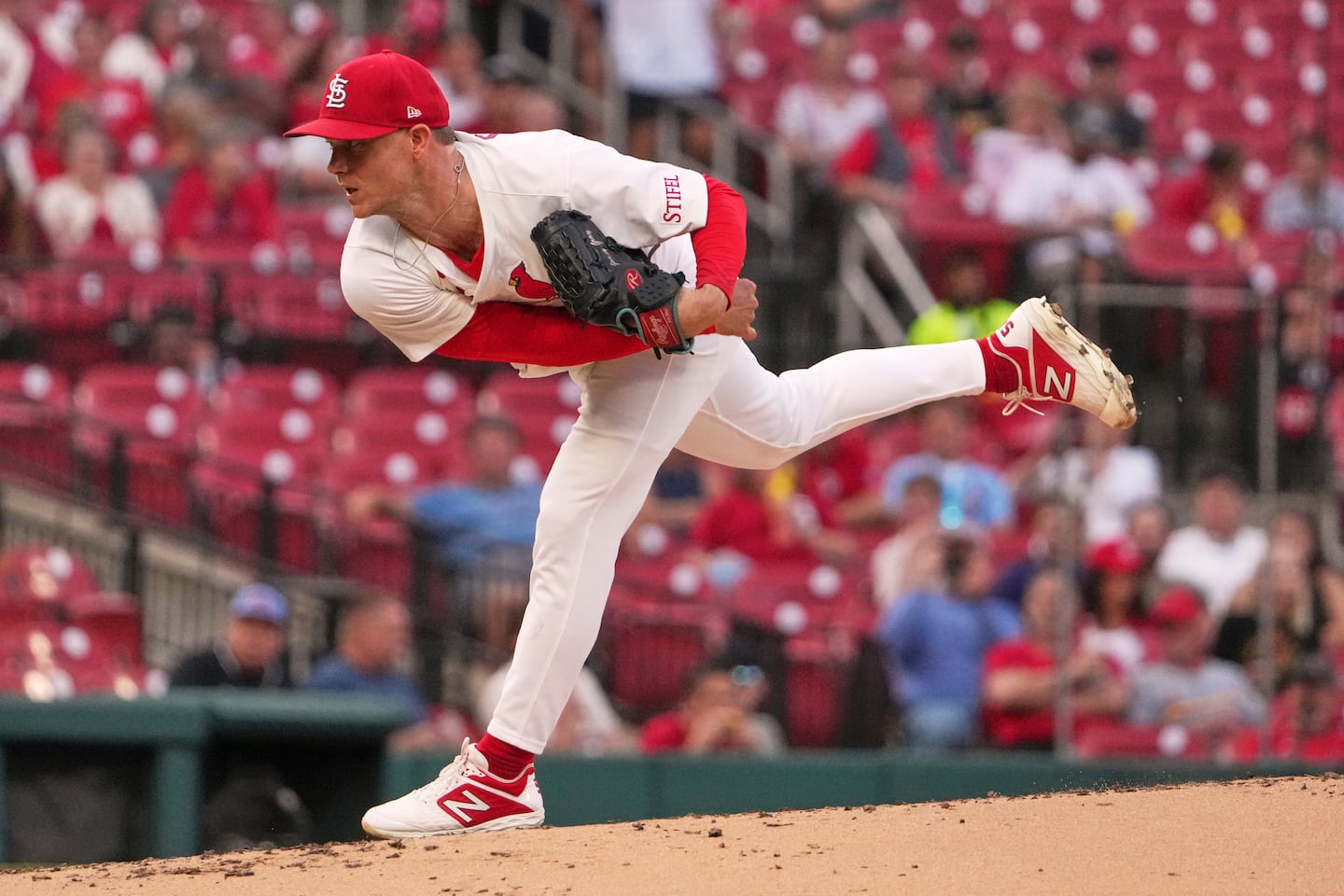
Red Sox trade for Cardinals pitcher Sonny Gray
Based on his ability to generate strikeouts, limit walks, and induce bad contact (he elicited a 45 percent ground ball rate, well above average), advanced statistics suggest Gray’s ERA was inflated by bad luck and bad defense last year.
Sox chief baseball officer Craig Breslow declined to say if Gray would serve as the No. 2 starter, but identified traits in the pitcher that fulfill the job description.
“He’s a guy who has pitched in the front of rotations,” said Breslow. “Those things that pitchers carry from year to year are strikeout rates and walk rates and the ability to stay off barrels, he excels there. We’re really excited about a guy who is coming off back-to-back 200-strikeout seasons and shouldering significant workloads.”
Gray, who turned 36 this month, was one of five pitchers to log at least 160 innings at age 35 or over this year. His four-seam fastball (which the Sox might ask him to deemphasize) averaged 91.7 miles per hour, well below the big league average. But his elite breaking pitches and seven-pitch arsenal, combined with what Breslow described as “impeccable command,” have allowed Gray to defy typical expiration dates.
“He really understands what he’s doing. He’s incredibly thoughtful about the art of pitching,” said Cardinals president of baseball operations — and former Red Sox chief baseball officer — Chaim Bloom. “Guys that pitch at a high level into their mid-30s, it doesn’t happen by accident. And being around him, I was able to see why.”
Over the last three seasons, Gray is 35-25 with a 3.63 ERA, 27 percent strikeout rate, and 6 percent walkout rate. He’s also been durable, averaging 30 starts and 177 innings during that span.
Over 13 big league seasons, Gray is 125-102 with a 3.58 ERA and a 24 percent strikeout rate. In six career playoff starts, he has a 3.26 ERA in 30⅓ innings. He has finished in the top three in AL Cy Young voting twice, most recently as runner-up with the Twins in 2023.
Gray was entering the final season of a three-year, $75 million deal that would have paid him a $35 million salary in 2026 with a $30 million team option for 2027 and a $5 million buyout. Gray had the right to veto a trade but waived it. Instead, he and the Sox reworked the deal to guarantee the pitcher $31 million for 2026, with a $30 million mutual option that includes a $10 million buyout.
The mutual option is just an accounting tool. Ultimately, Gray will receive $41 million for 2026 — with the Cardinals paying $20 million. The Sox will pay $21 million — $11 million in salary, then $10 million on the buyout — with an average annual value for luxury tax purposes of a little less than $21 million.
In return for Gray, the Sox drew from a pitching pipeline that has emerged, for the first time in years, as an organizational strength.
Fitts, 25, was 2-4 with a 5.00 ERA in 45 innings for the Sox last season. He showed immense promise entering the 2025 season but landed on the injured list twice — in April, when he suffered a right pectoral strain, and then again at the end of the year when he was shut down because of neuritis.
He is expected to be healthy for the 2026 season, and to compete for a rotation spot with the Cardinals in spring training.
Clarke, 22, was a fifth-rounder in 2024 who dazzled at the start of the 2025 season while combining high-90s fastballs and a wipeout sweeper. But after he overwhelmed hitters in Low-A to start the year (0.93 ERA, 17 strikeouts, 2 walks in 9⅓ innings), he struggled with control (18 percent walk rate), results (5.08 ERA), and blisters that limited him to 38 innings for the year.
He has huge upside if he can harness his command, but there are significant questions whether he can do so. The Sox had made Clarke available in trade discussions at this year’s deadline.
“We gave up two exciting pitchers with significant control. That’s the tradeoff when you’re trying to pull forward wins,” said Breslow. “We need to compete for the division, we need to compete for a deep postseason run, and that’s the cost of doing business.”
The acquisition of Gray, Breslow said, doesn’t necessarily foreclose further rotation additions as the Sox pursue upgrades. But one major league source suggested it would be surprising if the Sox pursued any of the top free agent arms, with the team mindful of the high cost of signing a top-end bat. Breslow characterized the free agent market for position players as “still pretty early.”
Another trade — perhaps involving the team’s outfield depth (untouchable Roman Anthony, along with Ceddanne Rafaela, Jarren Duran, and Wilyer Abreu) or rotation depth — to upgrade the pitching staff or position group remains a possibility. The acquisition of Gray, then, represents a large brushstroke across the offseason canvas — as part of a still-forming portrait.
“We felt like there was an opportunity to upgrade our rotation in 2026 and we did that,” said Breslow. “It’s early in the offseason. There are still opportunities that I anticipate materializing. Exactly what they look like, I’m not sure. But we’re not going to close off any chance to make the team better.”
Alex Speier can be reached at [email protected]. Follow him @alexspeier.
First Appeared on
Source link






