


Remember Asteroid 2024 YR4?
Yes, the ~60-meter space rock discovered near the end of 2024 that was once estimated to have the highest chance (3.1%) of any such asteroid to actually strike the Earth in the not-too-distant future (2032) — with the force of a multi-megaton nuclear blast that could potentially take out an entire city unfortunate enough to be in its impact path.
Fortunately, further observations over the next few months finally ruled out any possibility of a collision with the Earth itself, but paradoxically, the risk of a collision with our Moon shot up to 4.3%. Needless to say, this could have presented quite the potential problem for any manned missions to the Moon in 2032, let alone the establishment of an actual Lunar base. Even worse, debris blasted from the Lunar surface by such an impact could have posed an existential threat to the fleets of critically important satellites orbiting our planet, and it looked like we wouldn’t be able to refine that risk until 2024 YR4 was back in our part of the Solar System in 2028.
But Big Science, in the form of the James Webb Space Telescope (JWST) has now come to the rescue, as detailed by CNN:
Astronomers didn’t expect to get a chance to better assess the risk of a YR4 lunar impact until the asteroid came back into view from Earth’s perspective in 2028. However, Dr. Andy Rivkin, planetary astronomer from the Johns Hopkins University’s Applied Physics Laboratory in Maryland, and Julien de Wit, associate professor of planetary science at the Massachusetts Institute of Technology, spied an opportunity for an earlier glimpse.
Rivkin and de Wit applied and received approval to use the James Webb Space Telescope, or JWST, the only observatory with a chance of spotting the asteroid before 2028.
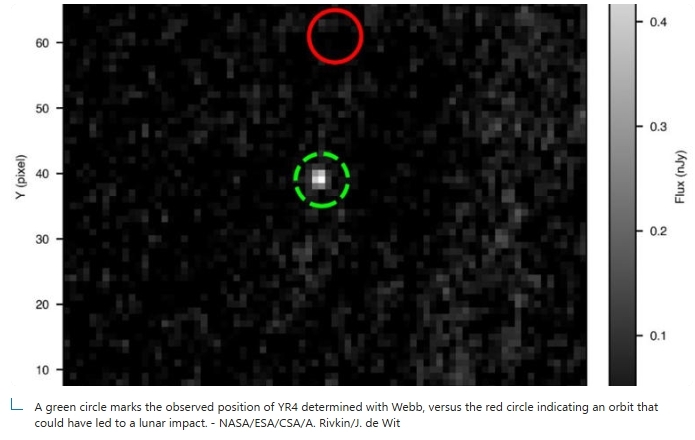
Their observations, taken on February 18 and 26, improved the certainty of the asteroid’s future position. Rather than colliding with the moon, YR4 will pass it from a relatively close distance of 14,229 miles (22,900 kilometers) — narrowly ruling out a once-in-a-lifetime lunar impact that humanity would have witnessed.
Rivkin and de Wit’s Webb observations were among the faintest ever made of an asteroid, according to NASA and the European Space Agency — and the detections weren’t easy to come by given the narrow window of time to capture them.
As the most powerful space telescope, Webb is perhaps a natural choice to aid the search for a potentially dangerous asteroid that could impact Earth or the moon. But YR4 presented a challenge.
The researchers had to develop new techniques for using Webb’s instruments to detect the asteroid as a nearly invisible speck amid the vastness of space, and their innovations could help future efforts if another similar threat arises.
The CNN piece goes into considerable detail as to how Rivkin and de Wit were able to utilize JWST’s unparalleled capabilities for deep space observations in refining 2024 YR4’s future orbit enough to rule out any potential collision with the Moon, and is well worth the read if you’re into that sort of scientific sleuthing. Well done!
First Appeared on
Source link






