


Researchers Found the Male G Spot—And It’s Not The One You’re Thinking Of
We’ve all heard the prostate is the equivalent of the male G-spot, or rather the P-spot. Now researchers say the penis has one too: not the glans, as anatomy books long suggested, but a small triangular patch on the underside where the shaft meets the head.
This region is known as the frenular delta. Its function as a male sexual pleasure point was determined after researchers examined fetal and adult penile tissue under the microscope. The researchers say they have mapped the most detailed neural portrait yet of the penis and found that this overlooked zone is packed with a dense concentration of nerves and touch receptors.
The new work extends earlier anatomical descriptions, traces the development of penile innervation before birth and carries implications for procedures that may affect this highly specialized sensory tissue—yes, that includes circumcision as well.
The Male Pleasure Hotspot
The study examined 30 fetal specimens and 14 adult cadaveric penises. The researchers found that the frenular delta on the ventral, or underside, surface showed region-specific nerve density that stood out from surrounding tissue. In adults, it contained tightly packed clusters of specialized touch receptors, while similar structures in the glans appeared more isolated and spread out.
“Our work scientifically validates the existence of a ventral penile anatomical region that serves as a center of sexual sensation,” the authors wrote. “In essence, the presence of a sensory center in the penis, akin to a ‘G-spot,’ emerges as a neuroanatomical reality.”
The team also traced how the penis’s innervation takes shape before birth. Early on, from about 8 to 16 weeks, nerves spread rapidly through the developing tissue. Then, between 17 and 24 weeks, specialized touch receptors appear, and some of the earlier excess wiring recedes.
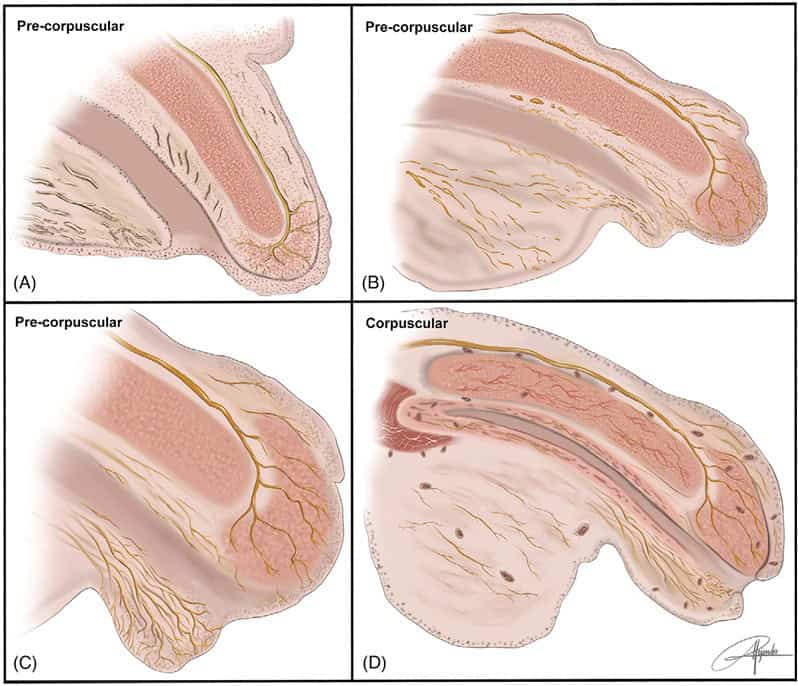
From the earliest stages of development, nerves were already concentrating on the underside of the penis. Some grew down from the main dorsal nerve toward the area that would become the frenulum, while others formed a dense network around the developing urethra. That pattern persisted into adulthood, leaving the frenular region especially rich in nerve tissue.
The paper also reports dense autonomic innervation in the preputial dartos—a smooth muscle layer in the foreskin—and sensory corpuscles in the glans and penile bulb. Together, those findings suggest that the sensory architecture of the penis is more elaborate than standard diagrams have implied.
All of this challenges the notion that the glans alone is important in penile sensation. The authors argue instead for a more complex sensory map, with the frenular delta emerging as a distinct focal point.
Technical Update
There’s another point worth mentioning. Circumcision can affect the frenular delta, especially when surgeons make deep incisions along the ventral side or remove the frenulum entirely. The authors argue that surgeons should understand the nerve-rich anatomy of this region before operating. They also discuss penile neurotomy, an experimental procedure for premature ejaculation that cuts or cauterizes nerves in the same area, warning of reports of permanent sensation loss, erectile dysfunction and serious psychological fallout.
The authors underscore that standard consent discussions do not fully address how decisions such as scar placement, the amount of inner foreskin left behind, skin tightness and removal of the frenulum may affect sexual sensation. Surgeons should pay closer attention to how much specialized tissue they remove, and they should tell patients that those choices may affect function.
The researchers say they are now conducting similar work on vulvas and clitorises, another part of human sexual anatomy that medicine has often treated with striking vagueness.
The study is published in the journal Andrology.
First Appeared on
Source link







