


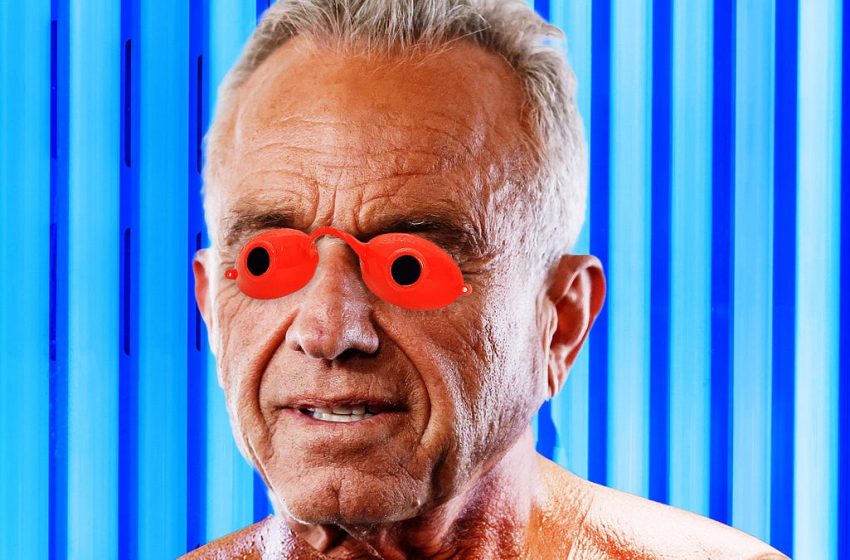
RFK Jr., Creature of the Tanning Salon, Throws the Industry a Bone
ROBERT F. KENNEDY’S JR.’S LATEST MOVE on public health seems like the setup for a joke: The preternaturally bronzed member of Donald Trump’s image-obsessed administration just quashed an attempt to protect people from cancer-causing tanning-bed rays. But the decision is no laughing matter, as retired dermatologist and Northwestern University professor June Robinson reminded me this week when she recounted the story of a former patient.
A “gorgeous” woman in her early twenties, the patient was a Polish immigrant who spoke very little English and had found work cleaning houses in Chicago. “She arrives in my office,” Robinson explained in a phone interview, “and she’s very embarrassed because she has a lesion—a spot—in her private area, and she doesn’t want to see a male physician.” Robinson noted the woman’s deep full-body tan, found the lesion high on the inside of her thigh, and instantly realized two things.
The first was that the lesion was probably melanoma, the most dangerous form of skin cancer. The second was that it had almost certainly come from ultraviolet light inside a tanning bed. “This is a place where, in reality, the sun should never have” reached, Robinson said. “Even if you were on the beach, in your bathing suit, you just would never have gotten sun right there.”
Robinson asked: Have you used a tanning salon? Yes, the patient answered, she had started bathing in tanning beds regularly when she was a teenager. “She proudly tells me it’s because she . . . wanted to appeal to her boyfriend,” Robinson said.
Melanoma is among the more survivable kinds of cancer with sufficiently early detection. But the odds have always been far worse when the cancer metastasizes and spreads into distant organs. And that’s what had happened with this patient. Cancer was already in her lymph nodes. She died not long after.
It was precisely to prevent such tragedies that the Food and Drug Administration in 2015 proposed new, tighter restrictions on tanning beds. One of those restrictions would have prohibited minors from using the devices at all, on the theory that young people’s still-developing bodies were more vulnerable to the carcinogenic effects of tanning-bed light, and that their still-developing brains were less capable of assessing the risks of exposure.
The proposal looked a lot like the FDA’s initial move to ban youth cigarette sales back in 1997, including the way it represented the culmination of a decades-long advocacy led by physicians like Robinson who had seen firsthand the damage tanning beds could do. And although the FDA rule sat in limbo for a decade, while tanning-salon operators and their allies stuffed the official public comment portal with objections, advocates for the prohibition have remained hopeful that it would eventually take effect.
Those hopes were dashed last week, when the FDA formally withdrew the proposed rule. The official notice from the Department of Health and Human Services—of which the FDA is part—cited “scientific and technical concerns” that had come up in the comments, along with questions about possible “unintended consequences.” It was RFK Jr.’s name on the order, just as it was his lieutenants and allies at the FDA who had made the decision.
Fearless reporting.
Sharp analysis.
And clear explanations of even the most complicated stories.
Support independent journalism—sign up for a Bulwark+ membership at 20 percent off the normal annual price:
HHS spokesperson Emily Hilliard told me over email that the FDA simply wanted “to reassess how best to address the issues [the proposal] raised, including how to balance public health considerations with consumer access and choice.” She also made clear that the agency was not disputing that tanning beds are dangerous. “Exposure to ultraviolet radiation, including from sunlamp products, is known to increase the risk of skin cancer,” she said.
But Hilliard didn’t respond to my question about whether Kennedy had weighed in with the FDA, either through official consultation or informally. And whatever role Kennedy did or didn’t play in the decision, the tanning bed announcement is emblematic of decision-making he’s brought to HHS. It is the latest sign that his promises to prioritize “gold standard” science and fight special interests are meaningless—and that, even as his political influence may be waning, he is finding new ways to undermine public health.
THERE ISN’T MUCH MYSTERY LEFT when it comes to the mechanism of how tanning beds lead to cancer.
The energy from any kind of ultraviolet light can damage both surface and deeper layers of skin, producing rogue cells that grow and reproduce in ways that the body’s normal defenses can’t handle. In other words, they become tumors. And especially when tumors appear in melanocytes—the inner layer of cells that produce pigment—they can spread to other organs, where they can become deadly, as they were for Robinson’s patient.
Whether ultraviolet light has this effect on any single individual will depend on a variety of factors, including genetic predispositions. But a key variable is the length and intensity of exposure. And although the sun is the most obvious and most significant source of potentially dangerous ultraviolet rays—that’s why you hear so much about sunscreen—tanning beds represent a whole other kind of threat.
“This is the most mutagenic form of UV radiation, equivalent to being at high noon at the equator,” Hunter Shain, a cancer biologist and associate professor at the University of California, San Francisco, told me. “So if you’re living in North America, you can’t even get this type of sunlight anywhere, not even in Miami.”
The light in modern tanning beds mostly comes from what are known as Ultraviolet A rays, which lead to tanning, rather than the Ultraviolet B rays that cause burns. Promoters of indoor tanning sometimes cite this as proof tanning beds are safe. But that’s nonsense, according to scientists like Shain, because the light levels inside are so much stronger than the natural kind. “Even if you’re in there for just fifteen minutes, that can do quite a bit of damage.”
The supposed safety of modern tanning beds is just one of the arguments the industry and its supporters sometimes make. Others include claims that “pre-tanning” before vacations in sunny places can protect people from cancer because tanning is the result of the body producing extra melanin in order to protect itself. One problem with that claim is that a tan is roughly equivalent to wearing sunscreen rated SPF3 or SPF4—i.e., far too minuscule to protect against carcinogenic effects.
But it’s not just the physiology of skin cancer that makes tanning beds such a public health hazard. It’s also the way they get used in real life—and by whom. Tanning has been a sign of high status ever since the early twentieth century, around the time cameras caught a glimpse of a sun-soaked Coco Chanel walking off a boat in Cannes and established a complexion standard that pasty-white factory and domestic workers could only envy. That helps explain why tanning beds became so popular in the 1970s, when they arrived in the United States and offered a sunning option for people who couldn’t afford a trip to the French Riviera.
Nowadays, they make up a multi-billion-dollar industry. And while tanning beds are dangerous for anybody, scientists and advocates worry especially about the threat to young people, because effects on both psychology and physiology can last into adulthood. “This has been studied extensively, and the risk of skin cancer is higher in people who use tanning beds when they are younger,” Eleni Linos, a professor of dermatology and epidemiology at Stanford, told me. “Some of it is the longer duration, some of it is habit formation.”
And lots of habits are being formed. Robinson led what is thought to be the first comprehensive survey of tanning bed use, which found that in the early 1990s in Illinois, roughly 16 percent of girls aged 17 to 19 were using tanning beds. She said it wasn’t so surprising given the ubiquitous advertising.
“We’d have Joe Camel advertising smoking right next to billboards for indoor tanning,” she said. And that was on top of more direct forms of promotion, something Robinson witnessed one day on her way to work in Chicago when a young woman gave her a flyer with a coupon for a nearby salon.
“I saw that and thought, this is one of the stupidest things I’ve ever seen,” Robinson said.
THE ILLINOIS SURVEY became part of the evidence cited by medical societies, cancer patient groups, and other public health advocates pushing for restrictions on tanning beds—including a ban on use by minors—across the country. The years of education, advocacy, and persuasion became a real slog, said Robinson, whose own efforts included launching a campaign while she was serving as president of the American Society of Dermatological Surgeons in 1994.
She remembered in particular a 2006 meeting at the FDA. Officials there made clear they agreed on the dangers of tanning beds, Robinson said. But they felt they could do no more than require device inspections, warning labels, and consent forms. More change would require legislation, they said.
Advocates pressed for just that, and won quite a few victories at the state level. Today, the majority of states have laws restricting tanning bed access for young people, though the ages and level of restriction vary. Advocates also kept pushing the FDA, which in 2015 finally proposed the rule to institute a total ban on use by minors.
Tanning beds are “dreadful, and young people typically do not weigh the risks properly,” Ezekiel Emanuel, an oncologist who is a vice provost at the University of Pennsylvania, told me. “That is why we don’t let them smoke, we don’t let them drink alcohol. We shouldn’t let them use tanning beds. It’s just as toxic, with no upside benefits.”
But the proposed rule didn’t move forward. It just sat there, waiting for action through the final year of the Obama administration, and then both Trump’s first term and Joe Biden’s presidency as well. And while there may be no simple, single explanation for the long delay, a likely suspect is all the pressure from the industry, which made its presence known in overt and subtle ways.
“We found that the studies that had financial links to the industry were much more likely to downplay harms compared to studies without these financial links,” said Linos, who published a widely read paper on the influence on research used in political debates. “It may seem obvious, but science should not be influenced by the incentives of any industry—whether it’s Big Tobacco or Sugar or Pharma. Science should be independent.”
Industry pressure is, of course, something Kennedy vowed to fight as HHS secretary, just as he vowed to prioritize high-quality science. But so far, he’s mostly used those rallying cries as justification for attacking vaccines, despite all the evidence that they are safe.
Meanwhile, the danger of tanning beds is an actual case of a well-documented, high-quality scientific finding that really has been waiting for government action, in part because of industry pressure. But instead of pushing the process forward, Kennedy’s department is yanking it back—while he himself is showing off his ultra-tanned body at seemingly every opportunity, including that now-infamous HHS video where he shares a hot tub with Kid Rock.
It would be amusing, maybe, if there weren’t evidence that messages Kennedy sends about health have real-world effects on people’s behavior. It’s no stretch to imagine Kennedy’s tanning inspiring people to use tanning beds, especially if they are already sympathetic to his politics.
The experts are worried, not just about the public health message he’s sending but about his personal health as well.
“Look at his leathery skin and his wrinkled face—that is what chronic exposure to ultraviolet light does to you,” Robinson told me. “He really needs to be looked over by somebody, to check for skin cancer.”
First Appeared on
Source link






