


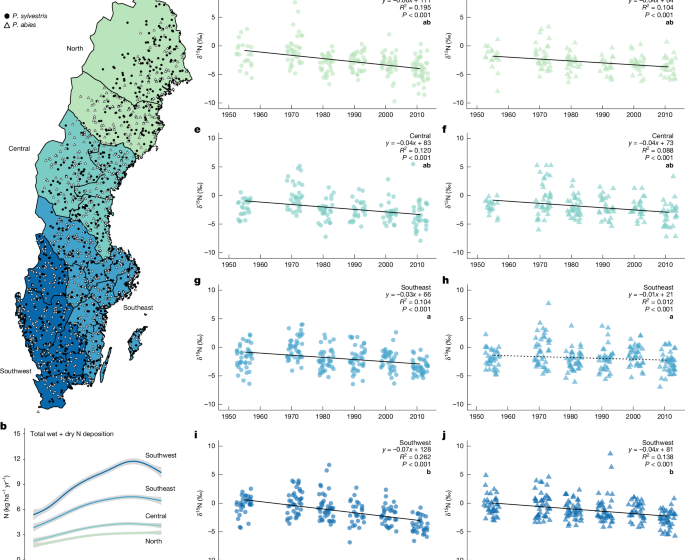
Rising atmospheric CO2 reduces nitrogen availability in boreal forests
Galloway, J. N. et al. Transformation of the nitrogen cycle: recent trends, questions, and potential solutions. Science 320, 889–892 (2008).
Craine, J. M. et al. Isotopic evidence for oligotrophication of terrestrial ecosystems. Nat. Ecol. Evol. 2, 1735–1744 (2018).
Hiltbrunner, E., Körner, C., Meier, R., Braun, S. & Kahmen, A. Data do not support large-scale oligotrophication of terrestrial ecosystems. Nat. Ecol. Evol. 3, 1285–1286 (2019).
Mason, R. E. et al. Evidence, causes, and consequences of declining nitrogen availability in terrestrial ecosystems. Science 376, eabh3767 (2022).
Mason, R. E. et al. Explanations for nitrogen decline: response. Science 376, 1170–1170 (2022).
Olff, H. et al. Explanations for nitrogen decline. Science 376, 1169–1170 (2022).
Norby, R. J. et al. Enhanced woody biomass production in a mature temperate forest under elevated CO2. Nat. Clim. Change 14, 983–988 (2024).
Terrer, C. et al. Nitrogen and phosphorus constrain the CO2 fertilization of global plant biomass. Nat. Clim. Change 9, 684–689 (2019).
Norby, R. J., Warren, J. M., Iversen, C. M., Medlyn, B. E. & McMurtrie, R. E. CO2 enhancement of forest productivity constrained by limited nitrogen availability. Proc. Natl Acad. Sci. USA 107, 19368–19373 (2010).
Rockström, J. et al. Planetary boundaries: exploring the safe operating space for humanity. Ecol. Soc. 14, 32 (2009).
Galloway, J. N. et al. Nitrogen cycles: past, present, and future. Biogeochemistry 70, 153–226 (2004).
Ackerman, D., Millet, D. B. & Chen, X. Global estimates of inorganic nitrogen deposition across four decades. Glob. Biogeochem. Cycles 33, 100–107 (2019).
Galloway, J. N., Bleeker, A. & Erisman, J. W. The human creation and use of reactive nitrogen: a global and regional perspective. Annu. Rev. Environ. Resour. 46, 255–288 (2021).
Lan, X. & Keeling, R. Trends in atmospheric CO2. Global Monitoring Laboratory https://gml.noaa.gov/ccgg/trends (2025).
Yue, K. et al. Stimulation of terrestrial ecosystem carbon storage by nitrogen addition: a meta-analysis. Sci. Rep. 6, 19895 (2016).
Luo, Y. et al. Progressive nitrogen limitation of ecosystem responses to rising atmospheric CO2. Bioscience 54, 731–739 (2004).
Hungate, B. A., Dukes, J. S., Shaw, M. R., Luo, Y. Q. & Field, C. B. Nitrogen and climate change. Science 302, 1512–1513 (2003).
Canadell, J. G. in Climate Change 2021: The Physical Science Basis (eds Masson-Delmotte, V. et al.) 673–816 (Cambridge Univ. Press, 2021).
Robinson, D. δ15N as an integrator of the nitrogen cycle. Trends Ecol. Evol. 16, 153–162 (2001).
Hobbie, E. A. & Högberg, P. Nitrogen isotopes link mycorrhizal fungi and plants to nitrogen dynamics. New Phytol. 196, 367–382 (2012).
Gerhart, L. M. & McLauchlan, K. K. Reconstructing terrestrial nutrient cycling using stable nitrogen isotopes in wood. Biogeochemistry 120, 1–21 (2014).
Craine, J. M. et al. Ecological interpretations of nitrogen isotope ratios of terrestrial plants and soils. Plant Soil 396, 1–26 (2015).
Craine, J. M. et al. Global patterns of foliar nitrogen isotopes and their relationships with climate, mycorrhizal fungi, foliar nutrient concentrations, and nitrogen availability. New Phytol. 183, 980–992 (2009).
Chen, Q. et al. Global mycorrhizal status drives leaf δ15N patterns. J. Ecol. 113, 1150–1163 (2025).
McLauchlan, K. K. et al. Centennial-scale reductions in nitrogen availability in temperate forests of the United States. Sci. Rep. 7, 7856 (2017).
Peñuelas, J. et al. Increasing atmospheric CO2 concentrations correlate with declining nutritional status of European forests. Commun. Biol. 3, 125 (2020).
Vitousek, P. M., Cen, X. Y. & Groffman, P. M. Has nitrogen availability decreased over much of the land surface in the past century? A model-based analysis. Biogeochemistry 167, 793–806 (2024).
Doucet, A., Savard, M. M., Bégin, C. & Smirnoff, A. Is wood pre-treatment essential for tree-ring nitrogen concentration and isotope analysis? Rapid Commun. Mass Spectom. 25, 469–475 (2011).
Bukata, A. R. & Kyser, T. K. Response of the nitrogen isotopic composition of tree-rings following tree-clearing and land-use change. Environ. Sci. Technol. 39, 7777–7783 (2005).
Poulson, S. R., Chamberlain, C. P. & Friedland, A. J. Nitrogen isotope variation of tree rings as a potential indicator of environmental change. Chem. Geol. 125, 307–315 (1995).
Thurner, M. et al. Nitrogen concentrations in boreal and temperate tree tissues vary with tree age/size, growth rate and climate. Biogeosciences 22, 1475–1493 (2025).
United Nations Economic Commission for Europe. 1999 Protocol to Abate Acidification, Eutrophication and Ground-level Ozone to the Convention on Long-range Transboundary Air Pollution. Protocol to Abate Acidification, Eutrophication and Ground-level Ozone (UNECE, 1999).
Pihl Karlsson, G., Akselsson, C., Hellsten, S. & Karlsson, P. E. Atmospheric deposition and soil water chemistry in Swedish forests since 1985—effects of reduced emissions of sulphur and nitrogen. Sci. Total Environ. 913, 169734 (2024).
Hakkarainen, J., Ialongo, I., Maksyutov, S. & Crisp, D. Analysis of four years of global XCO2 anomalies as seen by Orbiting Carbon Observatory-2. Remote Sens. 11, 850 (2019).
Mead, D. J. & Preston, C. M. Distribution and retranslocation of 15N lodgepole pine over eight growing seasons. Tree Physiol. 14, 389–402 (1994).
Nömmik, H. The Uptake and Translocation of Fertilizer N15 in Young Trees of Scots Pine and Norway Spruce (Predecessors to SLU, Royal School of Forestry, Sveriges lantbruksuniversitet, 1966).
Tomlinson, G. et al. The mobility of nitrogen across tree-rings of Norway spruce (Picea abies L.) and the effect of extraction method on tree-ring δ15N and δ13C values. Rapid Commun. Mass Spectrom. 28, 1258–1264 (2014).
Bassett, K. R., Östlund, L., Gundale, M. J., Fridman, J. & Jämtgård, S. Forest inventory tree core archive reveals changes in boreal wood traits over seven decades. Sci. Total Environ. 900, 165795 (2023).
Michaud, T. J., Cline, L. C., Hobbie, E. A., Gutknecht, J. L. M. & Kennedy, P. G. Herbarium specimens reveal that mycorrhizal type does not mediate declining temperate tree nitrogen status over a century of environmental change. New Phytol. 242, 1717–1724 (2024).
Ferm, M. et al. Wet deposition of ammonium, nitrate and non-sea-salt sulphate in Sweden 1955 through 2017. Atmos. Environ. X 2, 100015 (2019).
Kranabetter, J. M., Saunders, S., MacKinnon, J. A., Klassen, H. & Spittlehouse, D. L. An assessment of contemporary and historic nitrogen availability in contrasting coastal Douglas-Fir forests through δ15N of tree rings. Ecosystems 16, 111–122 (2013).
Oulehle, F. et al. Changes in forest nitrogen cycling across deposition gradient revealed by δ15N in tree rings. Environ. Pollut. 304, 119104 (2022).
Ťupek, B. et al. Foliar turnover rates in Finland—comparing estimates from needle-cohort and litterfall-biomass methods. Boreal Environ. Res. 20, 283–304 (2015).
Hu, C. C. et al. Global distribution and drivers of relative contributions among soil nitrogen sources to terrestrial plants. Nat. Commun. 15, 6407 (2024).
Balderas Torres, A. & Lovett, J. C. Using basal area to estimate aboveground carbon stocks in forests: La Primavera Biosphere’s Reserve, Mexico. Forestry 86, 267–281 (2013).
Gauthier, S., Bernier, P., Kuuluvainen, T., Shvidenko, A. Z. & Schepaschenko, D. G. Boreal forest health and global change. Science 349, 819–822 (2015).
Bergh, J., Linder, S., Lundmark, T. & Elfving, B. The effect of water and nutrient availability on the productivity of Norway spruce in northern and southern Sweden. Forest Ecol. Manag. 119, 51–62 (1999).
Elmore, A. J., Nelson, D. M. & Craine, J. M. Earlier springs are causing reduced nitrogen availability in North American eastern deciduous forests. Nat. Plants 2, 16133 (2016).
McLauchlan, K. K., Craine, J. M., Oswald, W. W., Leavitt, P. R. & Likens, G. E. Changes in nitrogen cycling during the past century in a northern hardwood forest. Proc. Natl Acad. Sci. USA 104, 7466–7470 (2007).
BassiriRad, H. et al. Widespread foliage δ15N depletion under elevated CO2: inferences for the nitrogen cycle. Glob. Change Biol. 9, 1582–1590 (2003).
Sabo, R. D. et al. Positive correlation between wood δ15N and stream nitrate concentrations in two temperate deciduous forests. Environ. Res. Commun. 2, 025003 (2020).
Isles, P. D. F., Creed, I. F. & Bergström, A. K. Recent synchronous declines in DIN:TP in Swedish lakes. Glob. Biogeochem. Cycles 32, 208–225 (2018).
Lucas, R. W. et al. Long-term declines in stream and river inorganic nitrogen (N) export correspond to forest change. Ecol. Appl. 26, 545–556 (2016).
Goedkoop, W., Adler, S., Huser, B., Gardfjell, H. & Lau, D. C. P. Climate change-induced landscape alterations increase nutrient sequestration and cause severe oligotrophication of subarctic lakes. Glob. Change Biol. 31, e70314 (2025).
Nilsson, J. L., Camiolo, S., Huser, B., Agstam-Norlin, O. & Futter, M. Widespread and persistent oligotrophication of northern rivers. Sci. Total Environ. 955, 177261 (2024).
Pan, Y. et al. A large and persistent carbon sink in the world’s forests. Science 333, 988–993 (2011).
Stocker, B. D. et al. Empirical evidence and theoretical understanding of ecosystem carbon and nitrogen cycle interactions. New Phytol. 245, 49–68 (2025).
Norby, R. J. & Zak, D. R. Ecological lessons from Free-Air CO2 Enrichment (FACE) experiments. Annu. Rev. Ecol. Evol. Syst. 42, 181–203 (2011).
Reich, P. B. & Hobbie, S. E. Decade-long soil nitrogen constraint on the CO2 fertilization of plant biomass. Nat. Clim. Change 3, 278–282 (2013).
Bassiouni, M., Smith, N. G., Reu, J. C., Peñuelas, J. & Keenan, T. F. Observed declines in leaf nitrogen explained by photosynthetic acclimation to CO2. Proc. Natl Acad. Sci. USA 122, e2501958122 (2025).
Thomas, R. Q., Brookshire, E. N. J. & Gerber, S. Nitrogen limitation on land: how can it occur in Earth system models? Glob. Change Biol. 21, 1777–1793 (2015).
Davies-Barnard, T. et al. Nitrogen cycling in CMIP6 land surface models: progress and limitations. Biogeosciences 17, 5129–5148 (2020).
Gerber, S., Hedin, L. O., Oppenheimer, M., Pacala, S. W. & Shevliakova, E. Nitrogen cycling and feedbacks in a global dynamic land model. Glob. Biogeochem. Cycles 24, GB1001 (2010).
Sigurdsson, B. D., Medhurst, J. L., Wallin, G., Eggertsson, O. & Linder, S. Growth of mature boreal Norway spruce was not affected by elevated [CO2] and/or air temperature unless nutrient availability was improved. Tree Physiol. 33, 1192–1205 (2013).
Read, D. J. Mycorrhizas in ecosystems. Experientia 47, 376–391 (1991).
Gundale, M. J. et al. The biological controls of soil carbon accumulation following wildfire and harvest in boreal forests: a review. Glob. Change Biol. 30, e17276 (2024).
Cambron, T. W. et al. Plant nutrient acquisition under elevated CO2 and implications for the land carbon sink. Nat. Clim. Change 15, 935–946 (2025).
Bunn, R. A. et al. What determines transfer of carbon from plants to mycorrhizal fungi? New Phytol. 244, 1199–1215 (2024).
Lindahl, B. D. et al. A group of ectomycorrhizal fungi restricts organic matter accumulation in boreal forest. Ecol. Lett. 24, 1341–1351 (2021).
Terrer, C. et al. A trade-off between plant and soil carbon storage under elevated CO2. Nature 591, 599–603 (2021).
Palmroth, S. et al. Increased leaf area index and efficiency drive enhanced production under elevated atmospheric CO2 in a pine-dominated stand showing no progressive nitrogen limitation. Glob. Change Biol. 30, e17190 (2024).
Fridman, J. et al. Adapting National Forest Inventories to changing requirements—the case of the Swedish National Forest Inventory at the turn of the 20th century. Silva Fenn 48, 1095 (2014).
Hedwall, P.-O., Gong, P., Ingerslev, M. & Bergh, J. Fertilization in northern forests—biological, economic and environmental constraints and possibilities. Scand. J. For. Res. 29, 301–311 (2014).
Harris, I., Osborn, T. J., Jones, P. & Lister, D. Version 4 of the CRU TS monthly high-resolution gridded multivariate climate dataset. Sci. Data 7, 1–18 (2020).
McCarroll, D. & Loader, N. J. Stable isotopes in tree rings. Q. Sci. Rev. 23, 771–801 (2004).
Lan, X., Tans, P. & Thonin, K. W. Atmospheric carbon dioxide dry air mole fractions from the NOAA GML Carbon Cycle Cooperative Global Air Sampling Network, 1968–2023, version: 2024-07-30. Global Monitoring Laboratory https://doi.org/10.15138/wkgj-f215 (2024).
Yang, J. & Tian, H. ISIMIP3a N-deposition input data (v1.3). ISIMIP https://doi.org/10.48364/ISIMIP.759077.3 (2023).
Elfving, B. & Tegnhammar, L. Trends of tree growth in Swedish forests 1953–1992: an analysis based on sample trees from the National Forest Inventory. Scand. J. For. Res. 11, 26–37 (1996).
Östlund, L., Zackrisson, O. & Axelsson, A. L. The history and transformation of a Scandinavian boreal forest landscape since the 19th century. Can. J. For. Res. 27, 1198–1206 (1997).
Fridman, J. & Westerlund, B. in National Forest Inventories: Assessment of Wood Availability and Use (ed. Vidal, C.) 769–782 (Springer, 2016).
R Core Team. R: A Language and Environment for Statistical Computing (R Foundation for Statistical Computing, 2023).
Pinheiro, J. C. & Bates, D. M. Mixed-Effects Models in S and S-PLUS (Springer, 2000).
Pinheiro, J. et al. nlme: linear and nonlinear mixed effects models. R package v.3.1-166 (CRAN, 2024).
Bartoń, K. MuMIn: multi-model inference. R package v.1.47.5 (2023).
Lenth, R. V. emmeans: estimated marginal means, aka least-squares means. R package v.1.9.0 (CRAN, 2023).
Wickham, H. ggplot2: Elegant Graphics for Data Analysis (Springer, 2009).
Lê, S., Josse, J. & Husson, F. FactoMineR: a package for multivariate analysis. J. Stat. Softw. 25, 1–8 (2008).
Bassett, K. Reduces nitrogen availability in boreal forests (dataset). figshare https://doi.org/10.6084/m9.figshare.30675002 (2026).
First Appeared on
Source link






