


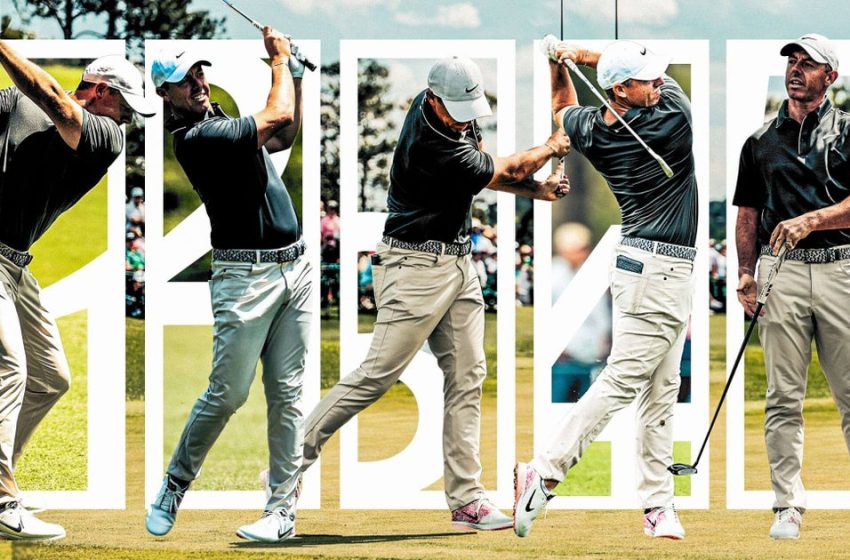
Rory McIlroy tells us his 5 best shots from the 2025 Masters
Rory McIlroy never let himself think he lost it. Not as he hunched over in front of Rae’s Creek after his ball tumbled into the water. Not as the analog scoreboards changed and his lead evaporated, reverberating throughout the Augusta National grounds.
“No, I never let myself,” he told The Athletic. “I felt like I still had time.”
But, he admitted, there was at least a moment when he no longer knew where he stood. As he followed that double bogey on No. 13 with yet another bogey, he was firmly in the dark: There are no scoreboards by the 14th green. Had Justin Rose made another advance? Had Ludvig Åberg caught up? It was disorienting, but McIlroy decided that all he needed was a birdie on No. 15 and one more on the way in.
The rest was history.
The beauty of McIlroy’s historic Masters win lies in how his final round encapsulated his entire tournament, and his tournament was an encapsulation of his entire career. Golfing genius combatted by infuriating, unforced errors for what may go down as the wildest final day in Masters history.
So The Athletic asked McIlroy to tell us the five shots of the 2025 Masters he thought were the best. Not necessarily the most famous or the flashiest. The ones that were the most important to him.
Friday, No. 10, Second Shot
McIlroy nearly gave it all away well before Sunday.
Early on Thursday, McIlroy was 4-under, firmly in contention. But things changed on that back nine. Chipping from behind the 15th green, McIlroy unravelled. His chip bounced from the back to the front of the green and rolled down the slope into the pond. Double bogey. Two holes later, another double to finish even par — seven shots behind Rose, the first-round leader.
So as McIlroy set up to his second shot from around 175 yards in the middle of the fairway on No. 10, he was just another golfer hanging around far from contention. Then he woke up. McIlroy laced his 8-iron to three feet right of the flag without so much as a roll.
With a sawed-off follow-through, McIlroy managed to pull off a subtly important feat. With the ball sitting slightly above his feet, a common occurrence at Augusta National, there was increased difficulty in the shot. It naturally wants to move left, but if you let it, the right-to-left slope of the green could shoot the ball away from the pin. But McIlroy skillfully prevented that from happening.
“It gave me some momentum and got me going,” he said.
The 10th hole has haunted McIlroy since his 2011 collapse. But this time it brought him right back into the tournament. He went to No. 11 and put it to five feet for a birdie. On 12, he made a difficult par save to keep it going. But it was the next shot that truly returned McIlroy to contention.
Friday, No. 13, Second Shot
Safer minds may have laid up. But standing in the pine straw, hitting into the iconic dogleg par-5 guarded by Rae’s Creek, that was not even a consideration for McIlroy.
He had 189 yards to the pin, so his only dilemma was the club: 4-iron or 5. Usually, he said, the ball comes out with more spin from the pine straw, so he elected for the former.
He hit a knockdown shot, choking up strategically on the club to compensate for the ball being slightly above his feet. Like on No. 10, McIlroy accomplished something unique here — he avoided a draw shot shape, on a natural draw-bias lie.
As the ball went into the air, McIlroy thought to himself: “You idiot, what did you do?”
Because of the pin location on the front-right portion of the green, he could accept the risk of a water ball. But the shot perfectly carried the corner of the putting surface by a few yards, cozying up to the pin for a 15-foot eagle putt that he made.
“Friday was what sort of got me back into the tournament,” McIlroy said.
Sunday, No. 3, Second Shot
A double bogey on the first. A disappointing par on the reachable par-5 second. In a matter of minutes, McIlroy went from leading by two to trailing Bryson DeChambeau by one. A story began to unfold that both he and the audience knew too well.
Then, he went to No. 3, perhaps the trickiest hole on the course. The short, 350-yard par four ends with a tiny green that sits atop a steep slope. Some players lay back with an iron or wood off the tee, allowing for a longer and more comfortable second shot. Others try to get as close as possible with their driver, risking the awkwardness of the short wedge shot they’ll have left. Either way, on the approach, you can’t miss short. The ball will plummet back down the hill some 30 yards.
The story goes that Gary Player sat next to Bobby Jones at the Masters Champions Dinner one year and pressed him on the third hole’s difficulty. Jones leaned forward with a grin and said, “You’re not supposed to make birdie on 3. The hole was designed for a four.”
Rory McIlroy had to have a positive result on No. 3 during the final round. (David Cannon / Getty Images)
After a 333-yard drive, McIlroy was left with that touchy little wedge shot. But in the lead-up to the tournament, McIlroy spent more time than usual dialing in his wedge game specifically for Augusta National’s contours. He went for early practice rounds to get comfortable with a predicament exactly like this one, knowing a bump up the hill was his only play.
So, standing at the very base of the incline, just 24 yards away from the hole, only the top half of the flagstick would have been visible to McIlroy. That’s how severe the slope is. And that far-left shelf on the green — where the traditional Sunday pin is placed — is minuscule. Between the front and the back of the green, McIlroy had 11 paces of room.
“He can afford one hop short, but no more,” Dottie Pepper said into her CBS microphone.
McIlroy did just that. The 60-degree wedge shot bounced once and curled toward the flag. It set up a birdie from nine feet, while DeChambeau went on to three-putt for bogey, immediately swapping places with McIlroy on the leaderboard.
Suddenly, McIlroy was back to himself. He birdied the difficult 4th while DeChambeau bogeyed again, McIlroy riding his own rollercoaster back to a three-shot lead.
This shot won’t go down in history like the next two, but McIlroy calls it one of the most pivotal of his run.
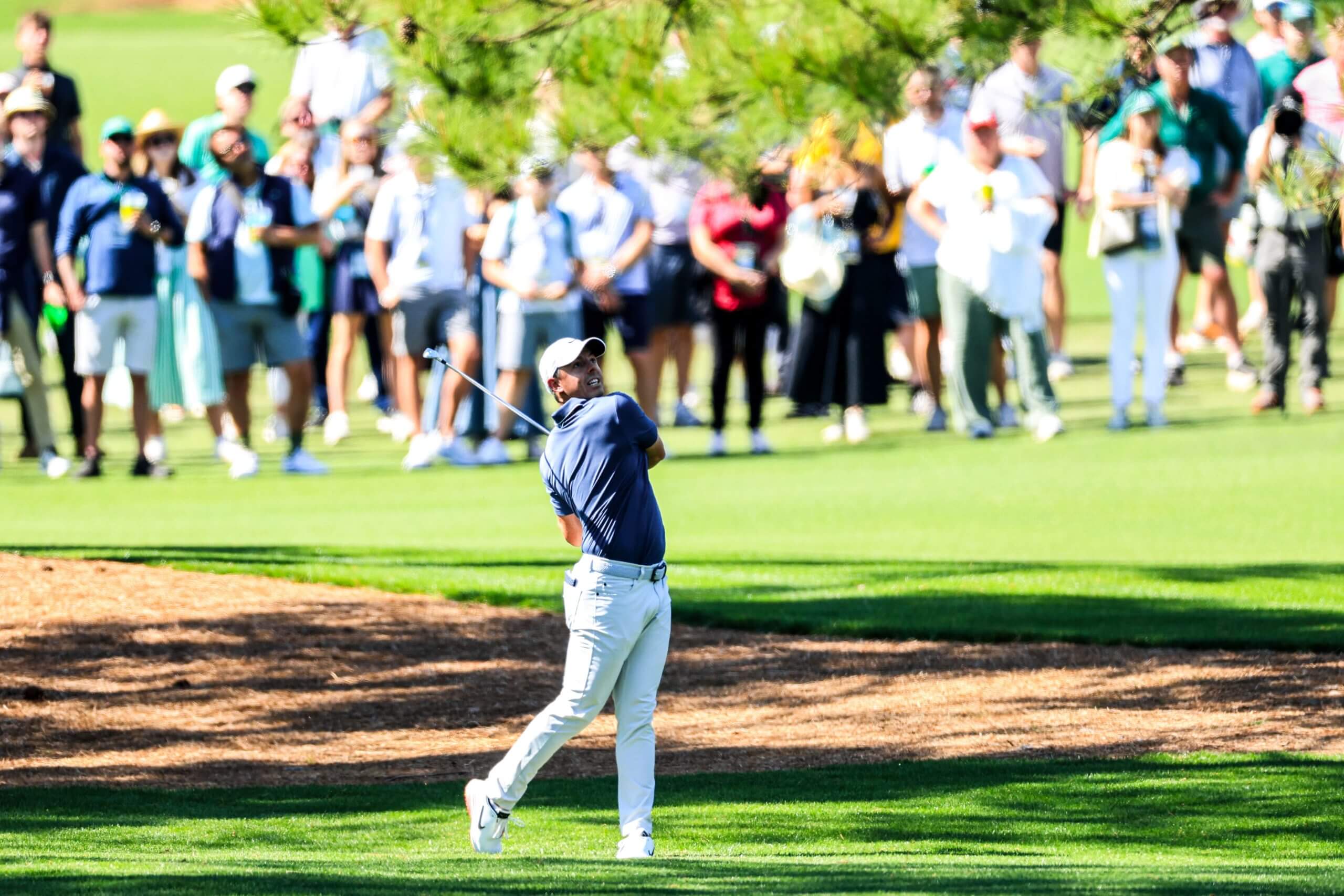
Rory McIlroy ignored his caddie’s advice on No. 7. (Augusta National / Getty Images)
Sunday, No. 7, Second Shot
The tee shot on No. 7 may be the most underrated at Augusta National in terms of difficulty. The already skinny fairway becomes even narrower as the trees gradually pinch inwards. You need to be in the fairway to attack the elevated green, which sits above a ring of massive bunkers.
McIlroy found himself overcompensating for a right miss and instead was in the left trees, 153 yards from the pin, blocked out by multiple Loblolly pines. Most sane individuals, including his own caddie, wouldn’t see a gap. But McIlroy kept gazing upwards. He didn’t want to chip out sideways — he wanted to go for the green. Caddie Harry Diamond is not exactly one to argue with McIlroy, but he voiced his discomfort with the shot. “I like it,” McIlroy said. “I feel like I’ve got a shot.” He had 9 iron in his hands. Diamond heard his lifelong friend’s confidence and deferred.
So McIlroy opened up his stance and set up for a towering cut. He had to swing so hard to properly launch the ball up into the sky that the club instinctively recoiled off his back. The ball clipped one branch of the pine tree, but wasn’t hindered. After several seconds of air time, it came plummeting down right next to the pin.
McIlroy’s reaction said it all. When he pulled that one off, McIlroy bent over laughing, his mouth agape like a little kid. He even looked to the crowd and tipped his cap as they applauded. He later explained that the shot, and the ensuing response, actually helped him loosen up.
Walking away, Diamond turned to Pepper and said, “It’s a good thing he doesn’t listen to me.”
McIlroy has often toed the line between his aggressive, risk-taking core and a tendency to get overly conservative when he has an opportunity to win. That’s what happened in 2011 when a 21-year-old McIlroy let a four-shot lead disappear on Sunday — he played defensively, he didn’t feel like himself. McIlroy is the first to admit that the inclination followed him, and that it possibly held him back in other close calls. He knew he had to let go of it.
There on No. 7, the risk stared him in the face. Only a handful of yards separated McIlroy from a plugged lie in the front bunker and the possibility of another double bogey. Instead, the result was a miraculous par.
“I rode my luck all week, and you need that little bit of luck to win these golf tournaments,” he said after the round.
Months later, when McIlroy, Brad Faxon and company went to replay that shot for his documentary, he shared a realization: “There was no gap.”
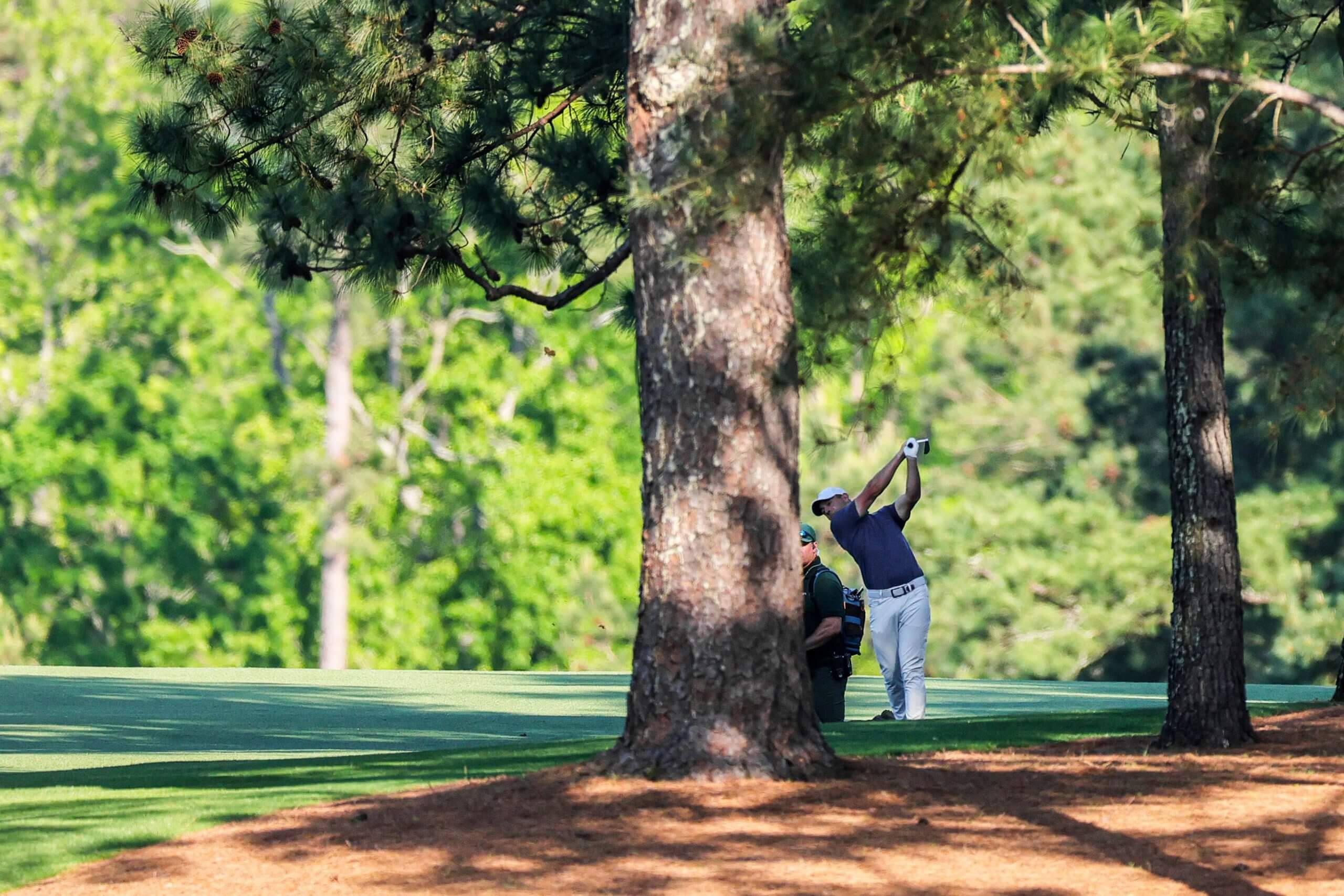
Rory McIlroy’s shot at No. 15 will be remembered for decades. (Augusta National / Getty Images)
Sunday, No. 15, Second Shot
But here’s the shot that will be seared in so many minds for golfing eternity. Between a double bogey on No. 13 and a bogey on No. 14, McIlroy had erased his four-shot lead. Now, on the 15th tee, McIlroy momentarily found himself one shot out of position — a stroke behind a surging Rose — for the first time since the 3rd hole. It felt to many like the final collapse of McIlroy’s Masters hopes. But as he said, he never let himself think like that. He went to the par-5 15th only seeking one thing: A birdie.
McIlroy’s drive bounded down the narrow fairway but veered to the left, where the fairway gets even narrower. He now had to attack the reachable par-5 from behind the trees — and only moments after DeChambeau misplayed his own attempt.
That was the first time McIlroy had outdriven DeChambeau all day, Golf Channel/NBC analyst and occasional McIlroy putting coach Faxon said, and it proved to be pivotal. McIlroy switched clubs, from an 8-iron to a 7, after DeChambeau caught a wind gust and hit his approach into the water. If McIlroy hadn’t watched DeChambeau and adjusted his plan, he may not have claimed the green jacket.
From 207 yards, McIlroy set up for a sweeping draw around the pines, aiming at the right-hand greenside bunker, but looking at the flagstick. The game plan allowed for error, but not necessarily punishment. It was the perfect risk-reward green light.
The shot came off the clubface exactly as McIlroy drew it up. It curved underneath the overhanging branches and then bulleted toward the green. The Northern Irishman liked it immediately, and everyone could tell. He started walking after the ball, his eyes never leaving the green.
He traced the shot as it dropped perfectly onto the right half of the green, with just enough draw spin to keep moving closer and closer to the pin: “The shot of a lifetime,” said CBS’ Jim Nantz to the largest Masters audience in seven years.
From a position where many players might have laid up, McIlroy left himself with just six feet for an eagle. He calls it one of the greatest shots of his career. He missed the first putt, but the birdie was all McIlroy really needed. That 7-iron reopened the doors to the career Grand Slam.
First Appeared on
Source link






