


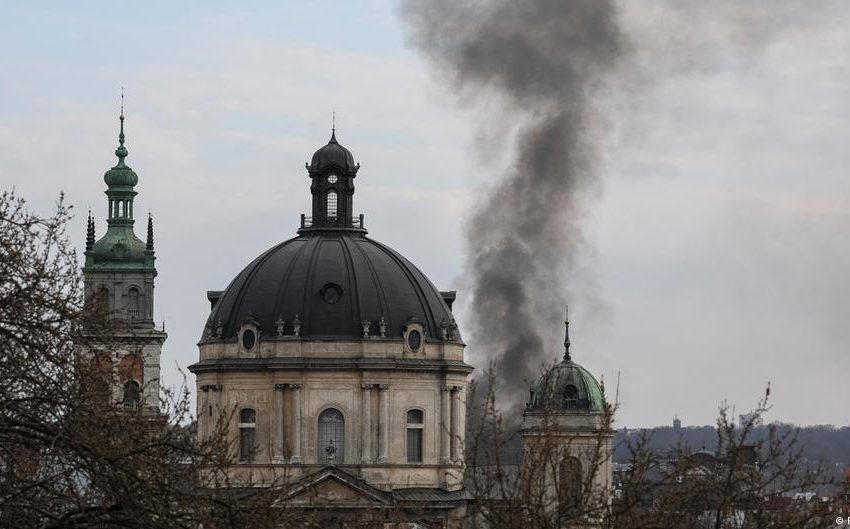
Russian attack on World Heritage sites in Lviv causes uproar
During a massive attack on Ukraine on the night of March 23 to 24, Russia launched nearly 1,000 drones and 34 missiles. According to the US-based Institute for the Study of War, it was “the largest Russian strike series against Ukraine of the war thus far.”
Several cities in western Ukraine were attacked, including Lviv where several people were killed and more than 40 injured.
Damage to 17th-century church and archive building
The city’s historic center — which has been a UNESCO World Heritage Site since 2023 — also came under attack. The governor of the Lviv region, Maksym Kozytskyi, said that a drone had struck St. Andrew’s Church, which is part of the Ukrainian Greek Catholic Church, in a former 17th-century Bernardine monastery and several buildings had been destroyed.
Though several of the church’s windows were shattered in the attack, the most significant stained-glass window depicting the Madonna with Child was spared.
The Central State Historical Archives in Lviv is located in a building adjacent to the church. Much of its collection comes from the Bernardine Archive that was founded in 1784 and housed in the same building. Anatolii Khromov, who is the head of the institution today, told DW that the archives held some of the oldest documents relating to Ukrainian history, including three 12th-century birch bark manuscripts, which are among the most significant examples of Old Russian.
“The archive building is dilapidated, and any explosion, such as the one on March 24, poses a risk to the collection. We are currently inspecting the building to see if there are any new cracks,” Khromov said. “The facade, windows and paintings are damaged. We are currently taking the necessary steps to repair the damage as quickly as possible.”
Russian officials and pro-Russian outlets have justified the attack by claiming that “foreign mercenaries” were hiding in the archive building, allegations that Khromov vehemently denied. He said that staff members had been working around the clock to digitize historical documents to protect the archives as effectively as possible.
‘We will not forget the crimes being committed today’
The Russian attack also hit a 19th-century building that was once a prison and now houses the National Museum-Memorial of Victims of the Occupation Regime.
“Almost all the windows were shattered — they were witnesses to the Stalinist crimes of the past century,” Ukrainian historian and lawmaker Volodymyr Viatrovych posted on Facebook. “But the culture of remembrance cannot be shattered. We remember all the crimes of that time. Nor will we ever forget the crimes being committed today.”
Ukraine’s Culture Ministry announced it was documenting all crimes against the country’s cultural heritage and was working with international partners to hold those responsible to account.
“Cultural heritage must not be targeted,” said Minister of Culture Tetyana Berezhna on Facebook. “Our team is currently preparing a report for UNESCO to inform them of the damage to a World Heritage site.”
UNESCO says it is ‘deeply alarmed’
According to the Ukrainian Culture Ministry, Russia has damaged over 1,700 cultural artifacts and 2,500 “sites of cultural infrastructure,” in Ukraine since the beginning of the full-scale invasion in February 2022. Of these, 513 were completely destroyed.
UNESCO said that it was “deeply alarmed” by the strikes. “UNESCO recalls that cultural property is protected under the 1954 Hague Convention and the 1972 World Heritage Convention,” it wrote in a statement, which was posted on its website as well as social medial platforms. “All parties must safeguard heritage and refrain from any acts harming cultural property. UNESCO stands ready to support the authorities with assessments, protection measures and emergency assistance.”
Ukraine’s Foreign Ministry has since announced that UNESCO experts will be travelling to Lviv to document the damage. Heorhii Tykhyi, a spokesperson for the ministry, said that Ukraine’s international partners had already condemned the attack.
“But we demand more than just condemnation — we demand concrete action. For example, sanctions against Russia in the cultural sector. The goal is to completely isolate Russia,” Tykhyi said, while calling for representatives of the Russian Federation to be barred from international cultural events.
On Facebook, the Ukrainian Institute of National Remembrance called for Russia to be expelled from UNESCO. It has already launched a petition and appealed to the international community for support. The institute’s director, Oleksandr Alfyorov, told DW that Russia could not be “allowed to participate in international institutions or organizations.”
This article was originally written in Ukrainian.
First Appeared on
Source link






