


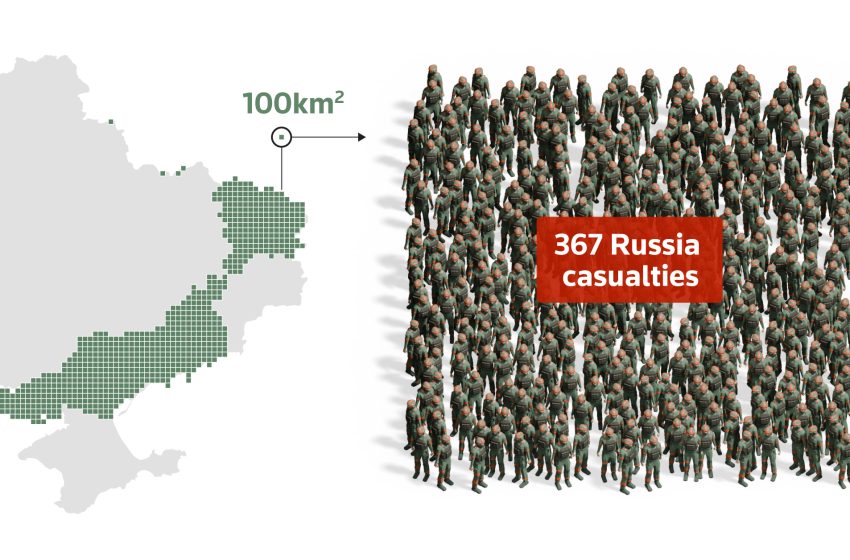
Russian lives for Ukrainian lands
Chart showing that an average of 367 Russian soldiers have been killed for every 100 sq km (39 sq miles) of Ukrainian territory occupied.
Four years after its full-scale invasion in February 2022, Russia occupies about a fifth of Ukraine’s territory.
But after taking large swathes of eastern and southern Ukraine in the early months of the war — creating a land corridor to Crimea, which Moscow illegally annexed in 2014 — Russia’s gains have slowed to a crawl as the front lines have largely solidified. On the battlefield, analysts say it has gained only about 1.3% of Ukrainian territory since early 2023.
The cost in Russian lives for those modest territorial gains, meanwhile, continues to mount.
Russia is suffering “crazy losses” in Ukraine, tallying around 65,000 soldiers dead or injured over the last two months, NATO Secretary General Mark Rutte said at February’s Munich Security Conference.
According to estimates released in January by the Center for Strategic and International Studies, Russian forces have suffered, on average, more than 26,000 monthly casualties — including dead, wounded and missing soldiers — or 1.2 million total casualties since 2022.
Kremlin spokesman Dmitry Peskov disputed those figures.
“I don’t think such reports can or should be considered reliable information,” he said. “It is the Defence Ministry that is authorised to provide information on any losses during the Special Military Operation.”
Neither Moscow nor Kyiv have recently released official casualty numbers. Reuters was unable to verify the accuracy of CSIS battlefield casualty estimates independently. The intensity of fighting over four years has made it difficult to corroborate battlefield losses.
Although military experts warn in warfare the attacker often takes heavier losses, Russia’s emphasis on sending waves of small infantry assaults into Ukrainian lines is a costly tactic.
Chart showing monthly Russian military casualties from February 2022 to January 2026. CSIS estimates a total of 1.2 million casualties, averaging about 26,060 per month.
At the outbreak of Russia’s invasion, fast-moving columns of armour and infantry swept across large parts of Ukraine, threatening the capital, Kyiv, and its second-largest city, Kharkiv.
They were beaten back from northern Ukraine in spring 2022, and further successful Ukrainian counterattacks reclaimed swathes of land in northeastern and southern Ukraine that autumn.
Early phase of the war
Feb – March 2022
Russia invades Ukraine from the north and east, threatens to overrun Kyiv.
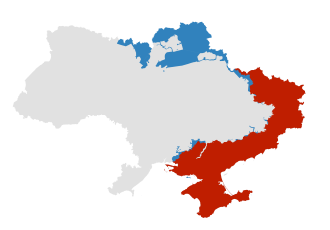
April – Aug. 2022
Russia is forced back from Kyiv, withdraws from the north and consolidates forces in the east.
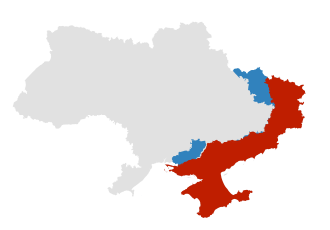
Sept. – Dec. 2022
Ukraine’s autumn 2022 counteroffensive recaptures territory in the east and south.
Since 2023, conflict along the 1,200-km front line has changed dramatically. The introduction of cheap drones that constantly patrol the contact line has replaced large armoured assaults and has allowed thinly stretched Ukrainian defenders to stymie a larger Russian force.
Territorial control now only changes hands in small parcels of land, taken by small units of attackers, often advancing on foot or motorbike before consolidating their positions.
Frontline as of …
Jan. 2023
Bar chart comparing monthly Russian casualties (red bars, left) and Ukrainian land gained in km² (green bars, right) from 2023 to 2025. Casualties remain high throughout, with peaks in mid‑2024 and late 2025. Ukrainian land gains vary, with larger gains in mid‑2024 and mid‑2025.
Much of the heaviest fighting has been focused in the eastern Donetsk region as Russian forces closed in on the so-called “fortress belt” of cities.
In recent weeks, Russian troops have also advanced further towards Zaporizhzhia — which is the capital of one of four Ukrainian regions the Kremlin has claimed as its own, in addition to Crimea, despite occupying only part of the Zaporizhzhia region.
Map of eastern Ukraine showing how often the frontline has shifted since 2023. A vertical band of red shading marks areas with frequent changes, running from Robotyne in the south through Vuhledar, Marinka, Avdiivka, Pokrovsk, and up to Bakhmut. Darker red indicates more movement.
The road and rail hub of Pokrovsk has been captured practically in its entirety by Moscow’s forces, according to open-source battle maps. Only tiny slivers of disputed “grey zone” remain at the very top of the city. Its fall would mark Russia’s biggest battlefield victory since it seized the eastern city of Avdiivka in early 2024.
Kyiv’s General Staff said its forces still held the northern part of the city with a pre-war population of 60,000, and were also defending the smaller city of Myrnohrad nearby.
Moscow claimed late last year to have fully captured Pokrovsk, which Kyiv denied.
Moscow’s assault on the city slowed to a crawl in 2025, making just 70 m (77 yards) of progress per day.
Map showing the Pokrovsk front, where Russian forces have advanced very slowly – an average of 70 m per day – compared with faster offensives in 2022, such as 590 m per day in Kherson and 7,400 m per day in Kharkiv.
In Kupiansk, another strategically important railway hub on the northeastern part of the frontline, Ukrainian forces claimed to have successfully repelled Russian forces in December.
President Zelenskiy posted a photo of himself at the entrance to the city days after Moscow claimed to have fully captured it, embarrassing the Kremlin.
The Kupiansk counteroffensive bucked a trend seen throughout 2025 as Russian forces have made gradual advances, albeit at huge losses.
A Ukrainian intelligence assessment presented to British military officials and first reported on by The Times of London estimated as many as 27 Russian soldiers were killed for every Ukrainian lost in retaking the city. Reuters was not able to verify the accuracy of that report independently.
Map showing Russia’s advance toward Kupiansk during the final months of 2025, followed by the Ukrainian counteroffensive in January 2026.
In January, Zelenskiy said his goal was to raise the lethality of Ukrainian forces. He said 50,000 Russian losses per month would be “the optimal level” to ensure Russian losses in Ukraine became unsustainable for Moscow to replace with new recruits.
Ukraine has also struggled to recruit new troops to replace those lost in attritional fighting in the east, with commanders and soldiers complaining that the shortage of soldiers is the main factor behind setbacks on the battlefield.
CSIS estimates Russia has lost between 2 to 2.5 soldiers for every Ukrainian one killed in the war.
Chart comparing estimated military fatalities: Russia with 275,000 to 325,000 deaths and Ukraine with 100,000 to 140,000. Russian battlefield losses are roughly double Ukraine’s, at about a 2:1 ratio.
According to CSIS, Russian fatalities in Ukraine are now five times greater than all Russian and Soviet wars since World War Two, combined.
Moscow’s losses are more than 17 times greater than the Soviet Union’s losses in Afghanistan in the 1980s and 11 times greater than Russian forces killed in both Chechen wars in the 1990s and 2000s.
Chart comparing estimated Russian military fatalities across three conflicts: 275,000–325,000 in Ukraine (February 2022 to January 2026), 14,000–16,000 in Afghanistan (1979–1989), and 12,000–25,000 in the Chechen war (1994–1996 and 1999–2009).
The current administration in Washington has urged Moscow and Kyiv to strike an agreement to end Europe’s largest war since 1945 after withdrawing most direct U.S. military support to the Ukrainians last year.
Peace talks, however, have largely stalled, while Zelenskiy and European allies have complained U.S. President Donald Trump had exerted undue pressure on Ukraine to make concessions, including giving Moscow further land in the Donbas – an area encompassing Donetsk and neighbouring Luhansk regions.
Zelenskiy has said he sees no reason to hand over the rest of the Donbas, as this would give Russia a platform to launch assaults deeper into Ukraine. He fears Russia would re-arm after any peace deal and at some point use Donetsk to sweep westwards.
Institute for the Study of War and AEI’s Critical Threats Project, OpenStreetMap
Jon McClure, Dan Flynn, Sharon Singleton
First Appeared on
Source link






