Russia’s Baltic Ports Oil Terminals in Flames From Punishing Ukrainian Drone Strikes
For the fourth time in five nights running, drone swarms on Thursday attacked crude oil export infrastructure in Russia’s Baltic Sea region to set fires and shut down tanker loading with Russian defenses seemingly struggling to stop Ukraine’s long-range robot aircraft.
Other drones launched from Ukraine’s northern Chernihiv or Poltava regions since Monday have hit tankers, half-capsized a warship, set two refineries ablaze and pounded air defense sites in a blitz of concentrated, complex air attacks.
JOIN US ON TELEGRAM
Follow our coverage of the war on the @Kyivpost_official.
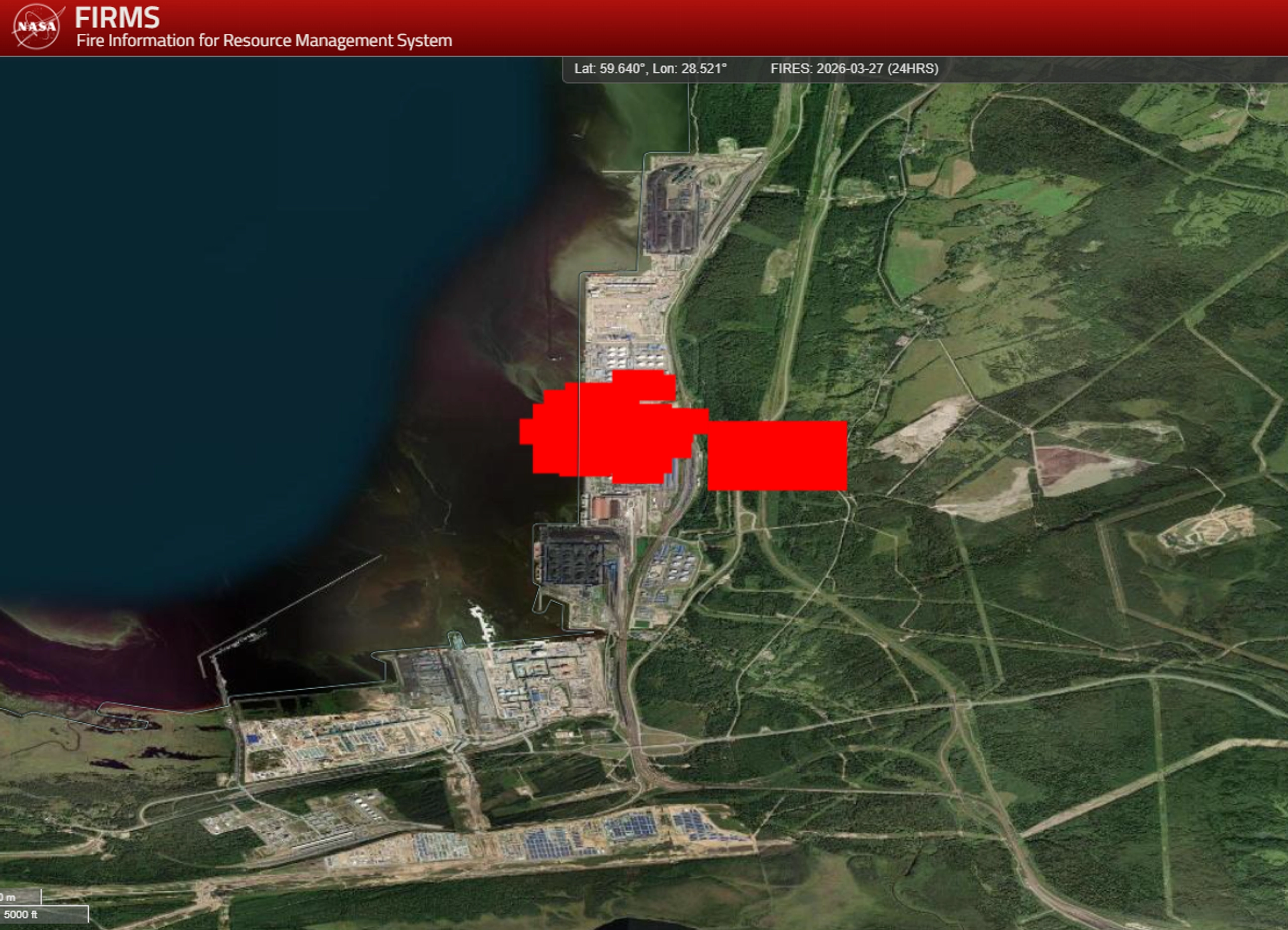
The most undeniable evidence of the success of Ukraine’s latest air operation seeking to severely degrade and, if possible, destroy Russian energy export capacity in the Baltic region was visible in geo-confirmed Friday images showing fires with flames sometimes 100 meters (109 yards) high burning fiercely at St Petersburg’s main Ust-Luga oil export terminal and the secondary Primorsk seaport. Together, both ports account for about 40% of all Russian Federation fuel exports by sea.
Satellite imagery reviewed by Kyiv Post at midday on Friday showed a blaze covering about 6 square kilometers (2.3 square miles) of Ust-Luga. The fires were centered on reservoirs in the north of the port’s territory, and adjacent to railroad track used by tanker cars to deliver product to the port.

Other Topics of Interest
Budapest-Moscow Axis: How Should the EU Respond?
Europe’s media call for decisive action.
It was not clear how much of the Ust-Luga’s fires visible on overhead imagery had been caused by the latest Ukrainian drone raid. Fires ignited on Monday by an initial round of Ukrainian attacks against the port had still been burning on Thursday evening, reports from St Petersburg mainstream and social media said.
Images and commentary of the latest Ukrainian attack as it was in progress, starting at about 11 p.m. on Thursday and continuing until about 2 a.m. on Friday, documented multiple, orange-colored, mushroom-shaped explosions lighting up the night sky in the vicinity of Ust-Luga port as drones struck.
Russian social media video recorded overnight Thursday-Friday from a location inside the Ust-Luga port rail switching station showed a Ukrainian delta-winged drone passing overhead through light small arms fire. A voiceover reported the Ukrainian kamikaze aircraft attacked in at least two waves. Light from the fires at that location was visible on the southern horizon in the Russian city of Vyborg, more than 100 kilometers (62 miles) to the north, by sunrise.
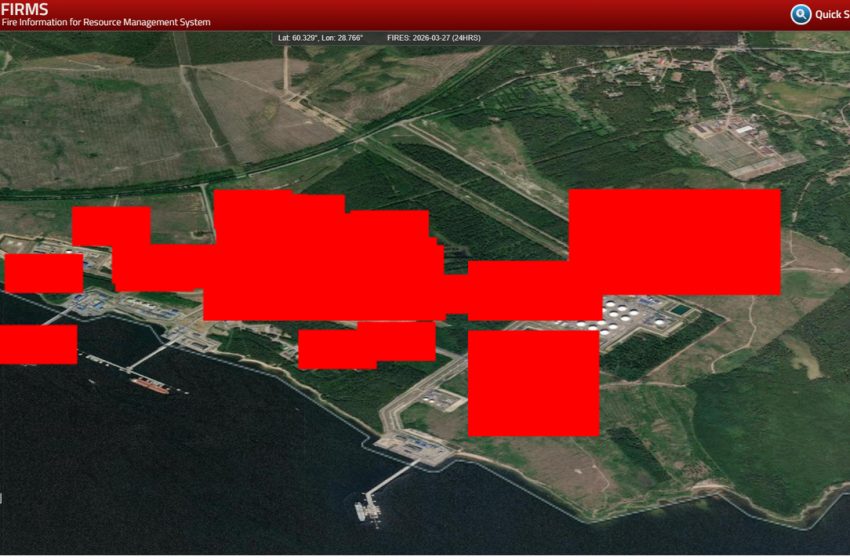
Also, a Monday target for Ukrainian kamikaze aircraft, the Vyborg region oil loading and naval port Primorsk was hit again overnight Thursday-Friday. By midday, satellite imagery showed the facility completely in flames, covering all 4 square kilometers (1.5 square miles) of the port.
The news agency Bloomberg led industry watch media on Wednesday to report that Ukrainian strikes against facilities at Ust-Luga and Primorsk had shut down at least 40% of all crude oil export capacity in the Russian Federation.
Extensive and at some locations visibly expanding fires visible at both sites on Friday pointed emphatically to that shutdown and corresponding loss of $6-9 billion Russian export earnings/month continuing, the NASA satellite imagery showed. Ship movement information-tracking platforms like marinetraffic.com on Friday showed both ports empty of tankers.
Leningrad region Governor Aleksandr Drozdenko, in a nighttime statement, said air defense forces had shot down 36 attack drones in air space above greater St Petersburg and the Leningrad region. On the night, Russia’s armed forces claimed a total of 125 Ukrainian drones overnight across 13 Russian regions.
Statements from Ukraine’s national intelligence agency, the SBU (Ukrainian: Служба безпеки України), and the military’s Unmanned Systems Forces, the USF (Ukrainian: Сили безпілотних систем) took credit for the strikes.
Other Ukrainian robot aircraft overnight Thursday-Friday hit a chemical factory in Russia’s Vologda region and air defense sites in Ukraine’s Russia-occupied Crimea region. Independent Russian media and local social media, along with Ukrainian mainstream media and milbloggers covering Crimea, documented explosions and fires at the Vologda chemical factory and at two Crimean air defense sites, but Kyiv Post could not confirm those reports independently.
Robert Brovdi, USF commander, in a Thursday evening round-up of his troops’ combat successes, laid out Russian sites hit by Ukrainian drones over the past 72 hours: the Primorsk oil-loading terminal near the town Vyborg struck on Monday, the Ust-Luga terminal hit on Wednesday and the Leningrad region Kyryshevsky oil refinery, critical for converting Siberian crude to product suitable for export set afire on Thursday.
The attacks and major fires described by Brovdi and other Ukrainian military members have been widely confirmed by multiple sources, among them satellite imagery. Brovdi credited the elite 1st USF Regiment for the strike successes and called on operators and technicians under his command to maintain the pace.
“By systematically ‘demilitarizing’ the enemy’s oil arteries, processing and export of raw materials, we complicate the financing of the enemy’s build-up of the capabilities of the worm army…(but) no rose-colored glasses…Get to work!” Brovdi said in part.
NOTE: In Ukrainian military slang, “demilitarize,” a term originally used by Russian propagandists as a euphemism for death and destruction caused by Russia’s army and air forces as they invaded Ukraine back in early 2022, has taken on the ironic meaning ‘to destroy Russian soldiers or military material.
Aside from attacks specifically targeting Russian Baltic region energy infrastructure, Ukrainian strike aircraft on Wednesday directly targeted the Vyborg Shipbuilding Plant to severely damage and partially capsize the Arctic-class patrol icebreaker Purga (Project 23550), which was under construction or fitting out. A Russian navy oceanographic research ship anchored next to the Purga suffered light damage and remained afloat.
During that same attack, 100 kilometers (62 miles) to the south in Ust-Luga, drones struck three moored oil tankers, five fuel storage tanks, three ship berths, a pumping station, crude oil processing units including a cracking tower, a port crane, an electric substation, a shore-side cafe and a crew dormitory, the independent Russian news agency ASTRA reported.
Some Russian internet users have complained that the effective and repeated Ukrainian drone strikes are evidence of poor work by Russia’s air defense forces and suggested that an ongoing state campaign to force users off of the messaging app Telegram for “national security reasons” is ineffective, because clearly the Ukrainian drones are getting through.
In a rare public objection by a Kremlin-appointed official to state security policy, Viacheslav Gladkov, governor of Belgorod, the Russian region most overflown by Ukrainian drones, confirmed Monday that the Ukrainian drones are still in the air constantly. The ongoing near total shut down of Telegram in Russia is preventing civilians from receiving timely air raid warnings, he said.
First Appeared on
Source link